

Science fiction and fantasy genres have this problem of sorts. A problem of focusing to much on the world building instead of the story. There are countless stories about aliens and elves that tell about just aliens and elves. Painting new worlds is interesting and it also can be interesting to absorb such stories, but in a longer run these are boring, repetitive and often reuse the same character creation or plot creation patterns.
Unless the story is not about the world-building. Unless the world building serves to tell a story.
Stanisław Lem was a Polish writer with a lot of events in his life that would potentially break a less willed person. He came from the Lwów, which was Polish back then (today’s Lviv, Ukraine) from a family of scientists, matemathicians (Lwów math’s school was one of the strongest on the planet). He survived two occupations – German and Soviet during the II WW, with all their ruthlessness. He has seen a lot of dead people and gory scenes.

It’s not puzzling that his faith in deities and humanity dwindled. Yet, he engaged his all mental powers in an epic attempt to understand it all – the human condition, the suffering, the motors of human behaviour. He managed to do this and left a lot of brilliant works with prognoses of the future.
“The Cyberiad” is one of those works. First published in 1965 it features two “constructors” – Trurl and Klapaucius in a distant future. Now, the said constructors are not human – they are a robotic entities, minds no longer made of flesh and no longer constrained by human limits. The only thing that constraints them is the reality itself, but as “constructors” they are constantly breaking or getting around the laws of universe, producing and creating the unthinkable – whims of galactic powers, legendary machines etc. Whatever challenge is there, they’re up to it, with the only limits being their own mind boundaries.
At least they think so…
The problem is they are deeply flawed. In all that futuristic, godlike advancement they embody, they still have limitations. They tend to be shortsighted with that particular kind of being shortsighted when one says “oh, lets kill all the pests in the farmland with the strongest pesticide ever!” just to find out later on that all birds died from hunger after bugs were eradicated. They are arrogant and tend to choose their own ego above all reason. And they have issues with morality.
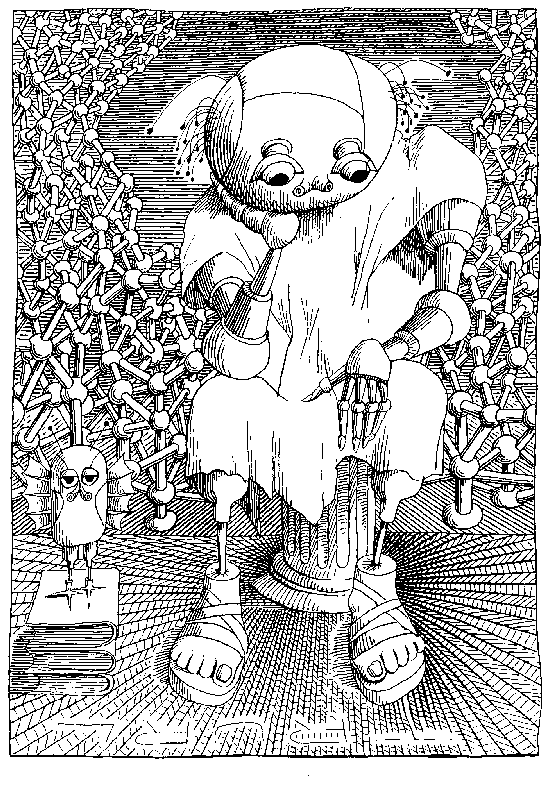
Morality is one of the most frequent themes in Lem’s works. For example – is it moral to create artificial life (intelligence) with artificial pain implemented? It’s what they did more than once. Do you, my dear reader, think this is an artificial problem? Well, there’s a game called “The Sims” (I believe deeply inspired by Lem’s works, knowing that one of the cheatcodes in game is “klapaucius”….) where there are artificial humans with artificial pain implemented, they cry, they can be hurt, they can feel sorrow and they can die… Lem asks – is that moral? What is the difference between the human and the machine? Trurl and Klapaucius themselves prove there is none. The whole civilizations in The Cyberiad are robotic as well. Lem dissects humans in one of the stories (robotic entities call human “palefaces” and tell stories about them to their offspring – the paleface is the monster to scare children with) – the paleface is a machine, according to robots, with a multitude of slippery tubes with fluids with oxidizing effect and hence, highly toxic for metallic robots. Human machines are flawed and cinstrained much more than robots, but they are cunning enough to survive.
The civilizations surrounding the constructors are flawed too. They are archaic, have watcher-kings and electro-knights, metallic-princesses and null-dragons. This is one of the most brilliant ways in the whole literature to show to the reader this one truth: technical advancement does not make us smarter. Want to argue? Science proves than our memory capabilities decrease with memory storing technology advancements, for example. An average ancient Athenian philosopher had a lot better brain than a Ph.D. today. He didn’t just have the data.
So the robotic entities feel silly and very retro. They don’t need constructors to do make their world a better place, even if they are capable of it. They just want entertainment. Seeing what today world is, just think how much energy of an individual daily goes to ecology and how much into entertainment. If I used the time I have to write this article to gather and sort some trash instead… I have an excuse that I want to share some important things, but in the end it’s entertainment mostly – isn’t it?
Our future versions of ourselves are flawed just like us.
There’s no better future, there’s just a different future. Of course if we don’t kill ourselves before then. We tend to create and create, think that technological advancement advances us. Lem shows that illusion. Because ultimately we face the same problems our ancestors faced. Sure, we extended our lifespans and make travel easier, but that’s about it. We still kill, make arbitrary decisions without full knowledge, chase after achievements to feed our ever-hungry ego. And in the end we produce more sorrow.
What “The Cyberiad” is not is the gimmicky sci-fi with lasers and spaceships. It’s a search for human happiness and perfect society. And it seems there’s just no way to achieve any of these two…Humankind and robotkind are just far to flawed.
A note for a non-Polish reader. Polish is the second hardest language on Earth (after Chinese). I am not exagerrating, I am nearly 40 y.o. and there’s a lot of things to learn still. When it comes to way of describing the world and using the words that seem synonymous but in fact aren’t because they have a slightly different metainformation or emotional pressure in them, there’s probably not many other languages like this one. (e.g. I use English to write these posts normally to make it readable for people over the world, but know this that this language feels … flat). It’s hard to show how it works, it’s like Eskimo or Inuite having dozens words to describe snow, with the difference Polish has similar for almost everything. See here and here to get the idea. Plus the hardest grammar ever (“like Greek, Russian and English combined” ) . With that preamble here comes a fact: the writing style of Lem is just stunning. Beautiful, intelligent, with phrases so perfect and beautifully constructed he got me gazing at those for a minute there and thinking “damn… that is something”. This style causes me blush when I think how imperfect my spoken and written Polish is (and again, I am a native Polish speaker with M.Sc.Eng degree….). I wish I could speak and write Polish as Stanisław Lem did. This means it probable looses a lot in translation. I dare to say the perfect way to read Lem is to learn Polish, the same way the perfect way to read Proust is to learn French and Nabokov to learn Russian. But the translation is very good too ,although it does loose some things; in the original poem (translation below), a mathematician dies with the broken heart in the last verse :). Rate the quality of the translation yourselves (the fragment is about the AI built by Trurl that could solve any problem, including poetry):
Klapaucius thought, and thought some more. Finally he nodded and said:
“Very well. Let’s have a love poem, lyrical, pastoral, and expressed in the language of pure mathematics. Tensor algebra mainly, with a little topology and higher calculus, if need be. But with feeling, you understand, and in the cybernetic spirit.”
“Love and tensor algebra? Have you taken leave of your senses?” Trurl began, but stopped, for his electronic bard was already declaiming:
Come, let us hasten to a higher plane,
Where dyads tread the fairy fields of Venn,
Their indices bedecked from one to n,
Commingled in an endless Markov chain!
Come, every frustum longs to be a cone,
And every vector dreams of matrices.
Hark to the gentle gradient of the breeze:
It whispers of a more ergodic zone.
In Riemann, Hilbert, or in Banach space
Let superscripts and subscripts go their ways.
Our asymptotes no longer out of phase,
We shall encounter, counting, face to face.
I’ll grant thee random access to my heart,
Thou’lt tell me all the constants of thy love;
And so we two shall all love’s lemmas prove,
And in our bound partition never part.
For what did Cauchy know, or Christoffel,
Or Fourier, or any Boole or Euler,
Wielding their compasses, their pens and rulers,
Of thy supernal sinusoidal spell?
Cancel me not — for what then shall remain?
Abscissas, some mantissas, modules, modes,
A root or two, a torus and a node:
The inverse of my verse, a null domain.
Ellipse of bliss, converge, O lips divine!
The product of our scalars is defined!
Cyberiad draws nigh, and the skew mind
Cuts capers like a happy haversine.
I see the eigenvalue in thine eye,
I hear the tender tensor in thy sigh.
Bernoulli would have been content to die,
Had he but known such a2 cos 2 phi
Just perfect. The content, the style, the philosophy. Perfect. Unwillingly, Lem’s is one of my favourite philosophers of 20th century.
Nota bene If you want to watch some material about the language itself, to see I am not exaggerating , here you go, it should give you the idea (turn the subtitles on, because there’s some Polish spoken in there) :
 Amazing Worlds