I think I am a quite good critic, I’ve gathered a substantial amount of knowledge and I am trying to be objective always, but when the creator is, quite non accidental, my wife, an objective criticism becomes a very hard task.
Lets try it nontheless:
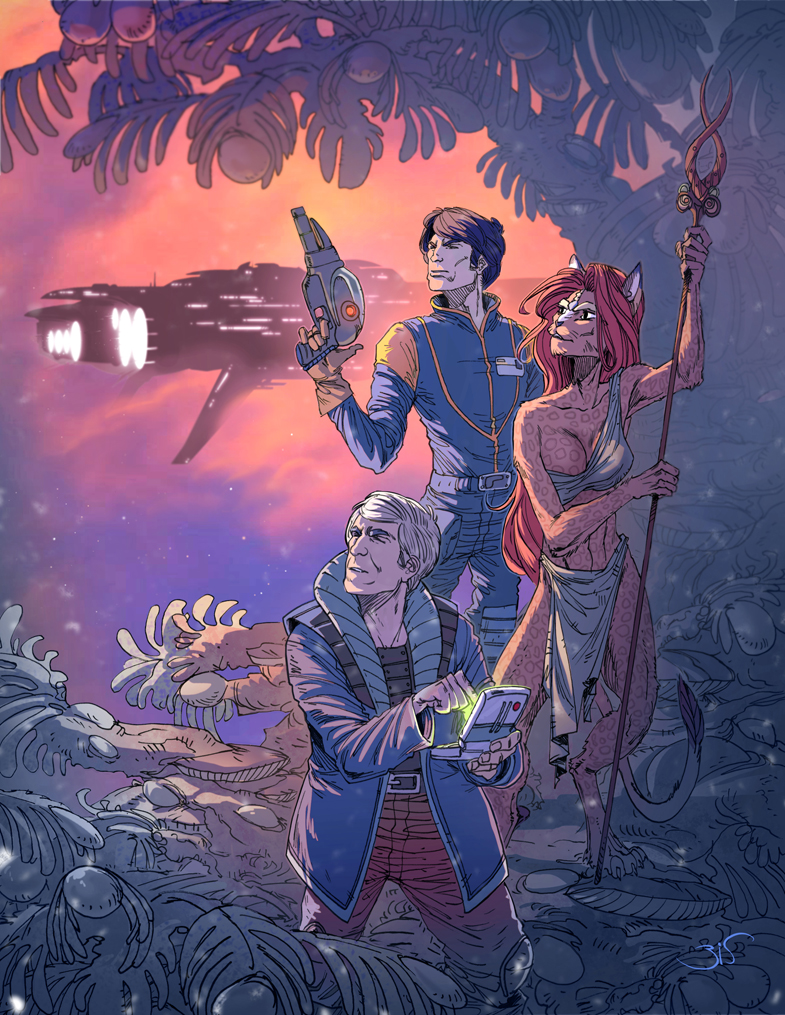
This is a quite good romance graphical novel, even better than a lot of manga ones – when it comes to the content.
I could end here, and leave the task of finding out the rest for the readers themselves how this graphical novel (yes, a graphical novel – not a comic book , marrying several different techniques and graphical styles – for good and bad). That kind of review would be devoid of any bias. But it wouldn’t be my style.
This romance is completely devoid of those unrealistic, dramatic elations, plethora of which one can find in a traditional mainstream romantic manga. Instead, it is “romantically ordinary”, and because of that, more believable. It has a lot of cliche elements too though. Protagonists are, indeed, young, silly and beautiful. Indeed, they meet my chance. Indeed, out young agents try to raise up to the challenge of an overwhelming work tasks and realities to which they both are strangers to – and I am speaking about the reality of the work at the Agency and sociopolitical climate of the city. This is cliche all right. But is some weird way, served in a very refreshing style. With my head filled with Twin Peaks and David Lynch recently I can see some parallels – this need how an ordinary world, ordinary interactions can be the “main” story. “What is it all about?” could be the question asked by some readers. You see, Lynch was asked the same question in the “Twin Peaks” context. The same question is sometimes a part of the high literature, ambitious fantasy and science fiction, e.g. the Marcel Prousts’ cycle about time, Dick’s “Ubik” or Lem’s “Solaris”
“It” is about good magic between ordinary people.
Seriously. It is mainly a romance, as perceived by the protagonists, who try to be competent workers and try to face the difficult subject of transgenderism, to understand the transsexual person with the predictable result. Because a heteronormative person could never fully, truly understand this subject- there’s an information bias between all people, we all need a common context to understand each other, and this is one of the hardest interaction cases – as proven by the current social climate and ages of disscussions about equality (which should be a simple matter one would assume). But it’s primary a romance. The clash of differences generates conflicts and as expected from the cliche, absurd conflicts. But in this novel, these seem to be more anchored in reality, again. It’s not objective of me – I can see several situation in the novel, for which I can swear they happened for real and I was the origin of some Rax’ reactions. And this can be seen everywhere – in the way characters act, how they understand the events, how they park a car or how they behave in the library. Interpersonal interactions are full of absurd, and love, in its own characteristic way, is also absurd. And this shows in the “Literary Detectives”
From the first pages it is clear, the author has a great, epic, multivolume, multithread tale in her mind. And that can be the main obstacle for a reader who wants to know everything, who would like to have every detail explained. But not for a detective mind – someone who read the whole “Dune”, “Silmarillion” or “Discworld” several times. It less of a selfpromotion, more the point of reference for other readers – albeit it’s impossible to compare the mentioned works to the “LD”, howver it needs a similarly callibrated brain if you will, otherwise it may not “click”). About PRatchett – I can kinda sense a little of the Pratchett vibe here too. For example in Pratchett’s L-space concept, being a lightmotiv – treating the literary reality as a world of its own riles, in which everything stays forever (as long as the book exists), even if it’s a small booklet with only 100 copies in existence. As a roleplaying game master, I am sure that “LD” could fit into the “Changeling: the Dreaming”, if someone decided to copy the novel’s characters into their game. That’s because of the constantly existent eroticism of the faerie world, with a major difference. In such media, women are often oversexualized, and here we witness shifting the male point of view into the female perspective. Men in the “LD” are completely unrealistic. You can believe me on that. But this also makes those males nontoxic. “Fantasy men”, equally viable as Drow priestesses from the Underdark, with their bikini chainmails. Both are “eye candies”. Additionally charactes have depth, but left for the reader to explore and derive upon, not given upon a plate. For example, the main protagonist constantly searchers for aceeptance and validation of her own personality and character, and faces psychologocal solitude in a manner equal to the Red Riding Hood.
TL;DR. The conclusion – the journey is more important than the goal and quoting David Lynch “solving a crime kills the show” – as it was with Twin Peaks. I really suggest finding delight in tropes and romance, not chasing for solution and closure, even if the lore can lure more than the protagonists. How to summarize all this… It’s a romantic graphical novel of the Age of Internet.
It was some time since the last post but I needed some vacation, both from the game development and blogging 🙂 Sometimes one just needs a break, right?
I wanted to tell you about a game I initially had some problems with. At first, I didn’t quite like the character model, graphical setting and animations to the point everything seemed artificial and, I don’t know, plastic? But then I convinced myself to go forward and every moment of it was worth my time.
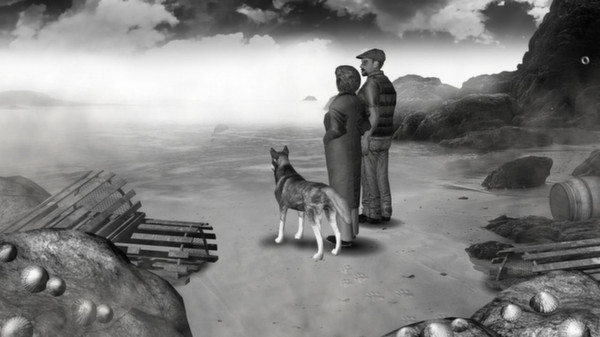
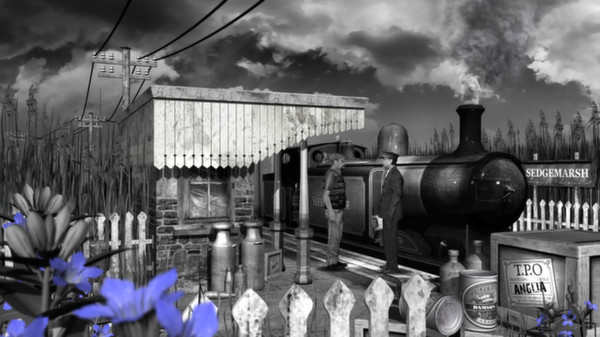
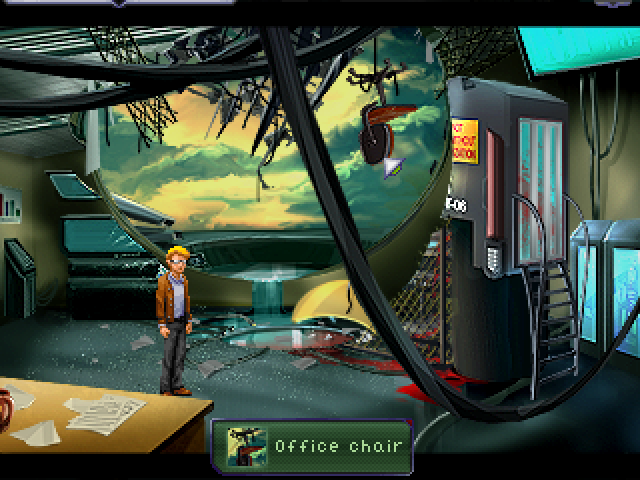
I am talking about “The Lost Crown: The Ghost hunting adventure” by Jonathan Boakes. The game takes us to the English town of Saxton, where as a ghost-hunter Nigel Danvers we try to find a Lost Crown of Anglia. The thing is , Nigel is a paranormal investigator and as such is a somewhat a weird character. Quite soon the player discovers that all other characters are also weird…I know what you are thinking – “Twin Peaks” right? Not really, because Saxton has a distinctive Anglo-Saxon charm. It’s not only bizarre, it’s really unsettling. Regular folks seem to be strangely absent, following their own strange agendas and all of this seems like a really onirical (dream-like) setting. I realized animation stiffness adds to the picture, as well as the fact almost everything in game is black&white, except some really interesting objects and animals like e.g. dragonflies in the marsh, which seem strangely “we do not belong here” because of that.
The fog… It’s unnatural.
The very first time Nigel actually sets up his ghost hunting equipment and start listening to the wavelengths kept me really on edge. Oh, I know – we all hate jumpscares. They are cheap and silly. “The Lost Crown” doesn’t do that often, it does that precisely when it needs to, and I am really thankful for that! Nigel’s ghost hunt, explorations and conversations with denizens lead him to some really unsettling discoveries, during which two worlds start to intertwine and collide. I will not spoil it for you, but after some time the player start to notice a fact that not everything is as it seems in Saxton.
A careful usage of colour produces a marvelous effect!
I still remember the plot line, the puzzles, the events from this game, even though it was several years since I completed it (5?). I could really appreciate it back then and now…Oh, how I now know how difficult the process of being a sole gamedev is! When I see the marvelous work Jonathan Boakes placed in his games (Because “The Lost Crown” has also a special called “The Midnight Horror”, and the prequel called “Blackenrock” is on the way) I cannot do anything else but say “a very great job, Sir!”
The trilogy of games that had a real impact on me is definitely “The Devil Came Through Here” trilogy, by Remigiusz Michalski (Harvester Games). This games were a long inspiration for me as a gamedev and also a lighthouse in the dark seas of storytelling. I had a pleasure of exchanging some thoughts with Mr Michalski, about game engines etc, and his insights on one of the forums helped me resolving a collision puzzle in my own project.
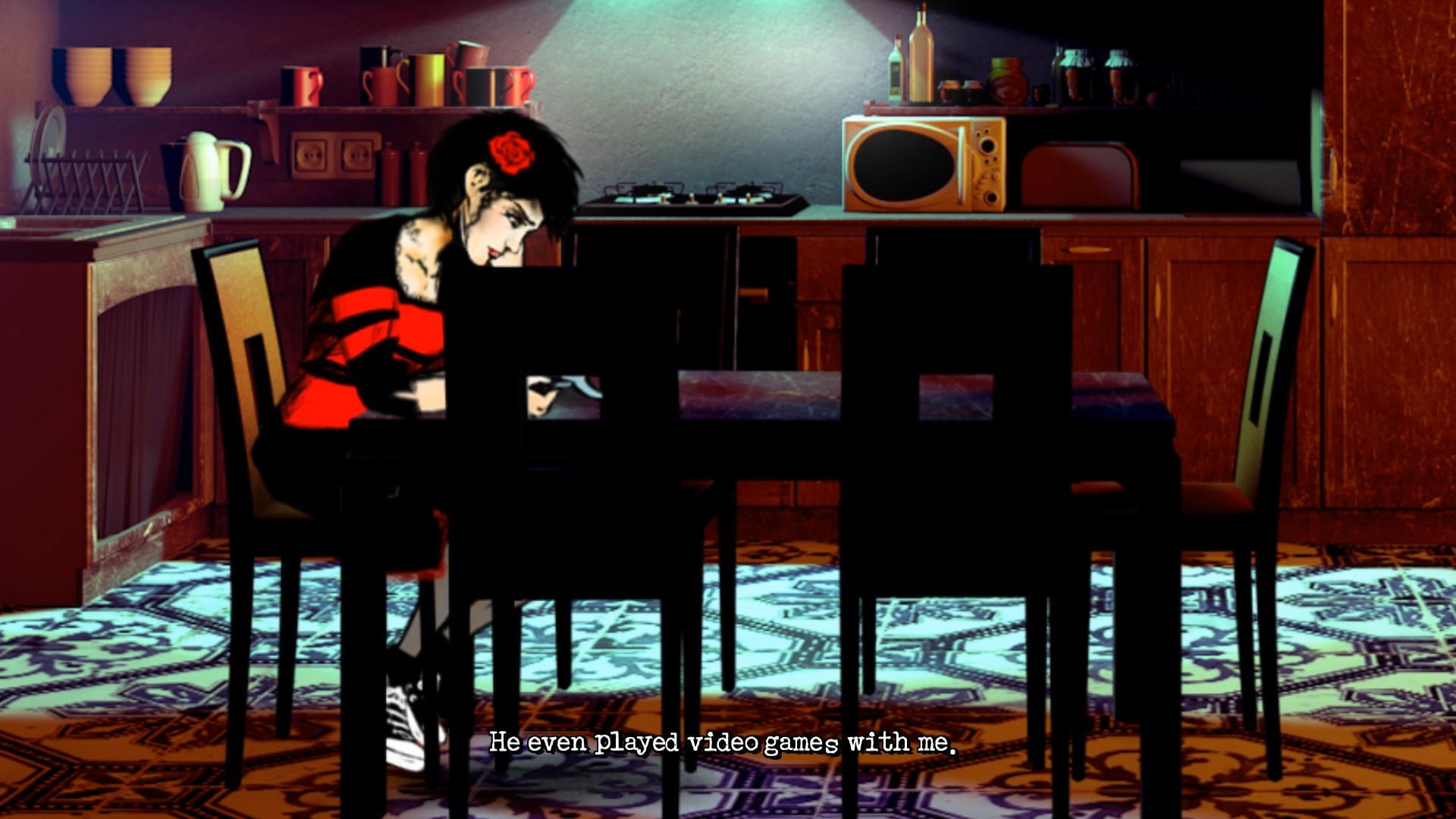
It started with a “Cat Lady” which I picked up with curiosity after seeing a trailer. The game in which the protagonist, Susan Ashworth, commits suicide in the very first scene, while her cat watches her slowly passing away. The scene had a very powerful impact on me, as I am a person deeply interested in the human psychology. What I did not know then is that the game features a lot of horror game mechanics, with occasional jumpscares, which I quite hate. Susan wakes up in a grassland afterlife, and is greeted by the Queen of Maggots, an old lady, with disturbingly skeletal-thin arms, and is sent by her back to life to get rid of five parasites – humans that should no longer exist. I couldn’t help it, but I immediately started comparing this game to the DreamWeb, and there’s a lot of similarities there. Susan cannot die on her mission, and dying and getting back to life to approach the situation from a different perspective is sometimes the last resort that pushes the action forward.
Susan’s reality is grim and depressing…
What is different though, is the dialogue the game has – the dialogue about emotional anguish, the feeling of loosing someone, depression and terminal illness. Of all disturbing moments from the game, the one that probably had the biggest impact on me was learning that one of the characters is terminally ill.
The majority of the game takes place in a tenement block 12th Helen Road, with its sinister sign letters forming a word “hell”. The building is a home to various people, and curious personae, that show the level of awkwardness not unlike the one from “Twin Peaks”. The more Susan explorer the place, the more it seems weird, hellish, onirical, with its denizens creepy and horrifying.
One of the disturbed denizens of the block is Joe, the horrid man, making a very, very bad impression of people who play the “Cat Lady”. We explore his story in the second game, “The Downfall :Redux”. The “Redux” is a remake of the earlier game by Michalski, and it’s a soft of a prequel to the “Cat Lady”, but the prequel that can be appreciated most whole played as a second game in the series. Joe is struggling with his love for his mentally disturbed wife. Yet again ,the game explores very difficult subjects – of anorexia, self acceptance, placing all feelings around a one person, and all destructiveness of those. And yet again, the game is very, very dark, with some unsuspected plot twists.
Meet Joe and his wife…
Right after playing the second game, I sent a short message to the author, thanking him for the game, and he shared the early alpha screenshot of his third game, “Lorelai” with me. I just couldn’t wait for it , but I had to. And finally, several months ago it was released. Serving as a finale to the story, we follow Laura, called Lorelai, a young girl from a deviated, dysfunctional family and its problems – a drinking mother, a dead father, a pervert, violent stepfather, poverty. During the series of events, full of violence and death, Lorelai meets the Queen of Maggots, who, in turn, wants to play the same game she played with Susan. Lorelai is sent back to life, and she is given yet another chance… As in the other two, Remigiusz Michalski is not afraid to ask difficult questions or convey difficult emotions. But I cannot help to think that the author is a little tired of these depressive games and would like to create something bigger. Well, some people struggle to get to his level, while he looks towards higher goals it seems 🙂
Lorelai wants just a normal life…
I wanted to write this article to say the trilogy is a MUST PLAY. You seldom find games so captivating, so grim and yet so beautiful with their discourse with humanity and its perils. The questions asked , questions about what it means to exist and what is the nature of evil, are heavy , the scenes are gory, and yet the whole thing feels like a serene contemplation about life, while sitting on the cemetery bench, rather than a horror.
And for me, for me it’s the gamedev goal I aspired towards and I hope my own game with be able provide, even if a part, of the same pleasure these games gave me. Rem Michalski is for sure one of my idol gamedevs.
Don’t wait, these are worth of your time.
A fun fact: the last game features voices of some well known Youtubers like YongYea and Jim Sterling.
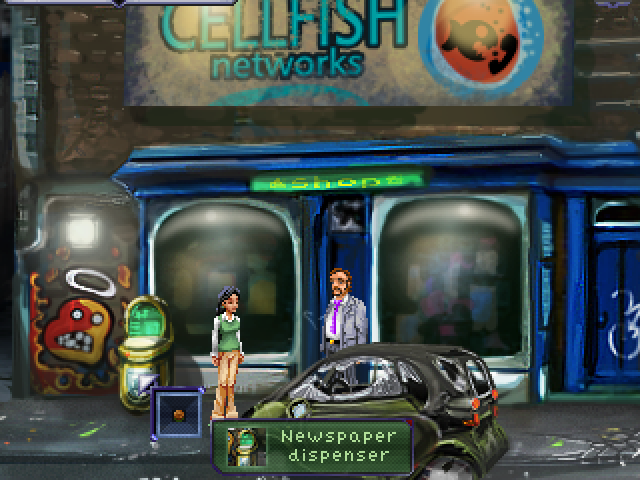
The first game made by Wadjet Eye I ever played was “Resonance”. I was drawn to it after seeing several screenshots published on some gaming portal and, as a person very much into pixel art and 90’s style of graphics, I purchased it immediately. What was just a “but a playtest” approach towards one game, quickly became a years long adoration of the Wadjey Eye company and their products.
The game, set up in the near future, features 4 protagonists. First, there’s Ed, an assistant to the prof. Javier Morales, a scientist working on the resonance effects of particles. Anna – prof Morales’ niece, is a hospital nurse having some psychological issues (and in fact she probably should be in one of the “psychological problems in videogames” articles of this blog) and an unbeaten childhood trauma. Detective Bennet is conducting a police investigation on the track of mysterious Antevorta organization. And there’s Ray, a political blogger and a hacker. All four are brought together by a mysterious explosion in the prof Morales’ lab and start acting together to uncover the secrets of the mysterious experiment.
An accident in the lab. An accident? What if…
I normally tend to talk a lot about the plotline of the particular game, but I will leave you deliberately in the dark with this one. It is a detective story, that is most pleasant while uncovering things and matching the pieces of the puzzle together, piece by piece. The game has several shocking plot turns and several dangerous timed sequences – enough to keep the player on edge sometimes ( and far less, than in, say, Telltale games – to my delight). But what makes the game and the plotline really interesting is how actually these 4 people interact with each other and how their personal storylines intertwine. Giving control over all four to the player is a bold move (although not a new one…), and forces player to experiment with different setups and combinations of characters to achieve some goals. Anna’s feminine charms and medical knowledge combined with a press/hacker attitude of Ray give different results than grumpy Bennet combined with awkward Ed, while facing the same problem and situation. The game tells its story mainly through that trial and error, and soon a player starts to feel those characters, starts to be invested in their lives and problems.
Protagonists meet on the stadium to discuss their next steps.
Well, I don’t need to tell you how important it is , especially for those, who like character-centric stories. E.g. “Game of Thrones” TV series was finished recently, and with the books and the show being really Westeros-oriented than character-oriented (as every fantasy with a pretense to be a mythology or a history book of its setting), yet everybody is talking about characters only…
But getting back to the matter – I often tell, times after times, how important it is to leave some things “blank”, so the reader or a gamer could feel it in by himself. The more product relies on imagination the more “blanks” it really needs. And I will be telling more about the subject when I am ready to talk about Tolkien’s “Silmarillion” (not ready yet, for various reasons…even though I read the book dozens of times for 30 years now…). In “Resonance”, player has got plenty opportunities to experiment and walk a mile in protagonists shoes. The player is forced to play a role, yet, the amount of freedom of experimentation, trying to combine various items together or operate various implements and discussing things with people, is huge and so is the amount of player generated story.
A futuristic touch&feel.
To those of you who played adventure games before, you know exactly what I mean, but for all the rest: imagine the “Sherlock Holmes” story, in which the chronology of Sherlock’s actions is not determined by a shortest possible way to get to the conclusion, while still building the mystery and the climate through narrration, but, rather, by an unknowing narrator, who experiments with the story, not knowing how it will end. This is what happens in games like this one, and this one is particularly good when it comes to its combinatorics.
I am not a big fan of conspiracy theories or conspiracy games for that matter, so the subject of this game did not captivate me as the other games did. I also prefer rather traditional detective stories instead of dystopian future theme (there’s just too many dystopian themes in popculture these days…). But, like I said before, this is the game that got me onto the Wadjet train and the game one could learn from a thing or two.
While in school one is forced to read many lectures. Some of those are interesting, some not. It’s a problem that happens with everything – if someone forces you to like what he likes, or what he thinks is good for you – you’ll always rebel, if but a little. “Lalka” (“The Doll”) by Bolesław Prus is a school lecture, and because of that, many pupils hate it. It’s presented to those pupils, while they are at their peak interest of celebrity pop stars, engaging TV shows with special effects and action, and when their biggest concert is if they will have enough money to party all the time.
And there’s another kind of readers – those who treat this book as one of their all time favourites. I count among those. It’s not just that. I also thing this is the best Polish novel ever written.
Just some explanations regarding pronounciation – there will be a lot of Polish names in the text below. Ł (dashed L) in “Stanisław” whould be read like English W (and “W” is V) so “Stanisław” is “Staniswav” and “Wokulski” is “Vokulski”. RZ and Ż (dotted Z) are like French “J” (Jean-Baptiste e.g.), so “Rzecki” is “Jaecki”. “Ą and Ę are nasal vowels, very hard for English speakers, but natural for French and Japanese. “Ą” is like on in the French pronounciation of “mon”, and “Ę” like the pronounciation of French department of Ain. “C” is like “TS” so “Łęcka” is “Waintskah” (“A” is alsways “AH”). “SZ” is like English “SH”: “Szuman” is “Shuman”. Masculine and feminine forms of names is something completely exotic for an English-speaker, but know that if Rzecki had a wife she would be named Rzecka, and analogically Starski would be married to Starska and Mincel to Minclowa,and Łęcka’s father is Łęcki 🙂 If you want to dig deeper , be prepared for a hard time :). One last thing – ski and -cki suffixes are the same location based naming patterns as “von” in German, “van” in Dutch, “de” in French and of in English, but made distinct adjectives. Wokulski = “of Wokulsk”.
There are some spoilers in the text below, but these should not affect the joy of reading, if you haven’t done so already.
The story takes place around year 1872 and follows the lives of two main protagonists – Stanisław Wokulski, a nobleman from an impoverished family, with interests in science, and Ignacy Rzecki, an old-timer, remembering the People’s Spring in which he fought. Wokulski was also a freedom-fighter. You must know, that in 19th century Poland was partitioned between 3 occupants – Russia, Prussia and Austria, and effectively, it dissapeared from the maps. But Poles never accepted it, and from time to time, an uprising started to fight agains the occupants. Stanisław fought in 1863 January Uprising , then he was captured and sent to a labor camps of Siberia. Strong and intelligent, he returned, but with frostbitten, reddish hands, betraying his fate and frowned upon in salons of greater aristocracy. Wokulski is a product of two epochs, romanticism ending and slowly starting modernism, which in Poland was called positivism . This is the first (of many…) tragical conflic our main protagonist has.
We learn of Ignacy Rzecki, the subject shopkeeper, from his diaries mostly. The awkward old man, with an unfashionable green jacket and old trousers, the perfectionist shop manager is a true romantic, deeply in his heart. He has a dog and play the guitar while being alone, he imbibes from time to time with several friends, remembering old times. He uses to play with the toys in the shop he governs And he’s deeply sentimental about the Mincel (polonized, from German “Minzel”) family, the original owners of the shop, who raised him, taught him all he knows about his trade, and changed his life forever. Ignacy believes strongly that all pains will be resolved by one of the Napoleon’s dynasty, a theory much ridiculed by cynical and realistic people.
Rzecki and Wokulski.
After Wokulski returns from his imprisonment he is employed in the Mincel shop and its owner – an old lady, Małgorzata Minclowa (a form of “Mincel” name, Polish is a hard language.. :)) fells deeply in love with Stanisław. He’s so powerless and has a chronical depression at the time, he agrees to marry her. Not from greed, but because he feels he owes her for taking care of him. This marriage, forced upon himself, is a hellish prison for him, especially while Małgorzata starts to be psychotically jelous of him. But he never does anything improper nor antyhing to hurt her. When Małgorzata dies, she leaves him all her wealth and the shop. Stanisław is indifferent to that fact, but soon something lifechanging for him happens.
Stanisław meets Izabela Łęcka, of an aristocrat Łęcki family, a beauty of the high circles, and he insanely, madly falls in love with her. Suddenly, he finds an unbelievable power reserves in himself and, to win her over, he starts amassing wealth. He builds a network of trade contacts, even participates in weapon trade, and soon he’s the owner of the most known shopping mall in Warsaw, with a lot of money for other investments. He is also considered as a main president of the joint venture aristocracy wants to invest in. Friends warn him that aristocracy is capricious and will never treat him as one of his own, but he’s blind the warnings. For him its one step closer towards Izabela.
But, on his mad chase for Izabela, the femme fatale (who secretly despises him but, knowing her father has business with Wokulski, never does anything to stop Stanisław’s worship) he never forgets who he is – a deeply moral and commpassionate romantic. Wokulski embodies the Polish idea of “praca u podstaw” (“the work at the basis”) which is philantropy, educating the uneducated, creating the jobs to revitalize the society and spend energy for the needing, so they could take care after themselves. He helps a lot of people in the book, he helps Ignacy Ochocki, the aristocrat- inventor, to pursue his dream of the flying machines, he helps an ex-prostitute to become a profiting seamstress, he helps the driver Wysocki when his horse dies, and then his brother the train conductor, when he loses his job, he helps the sculptor and a jack-of-all-trades Węgiełek to build his own workshop. Overwhelmed by his feelings towards toxic Izabela Łęcka, he’s ignorant to the fact of how many people genuinely love him and worship him as their benefactor. He builts up an army of devoted common people around him.
Then another woman appears in his life, Helena Stawska, a struggling woman, a mother of a child taking care of her own mother as well. I think Prus unknowingly and accidentaly was one of the first writers to actually invent moe and its effects. Because Stawska is like a perfect moe girl, in all those chauvinistic aspects. She perceives Wokulski as a demigod, a man above all men, especially after Wokulski helps her to resolve the matter of her missing husband and after helping her while she was wrongly accused of stealing by baroness Krzeszowska. She’s beautiful, willing and insanely in love with Wokulski, which is empowered by the fact Wokulski genuinely likes her daughter and likes to spend time with Stawska’s family – he, the rich genleman, in her eyes far above her in social standing.
Stawska with her daughter.
But Wokulski is drawn towards Łęcka, like a moth towards the candle flame. He doesn’t want to listen to Rzecki’s words, he doesn’t want to listen to Dr Szuman, a Jewish physician and his friend, btw, a brilliant guy and my favourite character, the cynical man who learned all there is to learn about humanity, or even Ochocki – real friends who want to warn him and save him from the devious lady. Nothing helps him elevate his social standing really, even the help of the high aristocrat, an ex lover of his late uncle, countess Zasławska.
Małgorzata Braunek masterfully portrayed Iza Łęcka…
The aristocracy mocks him when he’s not listening. He’s even challenged to a duel which he wins, much to amazement of aristocracy that a “mere shopkeeper can shoot like that”.
Then another woman appears – a young widow Kazimiera Wąsowska, an aristocrat. Oh how I love that character. In fact, Kazimiera shaped a view of the perfect woman in my eyes. She’s rebellious, strong, a beautiful feminist using and mocking men. Intelligent, cultural, declassing all aristocrats, shining very brightly. The ultimate moe for me. She’s flirtatious, knows her feminine strengths, but finding Wokulski intelligent and resistant, deeply moral and hopelessly in love, she falls in love with him. In true love, she tries to help him to win over Izabela, while hurting at the same time. One of the last dialogues between Wokulski and Wąskowska is my favourite part of the book 🙂
While wrting this text I did a quick sanity check on myself and I can see that majority of women of my life were femme fatales (because they either were real femme fatales or I was immature or egoistic at times – depends) – my failures while trying to find another Wąsowska 🙂
Wokulski and Wąsowska
Then the fateful moment comes, when Łęcka, wrongly assuming Wokulski knows French and Russian but doesn’t know English, flirts with Starski and denigrates Wokulski on the train while all three are sitting in the same compartment. Wokulski learned English as yet another skill required to concquer the heart of the sarcastic and arrogant Łęcka, he leaves the train, telling Izabela “Farewell, Miss Iza” in English and then he attempts to commit suicide by laying down on the railway. Just in time to be saved by the conductor Wysocki, the brother of the driver Wysocki, and one of those people Wokulski helped before.
Stanisław Wokulski, deeply in love with Łęcka. How he demeans himself while talking to her is just painful to read and watch…
The last pages of the book are a material to ponder on a lot. No more spoilers, but know there’s a discussion around it for tens of years now, generally divided on interpretation of Wokulski’s fate (it’s curious…). But it’s not the only thing that makes one ponder. The author outrun his own epoch, for sure. Well, Bolesław Prus was known as a weird man that tested the first velocipeds (an early form of bicycle) in Łazienki Royal Palace Garden in Warsaw, when these were just an oddity. Just imagine lords and ladies having a walk and a gentleman pedalling between them and shouting at them to move aside 🙂 Completely outrageous. There’s a science-fiction element to the book as well – two subjects intertwine in “Lalka” – the search for metal lighter than the air, and the flying machines. Wokulski, as a chemist himself, funds the research on the subject and is a big fan of baloon rides. He often meets wich Ochocki to discuss science and inventions.
So, apart from a perfect painting of the social strata of 19th century Europe, in which an average, but famous celebrity musician (like Molinari in the book) can access the aristocracy’s higher salons, but an impoverished nobleman has their door shut and barred for him, Prus painted also another views: middle class and the poorest: their daily lives, their problems and lifestyle in the epoch of mercantilism and imperialism. The insecurity of the working class, the struggle for employment and the power of money – it’s all in the book.
Prus saw the division between Poles and Jews. And it pained him. Wokulski and Szlangbaum family were always good friends. Prus wanted it to remain so.
And then there’s a socio-political element in the book also. The book features characters of many nationalities (Poles, Germans, Russians, French, English, Italian..), focusing several beautifully created Jewish charactes as well. Prus, through dr Szuman, a mentor-thinker type, analyses the rising anti-semitism with a horrendous accuracy. In fact, the author wanted to warn people of the possible holocaust, 70 years before it actually happened, and step by step – shows a pattern how humanity can reach that lowest of the stages. Then there’s a family of Szlangbaum, a merchant. The young Szlangbaum is Wokulski’s friend, while the old one is a seasoned trader and businessman. These examples show the unity and intelligence of Jews, who are able to survive among not so friendly environment, but, as Szuman warns: the artificial antisemitism, fueled by Russian occupants by giving Jews better business and living condition than the Poles, will have a backlash (pogroms will follow…) will take its toll on Jews as well, promoting those who are ruthless, surviving businessmen.
The legend says author was hated by students while he was teaching (he apparently was even beaten up by some..). But he portrays students only with positive vibes. One of the most hillarious moments and characters of the book.
The patriotic element is there, of course, as well. In fact, majority of the Polish literature has this element. This nation was in so many wars and struggled through so many occupations, way of Polish thinking is… Spartan. Combat, patriotism, sacrifice, defiance – these are Polish words, one might say. But Prus shows futility and destructivness of some patriotic actions, shows how stupid sometimes it is to fight, which leads only to destruction at times. Yet, as in the fairy tale about the tortoise and the scorpion, one cannot change one’s own nature. So, the echoes and the toll of Napoleon campaigns, Uprisings (1831 and 1863) and the Spring of Nations (1846-48) are visible in the book.
There were two TV series/movie adaptations (here and here) of “Lalka”. Both are critically acclaimed, but my favourite is the TV series with Jerzy Kamas as Wokulski and Małgorzata Braunek as Izabela Łecka. A brilliant show.
Like I said, this is the best Polish novel ever written. And that’s said by a guy who thinks Marcel Proust’s work as one of the best novels ever written on the globe. That tells a lot. If you are in the market for the slice of life, 19th century style, food-for-thoughts – search no longer.
One of the oldies I would like to talk about today is “Albion” by the German developer Blue Byte. The game was released in the era I still had a low tier PC (Pentium 60) and majority of my software was taken from the free cover CD-ROMs that came with magazines. In one of those, a really weird one, was a demo of this game. I was a seasoned c-rpg gamer back then already, with years of experience in the genre, so I had a lot of expectations. “Albion” provided, and to this day, remains one of my top favourite rpgs.
My expectations were quite simple: I wanted a great, rememberable storyline, unique protagonists I could understand and I could identify with, a compelling and consistent world, and of course, captivating game mechanics. Simple, right?
Iskai.
The story takes us into the year 2230, onboard the scientific-colonization spaceship “Toronto”, belonging to DDT Corp, into the mind and body of Tom Driscoll, a shuttle pilot, who is about to embark on a scout mission to the planet Toronto is currently orbiting. First few hours of game can be spent onboard that spaceship, with its futuristic, metallic surroundings, a hyper-smart ship A.I., cyborgs and security guards, and of course crew, amongs which Tom has some friends, a girlfriend, and a soon to be companion Rainer Hofstedt, a physicist and xenobiologist. The thing is, one of Tom’s acquaintances was killed in a strange accident in a hardware terminal area of the ship, and everything is so vague, while, additionally, ship A.I. urges Tom and Rainer to hurry up and start the shuttle mission to make the low orbit survey of the barren planet – according to all “Toronto”‘s computers and sensors – I immediately sensed something fishy here. So, instead of directly going to the launch bay, I started investigating.
Onboard the “Toronto”
During my investigation I was able to find a hidden entrance to the tech ducts, acquire a plasma pistol (a forbidden item for a simple crewman), smuggle it up from the tunnels with me, find the accident place and learn it shows signs of murder (why would the captain and the security want to cover it up?). At the time, I had a backpack filled with a lot of items, toothbrush, two mugs, first-aid kits, rags and even a pillow. And all that before the real adventure actually started – these were the deciding factors of why the game won me already, even before it even started. I was an immediate fanboy. Oh how many storytelling attempts nowadays forget that a convincing, interactive storytelling has to let you do seemingly poitless things, like gathering toohbrushes, because it builds up the world and the character you are playing. This is the storyline filler, the ultimate metaplot mechanic generator – the story you tell yourself while exploring the story relayed to you by others.
When I was ready I finally headed towards the shuttle bay (with all the stuff I had) and started the mission. Everything went smoothly with Hofstedt, until there was a circuit problem on the shuttle and all communications with “Toronto” were severed. The shuttle dove towards the barren, airless and lifeless planet surface. Only Tom’s skill saved heroes from crashing to their deaths, but to what end, I asked myself – they surely will die from exposure?
I just love the scenery…
When the shuttle hit the planet and Tom and Rainer escaped its hull, ready to risk their lives outside rather than to remain in a soon-to-be fireball, they discovered the planet is a wonderful paradise, and not barren at all. The fantastical pillars of rainclouds rose over the beautiful jungle, full of commotion. Years after, during watching of the “Avatar” movie, I was bitter because I could see how much the “Avatar” has taken from Roger Dean (an artist who we’ll return to while talking about another game soon) and the “Albion”. And I’d rather have “Albion” instead of “Avatar”…
The shuttle explodes and our heroes loose counciousness, to wake up later… among the catlike, intelligent race, the Iskai. What is happening? Why does DDT and “Toronto” try to hide that the planet is actually populated by intelligent , civilized race and full of life. Above intelligent, because, apparently, Iskai know…magic. I wondered a lot why Iskai are not as amazed of Tom and Rainer as these two are of Iskai, even spending there months and learning the local language (ofc without any rescue attempts from “Toronto”), until another plot development – there are humans on the planet too! Celtic tribes with culture exactly the same as on Earth in antiquity.
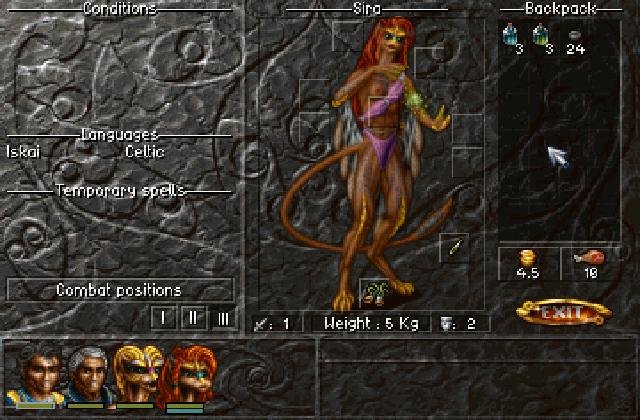
Sira knows Iskai and Celtic languages, and she’s a Dji-Kas wizard. I couldn’t have won the game without her…
So this is the legendary land of Albion, king Arthur travelled to…. But how?
Sci-fi becomes a fantasy medieval with magic (all neatly explained!) in an epic saga of the clash between the primal nature and the industrial change. A struggle between the new A.I. god versus an ancient magical goddess. There’s so many layers of the story there I can’t even express it. The murderous power schemes, the weird and forbidden love of human towards an Iskai, the story of beings that became ones with the nature, and a ton, and I mean A TON, of lore, regarding, Iskai, Celts and cyberpunkish reality of DDT. Nowadays there are several games that want to achieve the same level of detail with new techology, and these games are an instant win if they pull this trough (Witcher 3, and the upcoming Cyberpunk 2077 e.g.) but they seldom reach the level of “Albion”
Tom, Rainer and Sira – a fanart found on the Internet
But, apart from the great story and iteractivity, and gimmicky two ways of displaying the world (topdown and first person), the most important thing is how beautiful are the graphics. The exotic visages of Albion’s deserts and jungles still work on me (I played it last October, while on vacation in Greece, in these periods between returning from the beach of Korintian Bay and going to sleep 🙂 ) It really enhances my imagination to the point I can say I just fell in love with the setting.
I wish I could see more of Albion, and from that hunger I have it always installed and tend to replay every few years.
There’s nothing really in the game market these days like the “Albion”.
Exploring the world in both, topdown and fps views paints a full picture.
Humanity is a very sad and pathethic kind of animals. The vertebrae with the biggest capability of destruction of all vertebraes. Additionally, evolutionary mechanics evolved certain things beyond a vertebrae average, and left others completely underdone. It also applies to brain functions – while some behavioral patterns are top notch, other’s are, simply put, “in the dark”.
That limitation leads to a varying spectrum of human misbehavior, starting from domestic violence, through depression and frustration, to genocide. An average man likes to think that all the evil is performed by “the others”, perhaps sick or deviants. In some cases it is true, yet the majority of the bad things is actually done by socially and biologically programmed patterns. There’s a saying in Poland : “an occasion makes the thief”, meaning that even though people might be taught not to steal, there are situations, “occasions”, in which one would.
How to live with conditions like these? How can one retain morality or a stable belief system? Its impossible. In most cases it leads to atheism and misanthropy.
Douglas Adams fights this feeling, not unlike how Terry Pratchett did. Because sometimes it’s better to reforge the sorrow into irony and laughter. And Mr. Adams was merciless when it comes to irony and laughter, enveloping an intricate philosophy of life.
Life, universe and all the rest, in fact. The titular “The Hitchhiker’s Guide to The Galaxy” is a hitchhiker guide to space travel in our universe. It contains a lot of useful information (Wikipedia like) but its popularity is based on one simple fact. It has “Don’t Panic” written on its cover. Now this alone should convince you how brilliant this thing is. Can you imagine a shorter and yet bullseye pun on human ignorance? It really doesn’t matter what our Wikipedia or Internet contain. Its combined knowledge ALREADY is enough to change the world completely, for the better. But it will not happen. Because an average person prefers funny cat memes instead. Or soothing funny dog videos. Don’t panic, humankind.
The story starts with Arthur Dent, an average, not-so-smart Englishman, learning that his longtime friend Ford Perfect is an alien, and that Earth is to be destroyed because it’s an undeveloped patch of universe that needs to be erased because the interstellar highway will be built in its place. Not that it’s sudden – the notice about that was in Alpha Centauri development office for some time now, and noone should care if humans are so lazy and irresponsible that they don’t know about it. If they really cared they would read it, right? But before the destruction other messages were sent – as it is explained, dolphins tried to warn humans, but humans are so stupid that instead of understanding the complex language they thaught it to be a playful mood and a waterpool ball games and tricks. So dolphins leave the planet, thanking for all the fish and saying “so long!”.
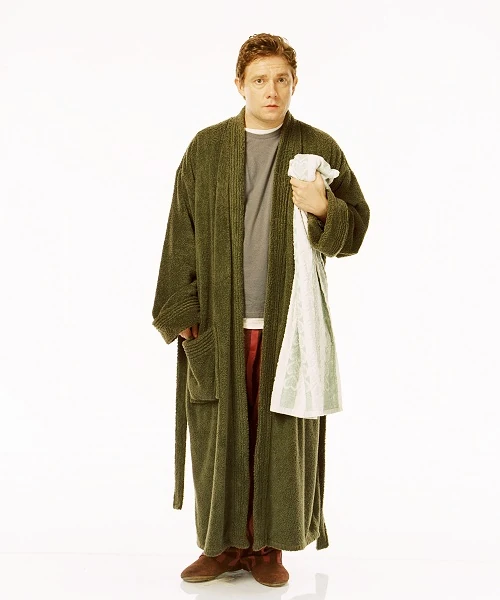
Martin Freeman as Arthur Dent. Remember, always carry a towel. And don’t panic.
Lets stop here for a moment. I’ll show you what human ignorance is. It’s when one says “dolphins are animals inequal to humans, clearly, because they did not develop any civilizations, powerplants etc”. If industrial civilization is the mark of intelligent, advanced life, then it means that Amazonian Indians are animals, right? Because they don’t have factories built. What about Inuits? Traditionally they wear animal skins and dont use electricity. No, in fact you are undeveloped. Your technology usage hindered you greatly. And yes, its about all of us. It frightens me every day how people browse the Internet for answers every day, instead of trying to work it out with their brains. Because technologically inadvanced people do – that’s why an average ancient Atenian was smarter that an average you.
And yet I sometimes see the movies about a scientist deciphering a language of the aliens. What about dolphins? We know they have one. Hell , we know dolphins have names! That’s what ignorance and arrogance is. Humans can decipher everything because they are so advanced… No. The Earth wasn’t made by any god for you to inherit it. You are but one of many animals in this planets megaecosystem, and not particularily nice species while we’re at it.
The book goes through almost every subject that matters. Sociology, economy, psychology, you name it. Marvin, the much loved paranoid-android, the smartest being in the universe and his hillarious permenent depression shows what strength is needed to see the universe for what it is, without hypocrisy or self-lying. A direct opposition to Marvin’s case are the sspaceship automated door, embedded with an A.I. conded to be happy whenever it opens. Orgasmic “ooh” and “aah” of the idiotic door, while Marvin passes through it with his heavy, depressed steps makes me chuckle while writing this text. Or a moment when Marvin, being alone and wanting to talk to someone, interfaces with a warframe computer, which in turn, commits suicide, allowing pur protagonists to escape.
Marvin as it is seen in the movie. The movie is fun, but sits nowhere close to what the book is. Read the book, don;t bother with the movie, unless you read the book.
Arthur Dent is a true human. Meaning his an idiot. A true idiot. His idiocy is a blessing, because a smarter person would go mad if exposed to the same experiences. He sees Earth being destroyed, he’s homeless, the only human alive in the universe he knows nothing about (until he meets with Trillian, whom he met on one of the parties back in England but was beaten in courting by some richman, then exposed to be actually Zaphod Beeblebrox, the president of the galaxy!) . But he’s a middleclass guy with no imagination, living his petty, conformist life. But he evolves as the story progresses, which also is a brilliant embodiment of the human condition. Near the end of the story (6 tomes) he’s a philosophical and religious guru (The Sandwich Maker).
The Fool. A Tarot card.
The idiot thopos is an important and recurring one. It is tabula rasa, the emptiness, the void to be filled with experiences, the start of the journey. We, humans, are born like that. Empty, unfilled vessels for things and thoughts to come. Tarot for example, has a Major Arcana card symbolizing this state : The Fool, and Arthur Dent is the fool in the same very sense.
Morality, media and politics are discussed with the Zaphod Beeblebrox and Ford Perfect characters. Zaphod, the president of the galaxy, is a showman, a celebrity, distracting people from the real politics. Yeah, humans are so stupid that they fall for every government trick if its exciting enough. Romans used the chariot races and gladiatoral games to achieve this in the antiquity and today governments use one scandal to focus attention and get supoort for the other. Ford is but a journalist, doing his job not because it show the truth or with some other said mission (only naive believe in the journalist mission to show the truth). It’s only about fame and money.
And then there’s a fact that this Universe wants to kill us. Paranoia? No, a reality. Falling rocks, self proud civilizations that dissapered in a blink of an eye, dinosaur extinction. It’s easy, simple and meaningless. And here comes Agrajag, the being killed by Arthur Dent in every incarnation and every lifetime. Agrajag believes it to be Arthur’s hatred for him and plans revenge, while in fact it is just. a meaningless, maliciousless, accident…
Morality versus food consuption is there too, with the restaurant At the End of Universe and a councious Dish Of The Day cow, bred with intelligence to be the tastiest, willing dish. The cow is willing to die, it is its purpose in life, yet Arthur is the only one disgusted by that practice, even though the cow reassures him that its suicide will be painless and by the numbers, and that it really wants it to happen. I know what you are going to say – GMO. No, its not that. GMO might be a way to save humanity from hunger when we reach 10 billion soon. Think about it as a threat of behavioral engineering coming with the same bioengineering tools GMO and microbiology gives us. The temtation of being a Gepetto to our lab Pinnochio might be to great to resist…
Or is it that we humans are so limited we don’t see the forest for its trees? Maybe the cow is right, after all?
When it comes to sociology, Deep Thought, a master computer that calculated the Answer To Universe Life and Everything for millions of Earth, returned a meaningless 42. A correct answer far beyond comprehension of mortals. So the second computer was ordered. The Earth…
Again, I don’t want to spoil this marvelous adventure the saga is. I don’t know any other work that is comparable to it except for Pratchett’s work. The world is cruel, nasty, we die and our lives are meaningless, but the only thing we can do is to be as moral as possible and accept the facts for what they are.
And, like Marvin looking at the message from the Creator to All His Creation, embedded in flaming letters on the mountainside, we can only say “I can live with that”.
I mentioned before I am a huge H.P Lovecraft’s and E.A Poe’s fan. My own adventure game, being developed at the moment, is, in fact, heavily influenced by those authors, with several references to the mythos and the overal mood. The “mood factor” is very important here, as capturing it is probably the most important thing of the storytelling by these two giants. Lovecraft, for example, managed to build tension with the exquisite vocalbulary he was using – words like “eldritch” or “gibbous” added to the overall reception of the ghastly scenes. The same was with E.A. Poe and his intense depictions of the environments, as seen in the mansions shown in the “Fall of House of Usher” and “Mask of the Red Death” .
I have no idea how I found “The Last Door”. I have several colleagues, also interested in the eldritch and storytelling, so I definitely was informed by them about the product, but I managed to dig to it several months before that. The game was first available as a browser game, with new episodes unlocked for backers (I was 567 backer I think, to show you how small the interest was…), and available for free later on. It was very easy to overlook this game. I mean – a browser game, with pixel art. I am very fond of the pixel art, but I hate browser and mobile gaming, because it tends to eliminate the storytelling element from games, and, well, I don’t need to tell you how important it is for me to have it in my games.
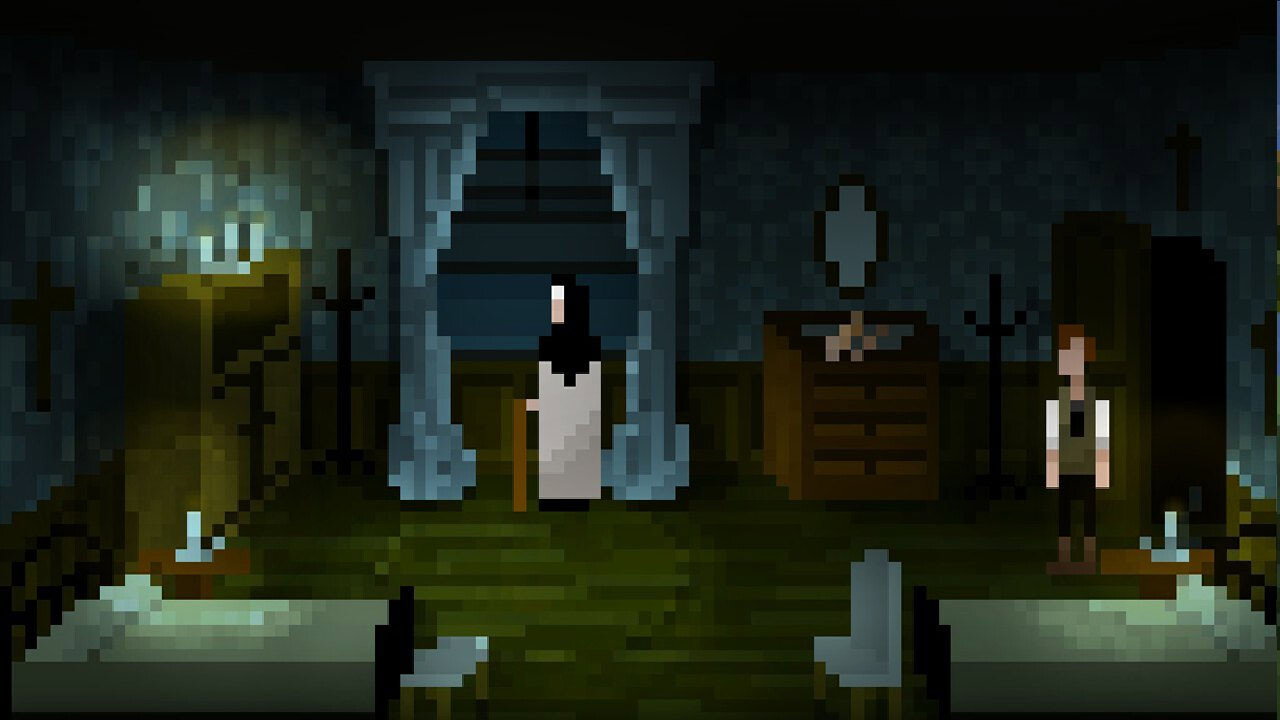
Devitt exploring the convent.
After the amazing intro, depicting some ravens and crows, being an obvious reference to the Poe’s “Raven” and the fantastic music I was immediately into it. Well, the “crow factor” is also something important for me. Wait till you see my game…
The story, made of two seasons, follows two protagonists. Jeremiah Devitt in Season 1 and Dr John Wakefield, Devitt’s physician in Season 2. Devitt’s task is a search for his colleague, Anthony Beechworth and for that, he travels first to the Beechworth mansion, which leads him to some other places in Scotland, featuring the hospital, the school. Mysterious and frightening events lead to Devitt’s dissapearance, and make Dr Wakefield deeply concerned. He starts following Devitt’s footsteps in Season 2 to uncover even more of the horrible, otherworldly truth behind the curtain.
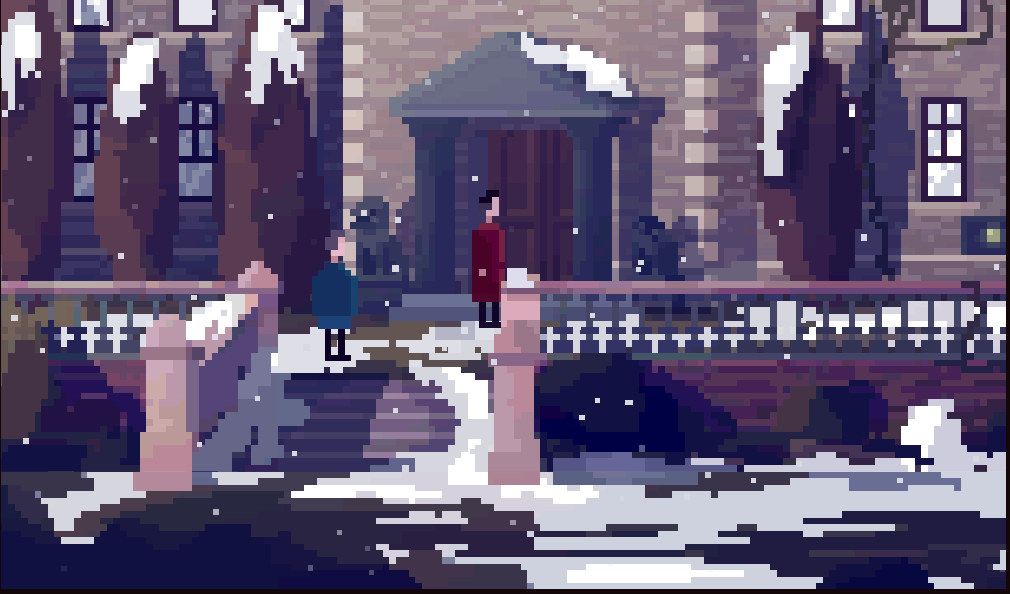
Wright entering the Wright Manor.
I will not spoil it for you, because if you name yourself a Lovecraft and Poe fan, either you already know it (so I don’t need to) , or you just HAVE to play it. I mean it. The wooden, squeeking floors. The dim lantern light in the darkness, the horrible visages and frightening events. It’s masterfully embroidered into the storyline canvas in “Teh Last Door”.
One could ask – frightening visages? In the pixart game? Yes, I say! The obscurity of the pixelart make the scenes even more onirical, even more eldritch and gibbous. The shapes are unsharp and twisted. The faces are expressionless, leaving all the work to our imagination. And it achieves the state of the brilliant synergy with its storytelling, to the point in which the storyline of “The Last Door” consists both of the Spanish developers ideas and player’s imagination, filling all the gaps. The effect is just brilliant.
It’s difficult for me to express how Carlos’ Viola music contributed to the game. I am completely certain the game would be half of what it is today when it comes to its mood, if not for the music he composed. Below I post two YT pieces, first an intro, and the second is the whole OST. Just listen to it. Brilliant. You’ll never forget the insane concerto music from the first chapter after you hear it.
One more shout of respect for the developers. At one point they were creating this game without having any money to continue the project, to the point when several devs left it with broken hearts to earn some money, elsewhere, because otherwise they’d become peniless. Yet they managed to pull it through, this marvelous piece of art this game is. Chapeau bas, gentlemen! Chapeau bas!
As one of the reviews say: it’s a “love letter to Lovecraft”. It’s far more than that.
The world knows J.R.R Tolkien’s “Hobbit” very well at this point. The story depicting how Bilbo Baggins travels with the dwarves and the wizard to defeat the malicious dragon and finds the One Ring in the process is deeply rooted in popculture. There were movies showing it to the wider audience, and a lot of people has read the book. In many schools reading “The Hobbit” was mandatory. From the tolkienist’s (myself being one) point of view the book is no longer a children fantasy book, but of course fits to the greater picture of the whole Arda saga (with “The Silmarillion”, “The Lord of the Rings” “The unfinished tales” and “The lost tales”). I have often heard an opinion it being the “ultimate fantasy book for children” wich always puts a grin on my face. As much as I love Tolkien’s works, I know better literature than “The Hobbit” . For example Tove Jannson’s “The Moomintrolls”, but I wanted to show you something different today.
“The kidnapping of Baltazar Gąbka” by Stanisław Pagaczewski is the first book of the trilogy. And it is a masterpiece, far exceeding “The Hobbit” and the other similar works. Althought a different setting, there are similarities allowing the comparison of those books. While “The Hobbit” uses the germanic legends as the basis of its storytelling (with all the post-Burgundian clumsiness of the Nibelungenlied and epic-like approach of the Norse sagas), “The Kidnapping of Balthazar Gąbka” (I will shorten both to “H” and “BG” in this text) focuses on the Lesser Poland’s legends surrounding the royal city of Kraków. Both books feature dragons =- there’s Smaug in the “H” and Smok Wawelski (The Wawel Hill Dragon) in the “BG” but their role is completely different. There’s a journey “back and there again” in both books – it’s Bilbo Baggins who travels to Erebor in the “H” while Smok Wawelski goes to adventure of releasing professor Gąbka from the custody of the Raindwellers. Both Bilbo and Smok are acompanied by skilled companions, some recruited along the way. Both feature different “literary biomes” as I tend to call them – multiple areas or “zones” (a gaming term) with distinct literary characteristics (“H”‘s Mirkwood and Misty Mountains, “BG”‘s lands of the Sundwellers and Raindwellers)- a typical mythological approach. There’s far more similarities. But there are some distinctive differences too.
Heroes. Smok, Bartłomiej and Don Pedro.
The reality of the “BG” is less fixed on the sagas and the legendary stuff and is not a literary experiment for adult professors of literature . It’s a children’s fantasy novel, so it uses the full spectrum of tools to give the engaging, intellectual, but fun, material for the younger reader. So there’s a mythical Duke Krak who’s sending Smok on a journey, but Smok is a gentleman here, not a monster, a crossover between the Sherlock Holmes, James Bond and Arsene Lupin but far more positive, encompassing the gentleman virtues of the man of 1950’s. Smok is given an car and a personal cook, Bartłomiej Bartollini, an Italian maestro of cooking, who uses his barbecue spit as a weapon. The book sets boundaries for its setting but does not set any boundaries for the imagination. The younger reader, after a dozen of pages, starts to have a feeling that anything can happen and anything is possible in this book, and craves for more. The book survives also adult’s eye surprisingly well, in fact, far better than the “H” does.
Don Pedro spies on and sabotages the heroes at first, but then becomes one of the good guys.
Pagaczewski masterfully manipulated emotions of his readers. I rember how outraged I was as a kid, when I first learned of the attempted poisoning of the Smok that Raindweller spy, Don Pedro, attempted with the toadstool mushroom jam. Treacherous, shady character who in turn gets recruited into the company (Gollum in “The Lord of the Rings” (not in the “H”) has the same impact, although Don Pedro is far more likeable). Polish experiences of the author with various dictatorships (Nazi and communist) also added to the picture. I remember I was genuinely unsettled and I had the feeling I was being watched for a week after the section in which prof. Baltazar buys the rainmuffins in Raindweller bakery from Mżawka (eng. “Drizzle”) and then learned that Mżawka is actually Agent Mżawka reporting every action of the professor to the secret police HQ. I was genuinely scared of the Great Raindweller (remember the Great Goblin from the “H”?).
The Great Raindweller was really scary, and what scares children most is his unlimited power…
One of my favourite sections, remembered after 3 decades after reading of the book is the moment when Smok and company are in the jungle, inhabited by monkeys and okropiki (eng:”Hideousies”). You see, there was a traveler to that jungle before, who died unfortunately and both okropiki and monkeys rummaged through his rucksack. They found two books. Monkeys found the physics book while okropiki a tome of poetry. That’s why it’s not weird when you learn the friendly monkey’s name is Interference. But’s okropiki who are greater here: I will never forget that one okropik, who, after piercing the gas tank of the Smok’s car, turns around and declares “I am as an arrow submerging in the gardens of peace!” and then “Time of the craddling comes!”. 🙂
The “BG” is in fact a trilogy. Professor Gąbka is released from custody of the Raindwellers and the Raindweller regime falls to be replaced by democratic Raindweller government of Salamandrus, Gąbka’s political co-prisoner. Mżawka and the Great Raindweller are prisoners in Kraków but they manage to escape. The hunt for them is the subject of the second book, as well as the scientific journey of Professor and Smok.
The third book is different. Our heroes, through hibernation, wake up in 1960’s Poland. The book is a very sad, deeply sentimental work, the longing for the old times. Our heroes try to fit into the new, grim and dull, reality but they somewhat fail, unable to find the charm of the lost epochs.Where Rowling ultimately failed with what she wanted to achieve with the feeling about “muggles”, Pagaczewski succeded. The book is a good-bye from the author,
There was a brilliant and very faithful animation series produced by Polish animation studios, that can still be found on YouTube (in Polish).
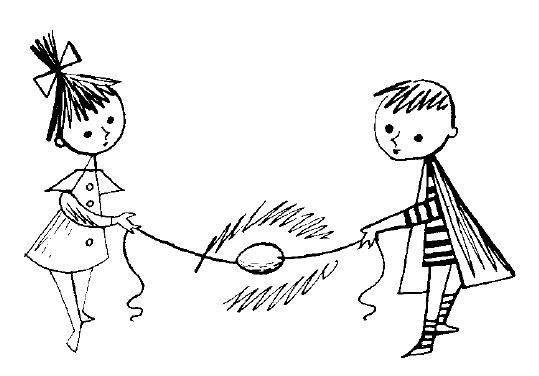
There’s one more book that imediately follows the “BG” as better than the “H. “Karolcia” (“The Little Caroline”) by Maria Kruger. The child fantasy following the crazy ride of a girl who finds a mysterious round, shiny bead, hunted by an evil sorceress. The bead, not unlike to the One Ring, has many powers, and Karolcia uses those powers to escape the Sorceress. The Frodo’s escape from the Ringwraiths had the same emotional power reserves as Karolcia.
So, if you are a fantasy fan, have kids, and say that “The Hobbit” is the best for you kids, think again. Read Tove Jannson, Stanisław Pagaczewski and Maria Kruger first.
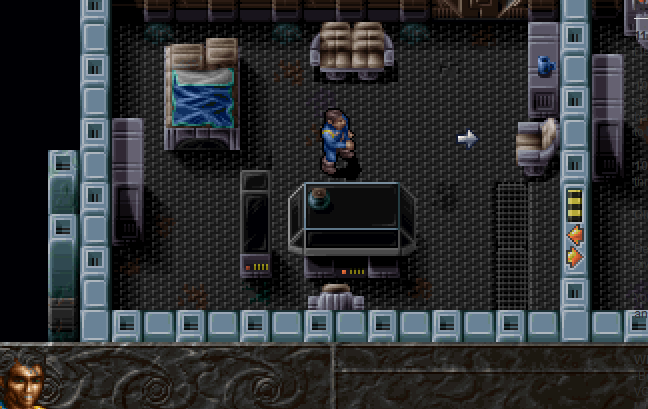
Another 90s Amiga adventure game hit was “Dreamweb”, for multitude of reasons, really. First of all, it strayed from the regular point and click schema and introduced a topdown view, as in RPG games of the era. Secondly, it produced a very, very dark mood. Thirdly, its setting was cyberpunk-ish, yet very mature. The mixture of these these three elements brought the game to attention of the press and audience, but what made it rememberable, was, again, its storyline.
The protagonist of the game, Ryan, is a bartender in a futuristic, dystopian state (implied to be England). He has a girlfriend and lives a mediocre life, being a medicre man. He clearly shows the sickly, maniacal indifference and other symptoms of depression. But it’s not implied anywhere that Ryan struggles with any mental problem: the game allows a player to feel and evaluate Ryan’s mental state only by showing his attitude to his surroundings, which makes it sometimes quite uncomfortable to be in “Ryan’s skin”, from the start. Aditionally, Ryan is having dreams, or nightmares rather. Ryan dreams of the entity called DreamWeb, and its Keepers, the hooded personae who communicate through dreams.
Ryan learns in his oniric state that DreamWeb is a world with a real power. It resembles the Changeling:the Dreaming (a part of my beloved World of Darkness) world constructs like the Dreaming and Arcadia, very much. Ryan also learns that DreamWeb maintains the stability of the real world and that stability is in peril.
DreamWeb featured a topdown view.
The Keepers bestow the world saving mission upon Ryan. He has to find and kill 7 “parasites” that endanger DreamWeb and the world…
This moment got me hooked into the game immediately, as I remember. An average person with a mission to kill people bestowed by a dream… That’s just… nuts! Immediate questions were: is the DreamWeb real, is it just Ryan being sick and depression started taking its toll. It doesn’t get any better when Ryan gets fired by his boss in the bar, and starts to be commited to the horrendous task.
He spots the first “parasite” on TV in the bar…
From that moment onward I was ensnared by the need to learn what is the truth behind all this. Is Ryan a maniacal murderer going on a killing spree, or is the DreamWeb real? I needed answers so I followed the tasks bestowed upon Ryan by the Keepers. And so Ryan started killing using me as a tool – to see the ending I had to pay the price of following the ordered tasks…
One of the most disturbing scenes of the game was slaying a rockstar (a parasite…) while he was having sex on the bed in his suite. Pixel blood and gore splattered and panicking woman had a shocking impact on the gamer of the era and was seen as very controversial, causing some difficulties to authors of the game.
The more player delves into the game the more the climate becomes darker. The last parasite is no longer human but becomes a disgusting huge monstrosity, crawling through the Underground tunnels, which also seem to belong to some monstrous world. It’s not unlike any other lovecraftian horror, and again forces a player to question Ryan’s mental state.
Everyday life is about to be changed forever…
The very last scene provides more questions than answer but is strangely fullfilling. I will spoil the ending now, so stop reading now if you want to play this retro marvel. Spoiler goes below:
3
2
1
Spoiler: Ryan is teleported to DreamWeb and thanked heartily by the Keepers but now the price needs to be paid: when Ryan gets back to the real world he is shot by the police after emerging from the subway. Yes, the quest ends as it should, really, in a quite consistent way. No matter the reasons, he was killing people and had to be put down or arrested, no doubt about that. But was DreamWeb a true entity or was it a delusion? Both answers are really plausible here, but at this point the most important thing from the player’s perspective is no longer the answer, but the sadness for the lives lost.
Clunky as it is by today’s standards, it is still a game worth playing today.