Tag Archives: Rpg

Vampire the Masquerade – the cat’s particulars. Gehenna and clans – part 2.

The mythology of the World of Darkness is a very complex thing. It was developed by a legion of people for 30+ years now, and it consists of many books, novels and supplements. The new plotlines were added and the existing ones refined. Of course, it often resulted in contradictory effects, like e.g. some metaplots events happening in only specific revisions of the setting, but overally it’s a smart and deep lore.

The whole setting is a one doomsday story. It really doesn’t matter when one places one’s sessions – be that ancient times, medieval, victorian or contemporary – there’s always a feeling of impending doom present. The fear for destruction of one’s being and the world around. The End of the World, the Apocalypse (Werewolf), the Oblivion (Wraith), the Banality (Changeling) and the Gehenna (Vampire). This one thing defines the whole mood of the each story told in that universe.

Is it true what I just said? On the second thought – not really, because, as always, it depends of the players how and what they want to play. As with every other setting, Vampire (and the whole WoD) allows one to tell all kinds of stories. You want comedy? No problem, you want action movie? Easy peasy. You want a slice of life? Absolutely.

The thing is all of those somewhere, somehow have always the bitter aftertaste. The comedy could be silly or really funny but sooner or later the vampire has to feed. Hunt or be hunted. That’s why one of the first most visible things in the lorebooks is how a vampire cannot maintain the relations with his mortal family. Well, she can try, but it won’t do good to anyone… On the contrary.

The vampiric state in VtM is a peculiar thing. No vampire knows for sure what are it’s origins. Many tried to explain the thing scientifically (Malkavian vampire Dr Douglas Netchurch…) to fail – there’s so many mystical and paranormal elements to the problem it’s just not possible to use just science to explain it. Some perceive it as a superhuman eveolutionary adaptation.  The ultimate predatory state, if you will. Some see it mythologically -as a curse. Such is the case of those western vampires, mostly from the Sabbat sect, believing that vampires come from the first murderer, Caine who slew his brother Abel, and was curse by God., and as such was condemned from the very start as was any offspring he dared to create.

And here’s the problem. It’s not the only possible explanation to it. First of all, Chinese vampires do not share that belief, and in fact, they are so bizarre in comparison to their western brethren, it sometimes makes the Caine story completely invalid. There are also multiple beliefs around how Caine came to power around western vampires (as stated in the most important vampiric text: “The Book of Nod”). One says he got his power from Lilith, who, predated him as a vampire (“Revelations of the Dark Mother”).  There’s an Egyptian strain, believing in Set as the first and the most powerful one, there’s an Arabic one, believing in Haqim as the progenitor… Many, many cults and beliefs, completely blurring the truth, whatever it may be.

The major belief, and the subject of coflict is the notion that Caine has created their first offspring, three vampires at first (the Second Generation) that created their offspring (The Third Generation) and lived with them in an ancient city of Enoch. But vampires are not nice, and curse or not, The Third Generation slain and eaten the Second. Caine left with grief and anger and the mithical Deluge was sent by God to cleanse the Earth from vampiric disease.

But some vampires from the Third Generation survived. These are known as Antediluvians, one of the scaries entities in the World of Darkness. Hidden, unbelievable powerful, godlike, always scheming and pulling all the strings.

All vampires fear that, if in fact Antediluvians exist, one day they will rise from the vampiric slumberstate – Torpor – and devour everyone, human or vampire. That is known as Gehenna in vampiric mythos.

Caine, Second and the Third Generations…

Aparrently only but a number of vampires believes in the whole Caine and Antediluvian thing. Camarilla sect vampires does not, and treats the thing as an allegory, or a myth only. Sabbat, very nietzchean in their ways, on the contrary – the very existence of the sect is dedicated to oppose the Antediluvians. That makes them thing of the organizations like Camarilla pawns in the hands of Antediluvians, and therefore, an enemy.

That is the genesis of vampiric Jyhad, the everlasting war. That is the mechanic that brings the doom to vampires. That is the mechanic that makes them destructive beings, unable to create in the long run, and, by looking at the bigger scope of WoD – tools in the hands of godike creatures of the night.

Now add another brick to the wall: 13 base vampiric clans come directly from Antediluvians. This makes the war a patricide war, and what can be more psychologically weighting than a mortal combat with one’s family? Aditionally, each clan bears a flavor, something of their progenitor is in their blood, giving them their powers and the curse.

The implications of that are grave. Just imagine – a part of your scary grand-grand-grand-grand-grand-grand……. -grandpa is a part of you…

Image result for vampire clans
The clans…

Lets list the clans:

Ventrue – the vampiric nobility, and creators of the Camarilla.

Brujah – the rebelious warriors, in the days of old believing in humanitarian pronciples, now reduced to bravos.

Gangrel – beastlike Gypsy nomads.

Malkavian – deranged nutjobs, but there’s an immense knowledge on their madness.

Toreador – artists and poseurs. Vane.

Nosferatu – hideous and monstrous on first look, but in them the humanity burns the brightest.

Giovanni – necromancers

Tremere – warlocks. Mages of old turned vampires. Their magic changed too, for the better or worse…

Assamite – arabic assasins.

Followers of Set – Egyptian serpents.

Ravnos – Roma (Gypsy) tricksters and illusionists.

Tzimisce – Central European shapeshifters and body sculptors (literally..).

Lasombra – shadowmancers.

And there are bloodlines there too. They differ from the normal clan structures and their genesis is so bizarre they have to be treated separately, almost as clans with their unique powers and heritage.
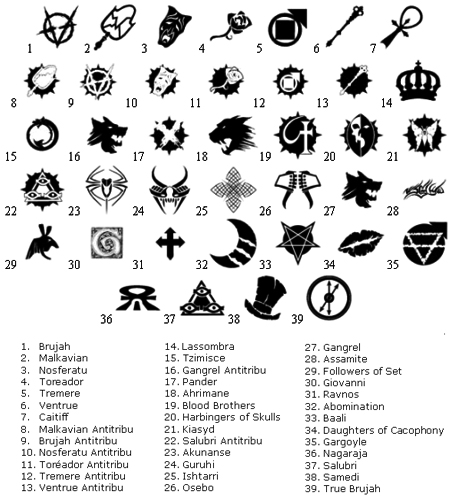
Image result for vampire the masquerade clan symbols
Even more symbolism..


This makes VtM a dance macabre (because vampires are undead..) of different flavours. This makes vampires very deterministic, with an illusion of free will and an overwhelming feeling of being but tools in hands (or tentacles…) of greater powers. In the scope of the whole WoD, vampires are unwilling servants of the very force that want to destroy everything – with a normal circle of life – creation, destruction, decay – which creates material for creation again, vampires do not participate in it. They are a pathology, a deviation. These attributes make them actually make Gehenna self-fullfilling prophecy.

In fact, there are scholars in the vampiric metaplot that learn that (Beckett)  Gehenna might not be a one time doomsday scenario – that in fact it’s periodical or happening over extended period of time. In other words – Jyhad is Gehenna.

As for the one time event, Gehenna was introduced as a supplement for the players to choose from 4 options, should they want to end their world in traditional style:

“Wormwood” (God destroys all vampires save for a few, who are given a chance at redemption)
“Fair is Foul” (Lilith takes her vengeance on Caine and his descendants)
“Nightshade” (the Masquerade is broken and the Camarilla divided as the Antediluvians awaken)
“The Crucible of God” (the Antediluvians rise up, ruling over or destroying most of the human race)

With the 5ed out on our doorstep though, I personally opt for Beckett’s point of view…

So, it’s the doomsday that marks unlives of the vampire (and all other denizens of the World of Darkness for that matter), with every step and on every occasion. The rope tightens constantly and this is the kind of storytelling players and storytellers alike  search for by playing this system.  They want ot be scared and feel hopelesness. And they want to fight it.

Is there a way to escape the doomed fate? Is there a way to somehow escape the endless loop of Jyhad? Perhaps. But this is a subject of another post, sometime. In the meantime, listen to the rhymes of ancient vampiric texts and arm yourself, Kindred:

On these signs, you must know,
that Gehenna waits, even at the door,
as an actor waits in the wings
It is coming! It is near!

Shine black the sun!
Shine blood the moon!
Gehenna is coming soon!

 (source: http://www.coven.50webs.com/BookofNod.html)

Check some art: https://www.deviantart.com/racca/art/Vampire-The-Masquerade-Clans-92161004?q=favby:floweringwolfsbane/1551097&qo=72

https://www.deviantart.com/zero0810/art/VtM-chibi-Clan-Lasombra-206976092 (and other clan chibis)

https://www.deviantart.com/axel-tw/gallery/ (vampire clans)

Vampire the Masquerade – the cat’s particulars – part 1.

Was it a dangerous night? The Kościuszko Plaza in Łódź was quite empty on 2 A.M. Of course there was some people there, doing late shifts or returning from discos. The usual rabble, the denizens of the night. Not that anyone from these people could pose any danger to Franek.

It was a dangerous night, but not because of some brigands. It was dangerous because of Franek.

He had lived  in that city for more than 150 years now. He stalked and hunted around the place since then. He remembered the very place built from a village to become a 1 million city. He was there when Izrael Poznański opened his textile empire, and he was there we Germans invaded 1939 and renamed the city to Litzmannstadt. He remembered the time when communists chaned it into the city of workers.

He still remembered the sweet blood of that SS-men beating up the little Jewish girl in the Litzmannstadt Ghetto. Oh how liberating it was to release the internal Beast back then. Sweet irony, the vampiric Beast became an angel of salvation, a punisher of human beasts.  He still felt the anger of the moment. But right after the anger a feeling of warmth mixed with sadness followed because he made sure the orphan girl survived.  He used all power and contacts he had to keep her alive and healthy. She has become a daughter to him for some time. He succeeded, she lived.

She died last year in Jerusalem, 77 years old.

Perhaps he should have Embraced her into the Childer of Caine

Franek felt peckish. He stood there, observing people leaving the night club, when he noticed two loud neo-nazis. He grinned. 

In fact, the hunt and the war never ended.

That’s one of the ways to start an RPG session in Vampire the Masquerade. I have written before on the World of Darkness setting, and this is my favourite subsystem of it. VtM is an RPG that changed my life, without exaggeration.

As a teenager sunk into fin-de-siecle literature, fantasy and sci-fi books and games, I was bombarded by a magnitude of contradicting pictures and visions. The western world produced hip-hop and consumptionist lifestyle,, that was enchanting, yet we lived for decades in Poland without the consuptionist spirit and we were quite happy. There were always drugs here, but the amount of drugs on the market rose exponentially after the fall of Iron Curtain. Even the young generations bear the trauma of 20th century wars – we see their marks everywhere to this day, so we are naturally reluctant and reserved when it comes to foreign politics. Cynism and cautious behavior are a norm.

Fantasy systems from the West seemed to ideal, to perfect. I couldn’t immerse myself into those except for the darker ones.

And then I found Vampire the Masquerade.

We know vampires from pop culture and folk culture. We know it from books like Anne Rice’s books (Interview with the Vampire”. “Queen of the Damned”) and the movies (“Lost Boys”). We know them from literature (“Dracula”) and folk tales (the word vampyre is a form of slavic “upiór”/”upyr”, which often means “the undead”). And we often tend to think about them either as a cheap gore horror elements or a hillarious/love story storytelling entities. One of course can use them in VtM in a similatr manner, but the Wolrd of Darkness setting is a far deeper one. The player is bombarded with a questions from the very start: what are vampires?  What is the meaning of this unlife? What makes one a monster – is it the hideous, undead look? Is it the rotten heart?

Image result for vampire the masquerade
The metaplot is huge and contains a lot of signature characters….

Players receive a powerful dark storytelling tool with VtM (and other WoD subsystems). From the very start fledgling vampires are sunk in the world of an undead intrigue and politics, dark magics and dark secrets. First of all, vampires don’t want to be discovered, they want to hunt and plot from the shadows (hence the Masquerade). They are fear embodied, nocturnal beings that were human but are human no more. Yet they do feel fear themselves – fear of far nastier and more ancient entities World of Darkness is populated with. This is a game of horror allright – be the horror and feel your personal horror.

Image result for beckett vampire
…Including Vampirearcheologist Beckett..

Storytelling capabilities of VtM are enormous. Just think about the reminescence mechanics we know very well from “The Highlander” movie (in fact the Highlander fits so well into WoD there is an unnoficial subsystem incorporating McLeods & co into WoD…). On many occasions one of the vampires during my sessions started telling the story that happened 100 years before, allowing skipping from contemporary era to victorian ages… With suplements on the market as Vampire: The Dark Ages, Victorian Age Vampire ,etc, possibilities are countless.

Image result for vampire the masquerade
Wearing a cape is so 19th century…


The internal vampire politics turn around clans & bloodlines (blood strains have various powers, as vampiric mythology  explains – coming from Caine the First Murderer – there’s 13 base clans and many more bloodlines) and sects (Camarilla, Sabbat, the Anarchs and Independents) – political orders representing different viewpoints on how to be a vampire and how to defend against the ancient vampiric and other powers.

And so the Jyhad, the war of the immortals (or rather – the undying), continues.

We touched but a tip of an iceberg with this post. To be continued.


The “World of Darkness” – the introduction, and why I love it so much.

I have been a gamemaster (GM) for more than two decades now. It would be probably more if only we, here in Central Europe, would be exposed more to these phenomena. Back in 1980’s kids in USA were perfectly accustomed with Dungeons&Dragons and other systems, but we were living behind Iron Curtain. Don’t get me wrong – we were exposed to fantasy and sci-fi for decades now, and we had our own great writers, so it’s not that we were completely in the dark. On the contrary – there’s a number of things that enriched also the western world after the curtain fell, coming right from our yards here. But I digress… Even though I am a member of a very rebelious nation and we had introduced a lot of “western junk” (as our government back then wanted us to believe) back in the 60s till 90s, like 8bit PC computer revolution, RPGs appeared here very late.

I remember there were references both to wargaming and rpgs in the oldest fantasy related magazine published in Poland – “Fantastyka”, often introduced by some well known critics and writers. But it was not until 1993 that I actually learned about it.

Being in high-school and a very invested (to say the least…) in Tolkien’s literature, I was all about elves and dragons too, of course, and after being introduced to Warhammer rpg (I will write about it later) I discovered the whole new world or roleplaying. Immediately I was exposed also to a system that changed my life completely, on many levels.

First of all – I was a “fin-de-siècle” kid.  So I was into all that was dark and gothic. I started listening to death/black metal, reading all manners of dark literature, along my beloved sci-fi and fantasy. The feeling of isolation I had in high-school was quite deep. Oh I had a lot of buddies I was having wild parties with, but, as a romantic spirit, I longed for something deeper than party-laughing-drugs-alcohol-dancefloor-sex activities. Additionally I was writing for some time back then, and I was imagining my future as that of a writer, and in the whole highschool period there I had maybe two people with whom I could talk about this. Movies like the “Crow”, “Interview with a Vampire”, “Dracula”, “Highlander” or “Lost Boys” got me immediately captivated.

And then I was exposed to the “World of Darkness” megasystem. Created by Mark Rein-Hagen, Stewart Wieck, Christopher Earley, Stephan Wieck and many, many others as a number of systems, all masterfully intertwined and sharing the same world, but with different viewpoints on it.

It started with vampires in Vampire The Masquerade. The gothic – punk methodology introduced shaped the way its world was created. Punk stands there for a dirty, problematic ways of living of the lowest strata of society- drugs, prostitution, mobsters. Gothic stands for a gothic story in a overgothicized city – monumetal cathedrals, gargoyles on corporate buildings, dark alleys and clubs, but also for it’s mood and character insights, especially when it comes to monsters. Mary Shelley meets Miami Vice or sometimes “A Midsummer Night’s Dream” meets “The Fall of House of Usher”… Blending these ingredients together lead to creation of a psychological horror setting that can introduce a certain grim mood almost immediately.

s
Gothic – punk. Self explanatory.

The World of Darkness (and I am talking about the old WoD, there was an offshoot called nWoD – Chronicles of Darkness, for a completely different generation and while mechanically better in  some oppinions, far worse in storytelling) consists of several subsystems, each introducing a new viewpoint on a horrible world of monsters our planet is:

Vampire: The Masquerade – the nocturnal vampires, Childer of Caine, the first murderer, play the endless war for sustenance, called the Jyhad. The world of politics, murder and eternal struggle with the horrible powers outside and within. An endless query trying to find an answer – how can one find balance in the darwinian predator-and-prey world.
Kindred of the Ebony Kingdom – vampires in Africa. The old veves and rituals of Benin and Congo may have more to them than meets the eye.
Kindred of the East  – bizarre, eastern vampires and their secluded lands.
Werewolf: The Apocalypse – werewolves, the servants of Gaia, one of the spirits of the Triat, fight an endless war against Wyrm’s agents (they consider vampires one of those..)
Mage: The Ascension – mages, humans that Awoken or Ascended, know no boundaries and can shape the world. But human spark is a capricious one…
Wraith: The Oblivion – after death one can face a horrible fate – imprisonment in the Shadowlands. Even worse – being abused by a necromantic vampire. Even worse – have one’s own soul forged into Shadowlands’ currency… And there are still worse fates…
Changeling: The Dreaming – changelings are faerie away from home. And they want to get back and fix the world. World is losing it’s magic, inevitably it’s glamour is being squandered under the hard proceesing engine of futurism. And faeries are mad.
Hunter: The Reckoning – old  Church organizations and organizations preceding the Church hunted vampires and other abominations to clean the Lord’s world from them. They do not rest and have some powers beyond comprehension.
Mummy: The Resurrection – muumies of Egypt and South Africa have their own agenda…
Demon: The Fallen – demons from Hell want to possess and win the endles struggle with heavens. They will use anyone willing or depraved enough,.
Vampire: The Victorian Age (set in the late 19th century)
Werewolf: The Wild West (set in the 19th century)
Mage: The Sorcerer’s Crusade (set in the late 15th century)
Wraith: The Great War (set during and immediately after World War I)
Vampire: The Dark Ages – the true lords of medieval realms  are powerfs behind the throne…

Needless to say , it’s a very dark setting. Discretion is advised, as is maturity. The subjects depicted are sensitive – vampiric Embrace is like rape, and there’s still Auschwitz shade running in the Shadowlands, where the countless dead are being punished with this limbo for eternity.  What stands out however is how big the metaplot is. It’s massive and absolutely tasty.

But a part of my shelf, and a percentage of the corebooks:

Obraz może zawierać: 1 osoba, w budynku
I have more coming this month…


I will delve deeper into the subject later on, going through subsystems, but I wanted to add the mechanics is pretty neat. 10-sided dice is used in all of these, and  the way skills are depicted makes it very easy to perform dice rolls and test almost any situation that comes to imagination of GM (here called Storyteller) and the players.

Like I mentioned, it’s a dark setting of roleplaying a very miserable creature. Of course, creature that has almost god-like powers at times, but still miserable. The internal struggles for humanity (or  the contrary – for an absolute alienation) of the vampires create the anguish and the pain that is a perfect basis for tales of what defines humanity at all. Werewolves can have noble motives ( ecological saving of the planet) but they still have the primal urge to kill and brutality of the rabid animal. Changelings are mad, insane to the point they create the world around them as insane as them.  Mages wage a horrible war with the ultimate weapons of mass destruction, war that spans far beyond the Solar system…

And somewhere out there, legendary powers dwell. Waiting for something. Eldritch powers beyond all comprehension that perhaps wait for their time to awaken and devour everything in a cosmic cataclysm.

Or they don’t. It’s an RPG game after all.  It’s all there waiting for your imagination to add to it. Just imagine these tales…

The art of storytelling – pen&paper RPGs

Pen & paper roleplaying games are there in the culture for half a century now. Semi-randomized storytelling is far older that that of course. The idea is as old as humanity itself I dare to say. Following Cohen, Pratchett and Stewart I also think that naming humans homo sapiens is giving our species far to much credit, and I also would rather name it “pan narrans” – “a storytelling chimpanzee”. From the hunter-gatherer tales near around the bonfire, through the recipient-oriented “One Tousand and One Nights” (to the point were Scheherezade has to adjust her stories accordingly so she could survive!) till 19th century, when Von Reisswitz created Kriegsspiel to teach Prussian officers tactics (a fun fact is that King of Prussia ordered every regiment to have a copy of Kriegsspiel).  Kriegspiel had many editions (at least 3) with revised rules, but all introduced some randomness into how the events developed. In the 1st and the 2nd revision it were dice, in the third, impartial experts. And thus, the role of a Game Master, an individual with knowledge, an arbiter of events was introduced in the 3rd version of Kriegspiel by du Vernois . American military followed with it’s Jane’s Fighting Ships and it was revered for it’s detailed unit descriptions (get it here) which started to serve as a first full-fledged rulebook ever . Then the wargaming  – tactical and narrative games with random elements, basing on scaled reproductions of battlefields with toy soldier miniatures – came into gentlemen homes. Important fact is that ancients (Minoans, Egyptians) also were fond of the miniatures so it’s possible the concept is also quite ancient… I absolutely adore the fact that the author of the “Time Machine” H.G. Wells was a wargamer:

Tactical and randomized elements of wargaming were used to a varied extent by many armies, businesses and organizations. But it was not until 1970s were an actual idea of unit or organization based storytelling shifted towards individuals. At first as a decision-helping roleplaying.Then into “man-to-man” wargames in the gaming world, where individual-based rules were used in a tactical environment.

Then came Dungeon & Dragons (and later Advanced Dungeons & Dragons) and what was a dice based boargame like entertainment started to shift into a storytelling based events. Players started to delve more and more into the “lore” – the setting of the fantastic worlds, expanded by numerous book supplements, descibing flora and fauna, politics and culture of those worlds. Within several years the amount of content, both produced by game developers and the players (as background stories for gaming events) was so big, it started to become a basis for novels. Works like the brilliant Raymon Feist’s “Riftwar Cycle” and Salvatore’s Drizz’t novels filled the bookshops next to the renowned books like “The Lord of the Rings” (which most of the rpg systems were based on to some extent).

The 80’s and the 90’s brought  true breakthroughs in RPG. Heavily climatic storytelling systems emerged. Warhammer in the Great Britain started to tell the dark story of an uneven fight with Chaos on an slowly dying world, in U.S.A the World of Darkness was created (myu personal favourite) which shifted the balance even more towards storytelling, to the point where dice were no longer that important, what really mattered was the story. Till this very day a multitude of systems and settings sees the light of day allowing tens of tousands of players to delve deep into magnificent worlds together on  problem solving quests.

Related image
A troupe of contemporary vampires- L.A By Night, Vampire the Masquerade

The sheer amount of systems is so big it’s really hard to review them or advertise them all. It’s sufficient to say there’s at least one system (and of course often hundreds more…) for each branch of prose fiction created – be that fantasy, horror, science fiction, mystery, criminal etc. If someone wants either an interactive whodonnit or a vampiric possesion there’s a system for it somewhere out there. With everything, rules, background, information and true, extensive knowledge to posses to create new, interesting stories. I will be telling more of those, later.

Some of those evolved into Live Action RPGs which are basically a custume-based, theatrical plays with interactive storytelling…

People still don’t understand it sometimes it seems. And they are quite amazed when I tell them about popular writers who were rpg gamers first or learned RPG during interest in writing. Andrzej Sapkowski, the creator of the Witcher, Raymond E. Feist, the creator of Riftwar and many many more. Is it really so bizarre that storytellers practice in an interactive storytelling environment?

I’ll give you a deeper look into the subject, later.

Sources worth looking at: https://crpgbook.wordpress.com/