Tag Archives: psychological

“The Devil Came Through Here” trilogy – psychological problems in video games part 7

The trilogy of games that had a real impact on me is definitely “The Devil Came Through Here” trilogy, by Remigiusz Michalski  (Harvester Games). This games were a long inspiration for me as a gamedev and also a lighthouse in the dark seas of storytelling. I had a pleasure of exchanging some thoughts with Mr Michalski, about game engines etc, and his insights on one of the forums helped me resolving  a collision puzzle in my own project.

It started with a “Cat Lady” which I picked up with curiosity after seeing a trailer. The game in which the protagonist, Susan Ashworth, commits suicide in the very first scene, while her cat watches her slowly passing away. The scene had a very powerful impact on me, as I am a person deeply interested in the human psychology.  What I did not know then is that the game features a lot of horror game mechanics, with occasional jumpscares, which I quite hate. Susan wakes up in a grassland afterlife, and is greeted by the Queen of Maggots, an old lady, with disturbingly skeletal-thin arms, and is sent by her back to life to get rid of five parasites – humans that should no longer exist. I couldn’t help it, but I immediately started comparing this game to the DreamWeb, and there’s a lot of similarities there. Susan cannot die on her mission, and dying and getting back to life to approach the situation from a different perspective is sometimes the last resort that pushes the action forward.

Susan’s reality is grim and depressing…

What is different though, is the dialogue the game has – the dialogue about emotional anguish, the feeling of loosing someone, depression and terminal illness. Of all disturbing moments from the game, the one that probably had the biggest impact on me was learning that one of the characters is terminally ill.

The majority of the game takes place in a tenement block 12th Helen Road, with its sinister sign letters forming a word “hell”. The building is a home to various people, and curious personae, that show the level of awkwardness not unlike the one from “Twin Peaks”. The more Susan explorer the place, the more it seems weird, hellish, onirical, with its denizens creepy and horrifying.

One of the disturbed denizens of the block is Joe, the horrid man, making a very, very bad impression of people who play the “Cat Lady”. We explore his story in the second game, “The Downfall :Redux”. The “Redux” is a remake of the earlier game by Michalski, and it’s a soft of a prequel to the “Cat Lady”, but the prequel that can be appreciated most whole played as a second game in the series. Joe is struggling with his love for his mentally disturbed wife. Yet again ,the game explores very difficult subjects – of anorexia, self acceptance, placing all feelings around a one person, and all destructiveness of those. And yet again, the game is very, very dark, with some unsuspected plot twists.

Image result for the cat lady
Meet Joe and his wife…

Right after playing the second game, I sent a short message to the author, thanking him for the game, and he shared the early alpha screenshot of his third game, “Lorelai” with me. I just couldn’t wait for it , but I had to. And finally, several months ago it was released. Serving as a finale to the story, we follow Laura, called Lorelai, a young girl from a deviated, dysfunctional family and its problems – a drinking mother, a dead father, a pervert, violent stepfather, poverty. During the series of events, full of violence and death, Lorelai meets the Queen of Maggots, who, in turn, wants to play the same game she played with Susan. Lorelai is sent back to life, and she is given yet another chance… As in the other two, Remigiusz Michalski is not afraid to ask difficult questions or convey difficult emotions. But I cannot help to think that the author is a little tired of these depressive games and would like to create something bigger. Well, some people struggle to get to his level, while he looks towards higher goals it seems 🙂
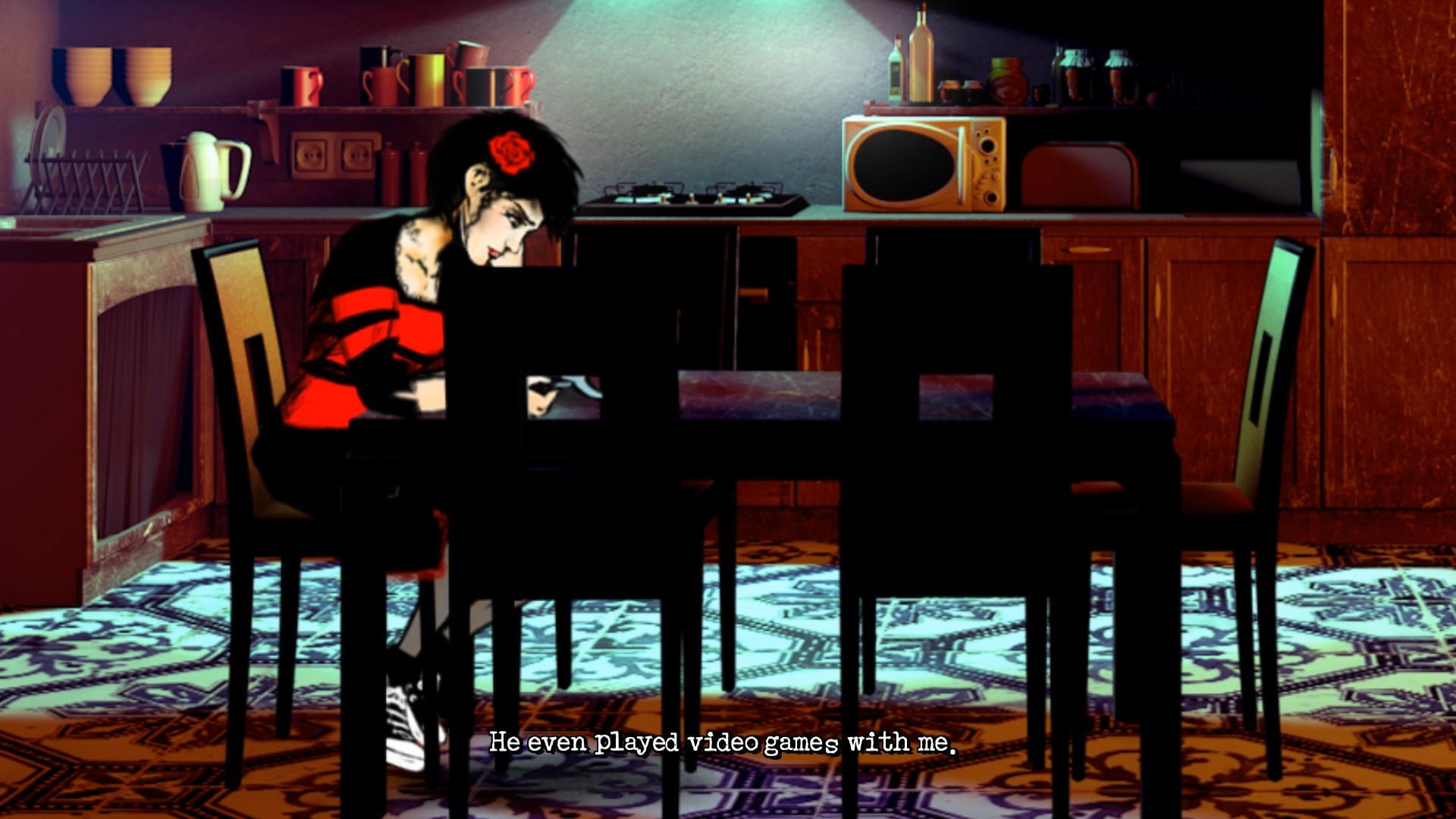
Image result for lorelai game
Lorelai wants just a normal life…

I wanted to write this article to say the trilogy is a MUST PLAY. You seldom find games so captivating, so grim and yet so beautiful with their discourse with humanity and its perils. The questions asked , questions about what it means to exist and what is the nature of evil, are heavy , the scenes are gory, and yet the whole thing feels like a serene contemplation about life, while sitting on the cemetery bench, rather than a horror.

And for me, for me it’s the gamedev goal I aspired towards and I hope my own game with be able provide, even if a part, of the same pleasure these games gave me. Rem Michalski is for sure one of my idol gamedevs.

Don’t wait, these are worth of your time.

A fun fact: the last game features voices of some well known Youtubers like YongYea and Jim Sterling.

“DreamWeb” – psychological problems in videogames, part 6

Another 90s Amiga adventure game hit was “Dreamweb”, for multitude of reasons, really.  First of all, it strayed from the regular point and click schema and introduced a topdown view, as in RPG games of the era. Secondly, it produced a very, very dark mood. Thirdly, its setting was cyberpunk-ish, yet very mature.  The mixture of these these three elements brought the game to attention of the press and audience, but what made it rememberable, was, again, its storyline.

The protagonist of the game, Ryan, is a bartender in a futuristic, dystopian state (implied to be England). He has a girlfriend and lives a mediocre life, being a medicre man. He clearly shows the sickly, maniacal indifference and other symptoms of depression. But it’s not implied anywhere that Ryan struggles with any mental problem: the game allows a player to feel and evaluate Ryan’s mental state only by showing his attitude to his surroundings,  which makes it sometimes quite uncomfortable to be in “Ryan’s skin”, from the start. Aditionally, Ryan is having dreams, or nightmares rather. Ryan dreams of the entity called DreamWeb, and its Keepers, the hooded personae who communicate through dreams.

Ryan learns in his oniric state that DreamWeb is a world with a real power. It resembles the Changeling:the Dreaming (a part of my beloved World of Darkness) world constructs like the Dreaming and Arcadia, very much. Ryan also learns that DreamWeb maintains the stability of the real world and that stability is in peril.

Znalezione obrazy dla zapytania dreamweb
DreamWeb featured a topdown view.

The Keepers bestow the world saving mission upon Ryan. He has to find and kill 7 “parasites” that endanger DreamWeb and the world…

This moment got me hooked into the game immediately, as I remember. An average person with a mission to kill people bestowed by a dream… That’s just… nuts! Immediate questions were: is the DreamWeb real, is it just Ryan being sick and depression started taking its toll. It doesn’t get any better when Ryan gets fired by his boss in the bar, and starts to be commited to the horrendous task.

He spots the first “parasite” on TV in the bar…

From that moment onward I was ensnared by the need to learn what is the truth behind all this. Is Ryan a maniacal murderer going on a killing spree, or is the DreamWeb real? I needed answers so I followed the tasks bestowed upon Ryan by the Keepers. And so Ryan started killing using me as a tool – to see the ending I had to pay the price of following the ordered tasks…

One of the most disturbing scenes of the game was slaying a rockstar (a parasite…) while he was having sex on the bed in his suite. Pixel blood and gore splattered and panicking woman had a shocking impact on the gamer of the era and was seen as very controversial, causing some difficulties to authors of the game.

The more player delves into the game the more the climate becomes darker. The last parasite is no longer human but becomes a disgusting huge monstrosity, crawling through the Underground tunnels, which also seem to belong to some monstrous world. It’s not unlike any other lovecraftian horror, and again forces a player to question Ryan’s mental state.

Znalezione obrazy dla zapytania dreamweb
Everyday life is about to be changed forever…

The very last scene provides more questions than answer but is strangely fullfilling. I will spoil the ending now, so stop reading now if you want to play this retro marvel. Spoiler goes below:

3

2

1

Spoiler: Ryan is teleported to DreamWeb and thanked heartily by the Keepers but now the price needs to be paid: when Ryan gets back to the real world he is shot by the police after emerging from the subway. Yes, the quest ends as it should, really, in a quite consistent way. No matter the reasons, he was killing people and had to be put down or arrested, no doubt about that. But was DreamWeb a true entity or was it a delusion?  Both answers are really plausible here, but at this point the most important thing from the player’s perspective is no longer the answer, but the sadness for the lives lost.

Clunky as it is by today’s standards, it is still a game worth playing today.


Silent Hill 2 – psychological problems in videogames part 5.

Now, this one is a bit of a challenge. I am about to talk about the game that has so many interpretations and such psychological depth that it’s really challenging to even start writing about it. I have an equivalent of those hiperventilation moments when one tries to tell someone everything about his favourite book or game. Except this is maybe not one of my top 5 favourites, but has a visible place in my gallery of stories with an impact – at least in top 20.

I did not play any other Silent Hill game, before and after completion (multiple times) of SH2. My experience of the foggy and grim town of Silent Hill is based solely on this one game and I don’t see any other references to other titles of the saga. That’s beacause I did not know of the franchise before I played Silent Hill 2, and after I knew there’s just no possiblility that any game from the series could beat this one up in anything. This one is a shining gem and the best of all in the series. Probably also the best storytelling survival horror there is as well…

Image result for silent hill 2

It got me hooked up from the very start – a man, John Sunderland, is washing his face and looking in the mirror in an obscure public toilet in Silent Hill. It’s not his first visit to the town, his wife was in a hospital and a hospice there. But this time, John arrived in Silent Hill, because he received a letter from his wife Mary to meet him there.

The problem is Mary died.

And so we start by looking at the face of a man, who knows he’s doing something insane – he follows the letter from a dead woman. We can feel his pain of the lost love, the many layered feeling of guilt (one layers of which is a guilt of being alive), and the insane and hopeless hope he has for meeting his deceased wife.

And that town…That town is covered with the thick fog, reducing visibility but to several meters. There are monsters in the fog, hideous creations that are twisted oversexualized, multilegged heaps of flesh… And so John explores the city in a hopeless journey of the mind.

He ocassionally stumbles upon others. People deeply disturbed and with serious psychological problems.  There’s Eddie, a bullied, ridiculed for his entire life,  young man with a complex of how he looks, absolutely self-councious of how he looks. There’s Angela, a girl with severe case of depression and suicidal tendences. There’s Laura, a little girl, all alone in the city. Mental problems these characters have are depicted in a very, very detailed manner, one can immediately see that devs did their homework. Nothing here feels fishy or is a laughing matter. They disturb player greatly, they scare from time to time, as a player wants to get inside their heads, to understand them or perhaps, to help them.

And there’s Mariah…

Image result for silent hill 2 mariah

The moment I met Mariah in game I was startled and intrigued at the same time. She looks exactly the same like the late Mary. She has her voice. She has a different personality and different haircut though. Imediatelly after meeting her ingame I slowly fallen in some weird player moe love for that character and yet, I was scared of her to the bone.  I started to follow her lead.

This game is so briliant on so many levels I just cannot fathom. Because that moe effect was intended from the start. Devs wanted the player to feel torn apart, to have doubts and yet, to follow the same fantasy John has – to reunite with his dead wife in life rather than death. The player is forced to delve deeper and deeper into that strange attachment, and learning that town actually might be creating all this characters and they might not be real does really nothing apart from strenghtening doubts – player still wants to protect Mariah, wants John to be with her.

The deeper into the rabbit hole the more knowledge about Silent Hill is aquired by the player. And that knowledge comes from various sources – from paper clippings, graffitis, books, conversations, from one of the scariest moments in videogame history – the elevator quiz… you name it. But the greatest knowledge comes from the little details, masterfully designed thingies that connect dots together. After some time player starts to realize that other characters don’t see each other even in the same room. While for John city is full of monsters he actually has to fight with, for Laura Silent Hill is a safe place, without anything scary or to worry about. The realization is so powerfull it adds to the horror. Is this happening in Johns head only? Is he mentally ill? What is this place that plays a different show for every person that visits it. Is what’s happening even real? The game balances on the edge and gives time to ponder on those things – and yet, player is unable to decide if Silent Hill is real or not.

And then there’s an infamous Pyramid Head. One of the most iconic monsters in videogames. Its notorious presence in the game frightens the player and John so much, it almost immediately causes sweaty palms and the raction often is to fight or run.  Primal instincts. Recently I watched a material about Pyramid Head by RagnarRox, who I am a big fan of, and I completely agree with his keen observation. Pyramid Head looks scary, we see him how he brutally, sexually exploits other monsters and it’s frightening and disgusting.

But it wants to help John.

You see, the more one thinks on what’s happening in game, the bigger the feeling of “this isn’t right” is. Following Mariah and the fantasy of regaining happiness is like an addiction. We know it’s stupid, we know John needs help and yet, we follow, unable to say “no”. John loses his senses, and the player loses his reason.  Visiting Silent Hill is not helping John to overcome his grief, it makes him detach further from the reality. The need to protect Mariah is toxic, because there are multiple times where it cannot be accomplished.

Pyramid Head appears always before a turning point, and if player overcomed his insticts he’d see that Pyramid Head attacks only when attacked, or if player is in its path. Pyramid Head wants to block John from progressing on the futile path Mariah sets before him. He fights and abuses the very monsters that attack John. He’s the only friend John has in this town.

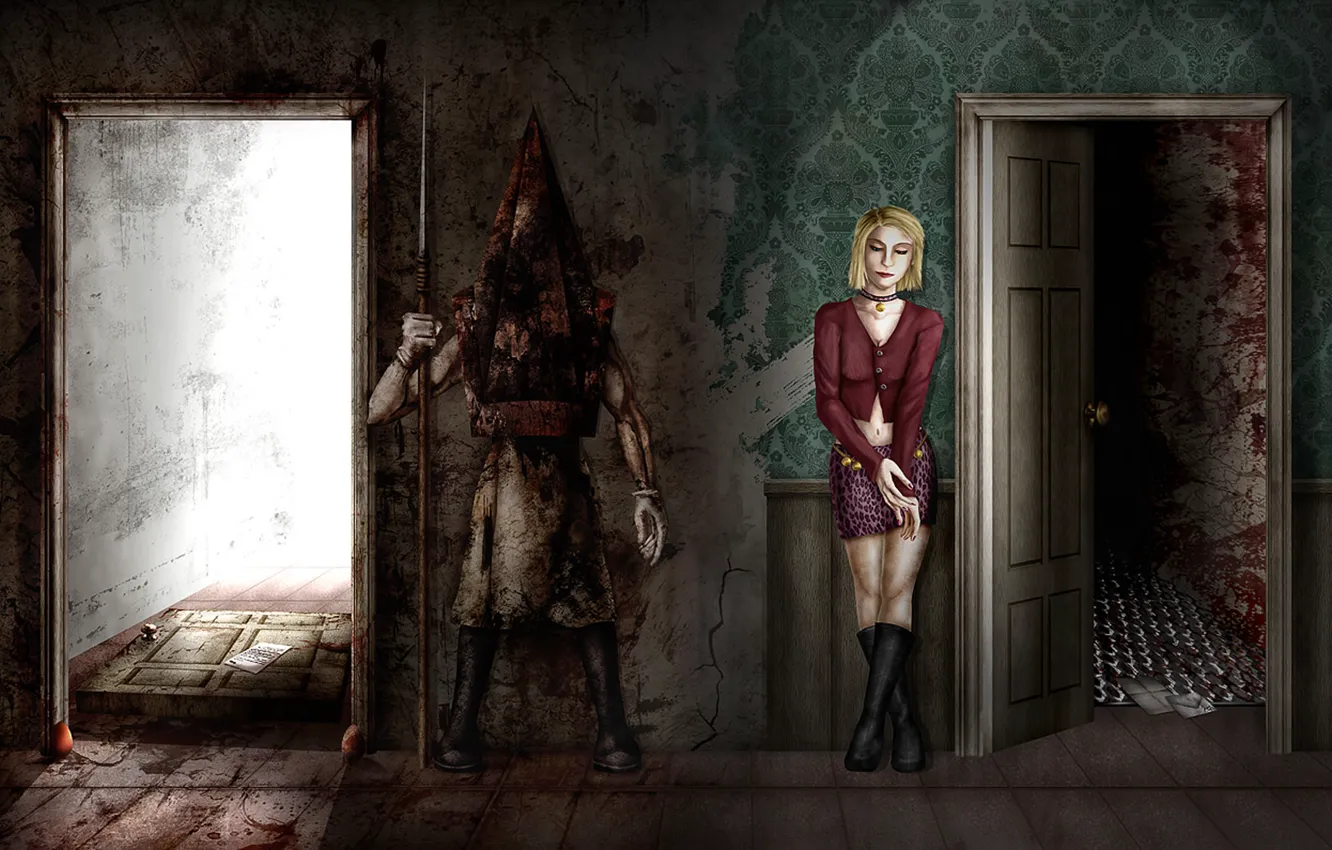
Image result for silent hill 2 pyramid head
This graphic says it all. (by Max888)

I couldn’t understand at first why actually following the Mariah’s path is the worst ending for that game. But then I replayed it again and again to see them all.  The understanding left a lasting impression on me. And I promise it will on everyone else who plays it…

Art. This is an early 3D game so everything looks retro for todays standards, but still, cutscenes are beautiful and directed excellently. But the biggest strength of game’s art is actually that it uses its full potential to tell te story. It’s depicting exactly what we need to see and know. For example –  monters. If we look close enough we’ll see how they depict the obsession John has, how they reflect what he’s trying to accomplish. Arts shows exactly how John’s mind is creating the world around him. And yet, it seem so real (just horror-infested…), player starts questioning it’s realism only after going deeper into the story.

This brilliant game really is about a dark side of being a man. The popculture depicts males as hunters-gatherers and brutes but it forgets about the real darkness of being a male. Romanticism, sentimentalism and the feeling of accomplishment are good, but only if everything goes well. Yes. Men are sentimental and romantic, and very goal-oriented, and when things go wrong these feelings become frustration and pain instead.  A true, overwhelming pain. Then add to the picture the knowledge that with great love often comes great pain, the pain of losing. A simpleminded brute is a just this: a brute, predictable, but frustrated, hurting masculinity is far worse: it’s toxic and dark. It hurts other people. It fights back, like a trapped animal. It snaps out of control. It causes the domestic violence and wars. It’s the very Hell.

Image result for silent hill 2 hell
See how brilliant this thing is?


This marvelous piece of work is probably one of the best games ever made.  I can’t recommend it enough.

“Gone Home”- a surprise.

In a constant search for thrilling and captivating storytelling, I tend to often pick up horror novels or games. With a lot of mediocre and a lot more of bad content out there, one has to be very, very careful while picking something to read or play. So I watched the trailer of “Gone Home”, and understood it was another horror game, placed in the abandoned house, with jumpscares and spectres. I am not a fan of cheap jumpscares, I prefer the psychological horror instead, but the thing looked interesting enough.

I am not sure what made the creators to produce a trailer advertising this game as a horror game. Perhaps they wanted to attract attention (succesfully as you can see…)? Or maybe they wanted to play a prank on an unknowing player such as myself? It really doesn’t matter, because in the end I was able to play that interesting and important story.

The year is 1995, Oregon. Katie, a student, comes back from overseas to her family home in a fictional Boon county.  To her amazement she finds nobody there, so she starts searching the house for the clues where her family might be. During the search she finds an objects from the mid 90s era (casettes, Street Fighter videogame etc) as well as other objects reminding her of her family: her father Terry, a failed writer who makes a living by being an electronics handyman, her mother Janice, who pursues her director of wildlife consservation career, and her sister Samantha.

Samantha. Game focuses on her from the very beginning, when Katie finds a note from Samantha on the door, asking not to investigate what happened.

For me it sounded as an invitation to actually investigate…

During exploration Katie finds more and more messages from Samantha, or items shedding light on Samantha’s life. Freshly after moving in to this new house, Sam was estranged. She couldn’t find a common ground with other teenagers at school, she felt lonely and misunderstood. Eventually she met Yolanda, a military school cadet. They started sharing interests like grunge music and Street Fighter game, and, eventually, became romantically involved. When the whole thing was found out by sam’s and Katie’s parents, they started living in denial her daughter was lebian and started imposing some humiliating regulations, like the one Sam’s bedroom has to be opened at all times when Yolanda was visiting.

Again, I don’t want to spoil the story. I just want to highlight that this game is one of the most important games there to depict the LGBT problems of the 90’s, and of the current times, still. I’m a straight guy, so I have to learn about that anguish, feeling of injustice and pain people like Samantha still feel in the world of self righteous idiots who use religion (the worst tool there is) and morality (non-validated morality; morality requires constant validation –  Socrates…)  to justify their worst behaviour. The evil that actually makes people like Samantha suffer.

Because evil it is. Socrates argued that no one wants to be evil, yet people still are becoming as such. What are the mechanics of evil then? A higher power, like the devil? Highly unlikely – for me the devil doesn’t exist, as there’s no god or gods. One cannot prove god, not with a scientific method, and without scientific method a proof is as valid as me saying that elven warriors rode dinosaurs in the medieval Kraków – a complete and utter bollocks. Lets focus on certainties instead: what is certain is human ignorance and carelesness. Let me emphasize:

Evil is born out of ignorance.

That’s why it is so important to learn .

That’s why it is so important to learn about other people, other cultures and viewpoints. That is why multicultiralism is better than xenophoby and monoculturalism,although not without its own perils (yet still better!).  Without knowledge there can be no idea of wrongdoing. Take the SSmen and Wehrmacht military – the German Nazi butchers of the II WW. Did they think themselves evil? No, not until they learned the cause and effect of their actions, and some of them, sincerely understood they were evil, while the rest remained in the darkness. What was the difference?  The knowledge about the whole picture.

Games like “Gone Home” are doing the blessed job of letting us, gay, trans or straight, know of the suffering and anguish of another person. The pain that could lead to broken lives, broken promises and depression. The storytelling that makes us feel the problem and by engaging the emotional intelligence, to grasp it better. Shortly – to employ our empathy, and thus, to become a better human.

Do I have to say more?


Sanitarium – psychological problems in videogames part 3

Building tension in a story is a very hard task. In writing it’s difficult because it’s really hard to compile text the way the tension contained within unfolds in the reader’s mind as expected. In videogames it’s sometimes twice that hard: the first thing is the writing – dialogues and scene descriptions, the second being other media, like sound and graphics. It is to easy to make what was supposed to be a creepy story a ridiculous  one. Especially when that story contains supernatural or psychological elements.

“Sanitarium” is a very special game. Right from the very beginning it builds up the said tension. First of all, after seeing the intro of a doctor trying to get to his office ASAP for some reason we wake up in an asylum. And not the regular asylum, but a heavily overgothicized, grim version of one. Our nameless protagonist has the whole head covered in bandages and an amnesia. The very first contact with the surroundings is based on fear.  Fear of the unknown place, unknown people, lunatics in the state of psychotic episode as the tower they are placed in is about to explode.

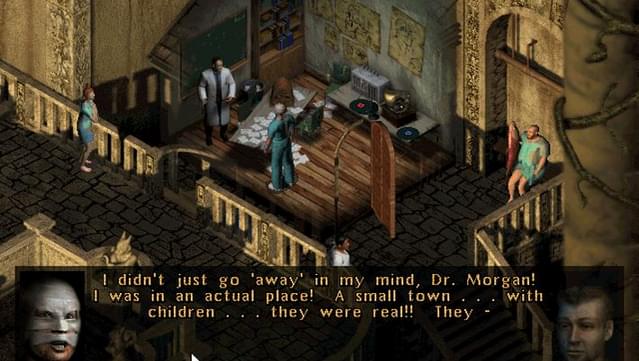
Image result for sanitarium game
The tower…. See the patient banging the wall with his head? Brrr….

Then it gets better and better. Our protagonist starts having visions. First of all there’s an angelic figure that embodies the sadness and the genuine care for our protagonist and that is she that takes him away from the exploding tower. Max, because finally our protagonist is able to remember his own name, is miraculously saved. Or rather placed on a perilous journey of finding himself. He lands in the land of heavily disfigured children withour adults taking care for them and exploited by an alien entity. There a player learns an important lesson about Max – he’s empathethic and compassionate. This is the first clue to the puzzle, because at this point a player is completely puzzled what it is all about.

Max journeys through many places having some interludes in the asylum, which makes him believe (which is supported by one o the doctor) he is insane and experiencing just delusionary visions. But world after world he unravels there’s far more to it – he goes throught the comic-book like setting where he has to save the world, the sad memory of his deceased sister (one of the most heartgripping moments in the game, and probably in the whole game industry), the domain of the dead and the Aztec village.

The game constanly builds up tension, the plot thickens, becomes denser as Max and the player move towards more and more answers, which in turn produce more and more questions. The solid world surrounding Max, that at one point makes Max to start accept the fact he is insane, becomes more and more fluid. To the point one can think Max is really shaping the world around him somehow, and the player slowly stops believing in Max’s insanity. Max feels disturbed and hurt, but logical, and in all his logic he’s a feeling and a deeply caring person. This just doesn’t add up.

Image result for sanitarium game
A medical examination and a psychiatric ward. Something doesn’t feel right though…

Tension is built also by the growing urge of doing something, yet no player nor Max know what it could be. One just feels it, as Max is being forced to solve more and more problems around him, that these problems are but a tip of an iceberg, and in fact, there’s something else to be solved, elsewhere. This uncertainty is the main stressing factor, and the deepest cause of this game being so memorable, in my oppinion.

That feeling that you have to do something, to complete something, but you cannot remember what it was is infuriating. Max directs his attention to other tasks, because idlesness is the one thing here that truly makes both protagonist and the player, insane.

And there’s a moment when Max stops being Max at all. He becomes his deceased sister, visiting a circus on an island. The island and its denizens are cut off form the land because there’s a huge Kraken in the sea surrounding the place, that kills everyone that wants to leave. It’s really hard to express how bizarre the felling of the place is, and how out of place the characters there are. In this oniric place the urge of doing something important, to understand, is just overwhelming.

The journey of the mind goes through many stages in this title. Battling amnesia and trying to understand the symbolism of the world around Max is the true challenge of this game, and the main highlight of it’s writing.

I will not spoil it for you anymore. If you want to unravel its mysteries, learn the truth about the angelic entity and the urge of doing something Max has, then pick it up, play it if you haven’t already. The game aged a little but it’s still beautiful and heart-touching. I replayed it a dozen times and will never forget it.

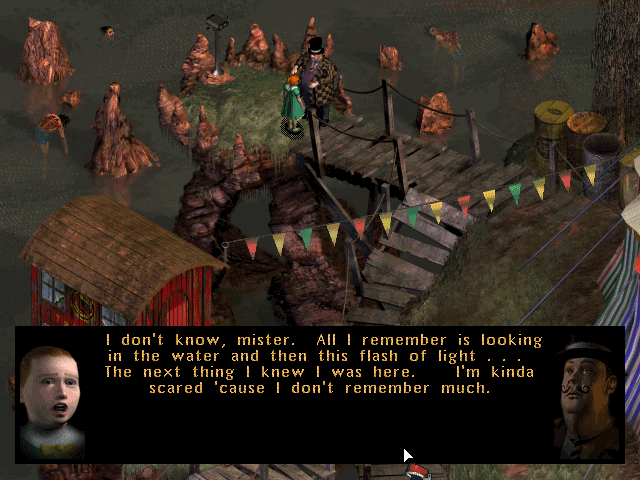
Image result for sanitarium game
The circus and a kraken victims (in the water)..

Davey Wreden’s marvels: the “Stanley Parable”


Sometimes during browsing for a game or a book, an item catches one’s immediate attention. Such was the case with “Stanley Parable”. I think it was the screenshot with a man sitting next to his computer in a darkened office room that kept me instantly interested. Oh, I know that picture all too well – sitting in a dark room, doing work rapidly because of some deadline, or because some software failure. It happens very seldom in my life these days, as I became better and better (and more careful) of what I am doing with age, but I do remember sleepless hours. There was a point in my life (20 years ago, when I was just starting my career) where I had a sleeping bag ready in the server room in case I needed to stay at work for a very long time. The feeling of insecurity, tired, automated performance of the job that should be everything but repetitive (coding is a creative process) causes some minor traumas and makes people very stressed at the slightest possibility of the situation happening again. So, by looking at the screenshot I felt also stress. I needed to investigate.

This is story about a man named Stanley, whose job is to press buttons whenever they appear on screen. Yes. Not the other way around. One day though, commands stop displaying on screen. What did Stanley feel at the moment of leaving the corporate grinder? This is a question a player must answer because at that very moment player becomes Stanley.  The quest for answer what actually is freedom, and what are its limitations begin.

Stanley is not alone though. He’s accompanied by the brilliant Narrator. Narrator tells the story of Stanley, urging him to go the predestined route of the story. Stanley (the Player) does not say anything in return but can act. The dispute against the Narrator expectations starts. Narrator tells Stanley to go through a door, but Player may actually never leave the room in a complete act of defiance not only against the Narrator but the game itself! Again, I find no words how brilliant it is. Should one decide to go against Narrator’s wishes with silly behaviour and childish (sometimes) acts of defiance it will always result in Narrator’s comment or riposte. And lead to unforeseen consequences. Free will can lead to bad results after all, it does not guarantee success nor happiness. Following one’s “destiny” though may actually fulfill that destiny, only leaving that person with a feeling of complete disappointment, emptiness and striving for more, even though Narrator summarizes it as “happily ever after” ending. The act of the ordered storytelling becomes boring, and the whole story about Stanley becomes a story about what makes the story (or life for that matter – the most personalized story of them all) interesting.

The answer for that question is not an easy one and open for an interpretation for tens of thousands of years, of course.

For me the answer is: chaos. The ultimate creator of diversity.

Chaos surrounds us, defines all matter and energy and thus life and intelligence itself. And as above so beyond: the stories, whenever they become ordered they become dull. Yet again , entropy is at work here. The more ordered the system, the less happens inside that system, be that thermodynamics or telling tales. In Stanley Parable, player starts to feel obligated to raise the entropy of the system by the childlike “trial and error” and “lets see what happens when I stick the nail into the power socket” attitudes. Narrator scolds these acts of defiance and takes this personally, and , although sometimes it is hilarious to defy him to see what he’s going to say next, the Narrator is not the nemesis here.

The world is. The universe, biology and its outcome: society, are. Systems that shaped us with deterministic fates (not very nice but accurate title of one of the records I’ve listened to in my life sums it up: mate, feed, kill, repeat. ) We, as humans, tend to think we are masters of our destinies, that we are above all that, but are we really? We are born, go to school, go to work, get married, have families, get old and die. With some deviations – this rule applies to every human on the planet.

In the globalized world of corporate cultures, this life has become unbearable for some.

Stanley Parable is a philosophical discourse, recursively focused on the player asking and giving the answers. It’s not possible to play this game without thinking about what culture and the way we are being raised, does to us. At one point Narrator, in genuine act of care…draws a yellow line on the floor to lead us to the happy ending. Isn’t that what parents do for us? Isn’t that what we rebel against as teenagers?

Brak dostępnego opisu zdjęcia.
Narrator wants to help us…


Our acts of defiance and urge to explore the world around us sometimes fails. Narrator then restarts the game. The story stops. It is death, in game’s internal language. But after continuing we start to see that it is actually not the end. The world changes which each trial a little. If we decide to enter the broom closet too many times, against Narrator’s wishes, we will find the broom closet door being barred and nailed down after the restart. This makes each trial a part of a one big story.

The game is hilarious (actually, best philosophers of the XX century, according to me , Pratchett and Adams, also chose comedy to share their point of view). Narrator has his own feelings, and with showing those, he gives a player a great feedback on undertaken actions, effectively breaking the walls between reality and the game and the nature of games.

Oh dear, life is a game…

Brak dostępnego opisu zdjęcia.
At some point Narrator forces us to play “other people’s” game….


Davey Wreden is a very talented game developer. Even if he stopped developing games – he already took his place in the hall of fame…The goal I am still trying to reach, and probably will never succeed (although I am trying pretty hard, I hope to release my first game this year). I’ll get back to Davey and his second title, equally brilliant, soon.

About trailers. Below I am posting the two trailers of the game. The second, called the Raphael Trailer, is a response to a letter sent by a player, a young teenager probably with ill misconceptions about women,  criticizing game for not having enough feels 🙂 A brilliant response, with Narrator’s voice!

Launch Trailer:


Rapahel Trailer:


Fran Bow – mental problems in videogames part 2.

There’s a number of games there on the market, touching the sensitive subject of mental disorders and social angst. Some time ago it started to be a general rule that the plot has to be treated with an extreme care if someone even tries to do something around this subject. It’s not only because someone could feel offended, but also because the reason of telling such stories is not to make the ingame observations entertaining (“adventure game voyeurism” – my personal term to depict it), but often to deal with the problem itself, doesn’t matter how futile or hard that problem seems. There’s a sense of mission in these games, a quest for wellbeing, a fight against social rejection and indifference, an uprising against inner deamons, both developer’s and player’s.

A shining example of how to approach the subject is Fran Bow, made by a couple of Swedish developers, Natalia and Izak Martinsson. They hold a special place in my mind and heart, beacause as a subscriber to their Facebook page, Twitter account and videos I am continously impressed by them and their ventures, which in turn gives me a heckton of inspiration.

Fran Bow is a girl living in an asylum. She looks pretty normal, “kawaii” one would say after the Japanese, but there’s something unsettling about her from the very start. Maybe that’s how she reminds me of the Beetlejuice and Lydia Deetz? The deeper concern for the character appeared after she received her medication. The simple mechanic of hallucinating after taking a pill to unravel the whole new world with its scary denizens makes one go deeper and deeper the rabbit hole. Fran is traumatized by a loss of her parents, that, according to an intro scene, were brutally murdered, but the more one delves into the story, the more one realizes that the real past, the truth, is obscured. It is obscured by memory and the thin barrier between what is real and what is not in Fran’s mind. It is obscured by self-centered denial, and the justification of acts performed by seeing herself in the light of blissful innocence. Finally,  there’s this strong perception  of Fran being a victim, not only in her own eyes, but also the player’s. Asylum is a bad place and the alternative world is sometimes worse. Sometimes it is the opposite though – the alternative world gives much more option, friendly interactions and the false feeling of security.

Because there’s Remor out there, an immensely scary entity who toys with her and haunts her. The first time Remor appeared onscreen, even I was startled.

Fran is a victim of many things, but what was depicted greatly by game’s creators is how Fran additionally self-victimizes herself in an inescapable loop, going deeper and deeper to the black abyss of despair and lack of self-confidence, as she wanted to punish herself additionally. But there’s part of her there that is still fighting. That part becomes strongest in the alternative world of medication pills, but even there deamons lurk that make her helpless and weak. At one point she’s made completely unable to act, being only at the mercy of the things she cannot control. This is a true art of storytelling – because the only idea how that feels like I have in my life comes from games like this one. I have never been struggling with PTSD, I know myself enough to withstand some difficult things and I understand a lot, but I have not a slightest idea how an orphan, whose parents were brutally murdered, or a gravely hurt girl (physically or mentally) for that instance, feel like. In us, consumers of adventure games (and storytelling in general), there often is this dark urge to go farther on the lane of empathy and be able to feel things a regular person wants to escape from. Some of those disguise themselves as such with a sinusoid of the presentation of contradicting emotions (cheap TV series these days…), but this story is different.

It really gets you to walk a walk in Fran’s shoes.


Image result for fran bow itward
Fran meets some very interesting characters. Even more questions arise…

And there’s that thing – as Fran delves deeper into her own story, there’s no way to tell which of the worlds is the real one. The border gets thinner and thinner, and even player has a problem of determining what is real and what is not. This schizophrenic uncertainty is followed by a weird feeling of stillness, that again, brings Beetlejuice to my mind. Is Fran even alive..?

Following Fran’s steps the player is exposed to the immense lore and a gallery of bizarre characters of the protagonist’s world. Here comes another layer of the problem – an addiction to exploration of that everchanging place with it’s own rules and rulers. Even if ego, id and superego are somewhere there to find and bind together as a solid personality, there’s so much more distractions in there, providing the false feeling of coziness and socialization with others. A mind trap.

Walk a mile in this girl’s shoes if you dare.


“Edna & Harvey” – psychological problems in videogames – part I.

Videogames are there on the market for several decades now. It’s hard to think about this medium as a new one anymore.  The current generation of 40-60 years old people grown along the rise of the 8 bit personal computers, and these people are no longer younglings videogames are attributed to. Because for several reasons, the medium is still considered “for kids”. Whenever a parent sees PEGI’s markers they think about videogames in terms of gore, sexual content, violence and swearing in general, thus creating a binary mindset in their heads: a) games for kids, b) games not for kids created by deviants. It might sound severe but that is still the truth. You would be amazed how often I still stumble upon “aren’t videogames for kids?” ignorant question.

Games are a storytelling medium – like a movie or a book. The medium itself does not define it’s contents. Of course, it’s a game so some elements of it could be predicted and that’s a good thing, otherwise we would be exposed to the constant information chaos (as it is with TV series these days – 90% being the same stuff with different configurations of the same tropes – it’s very hard to pick a good one, and by good I mean not only emotionally but also intellectually captivating; needless to say I no longer even try to watch those).

With this article I am starting a series of describing videogames absolutely not for kids, and not because of their gory contents, but because these require a degree of maturity to comprehend. Over last decade many titles were made with the sole idea of depicting problems that normally are very hard to show in the other media. Like psychological issues and mental health. The subject is so sensitive, I know but a number of books and films that can deal with it in a compelling and inoffensive manner. Oh I know a lot of creators try to show those, but only a small percentage is succesful. The numbering does not rate the products  because all are equally captivating and valuable (of course I do have my favourites but that information can be read between lines I believe…)

I learned about the German developer Daedalic Entertainment from some other game I hope to write about in the future as well. After becoming a fan of creations of these fabulous, creative and unbelievably talended people I naturally searched for more, and found one of their older productions: “Edna & Harvey: The Breakout”.

After running the game a player starts as a young woman Edna, dressed in a hospital gown in a… solitary padded cell. That was an immediately unsettling view for me. The uncomfortable feeling grew bigger with time, especially after understanding that Harvey, the plush rabbit mascot Edna carries with her… talks back to her. The beginning of this story is a small masterpiece on it’s own: the player immediately wants to leave this too bright, unpleasant place. In the beginning one knows nothing about Edna, Edna’s past and character, but two things: that she believes she is healthy but kept against her will for some nasty experiments by dr Marcel. That basically is all that is needed to convince the player to leave this place ASAP. The breakout begins. The story leads Edna to interact with other denizens of the asylum she is in, as well as dr Marcel, always perceived as an evil person, view supported by Harvey. And there goes an another unsettling part of the story that comes with gradually learning how indifferent and empty Edna feels. Something is just not right about how she treats other people’s misery and that, in fact, she’s exploiting the others. After this realization I gradually started to suspect she’s in fact sick.  The game made me believe Edna is well and being abused, especially by showing retrospections of her childhood. Then I realized how devoid of an empathy she truly is and that her self-centered demeanor could be really a mental disorder.

Image result for edna and harvey
Edna, Harvey and dr Marcel

The problem is she manages to escape the asylum with the help of other patients, including a serial killer. In the very end the player is exposed to the truth about Edna and dr Marcel – that whatever sympathy player might have for her she does need professional help and is unable to live a normal life in society. That in fact, she’s dangerous and that was the reason of her confinement and hospitalization.

What makes it brilliant is how game allows a player to get in “Edna’s shoes” and realize how a part of schizophrenia can feel like – he feeling of fear, of being abused by the people actually trying to help you and learn how difficult it is for such a person to tell the truth from lies in a subjective perception of the world.

The second part of the game, “Edna & Harvey: Harvey’s New Eyes” follows Lily, a small, extremely shy girl from a convent orphanage governed by a very harsh sister-superior. Lily is so shy she only starts saying sentences in the game! Every person she interacts with always know better than her what she want’s to say so she is never allowed to complete any sentence. Even Edna, that shows up in a very, very unexpected way, especially for the people that completed the 1st game acts towards Lily is a bizarre manner. The first disonance here is how the environment is depicted like and how it is explained. It’s a contradiction, because of colourful scenes depicting harsh living conditions. This got me in red alert stage and I focused extremely, just to see what happens when one of the characters dies and how Lily reacts to it: the little, nice gnome appears over the mutilated corpse that we never see, and paints it pink. Yes, what we, and Lily see is a pink blob whenever something nasty or gory happens. Lily supersedes all wrong things from her life, she just doesn’t want to see it. Additionally there are only two persons that actually seem to care about her, and both are rather peculiar to say the least. I don’t want to give to much spoilers, so I’ll just add that Harvey is also here and he gets a pair of new, evil, hypnotic eyes. Harvey embodies all awkwardness of the mental anguish and all the horror of insecurity of an infant in the world of matures. It’s really hard to write more about it without giving to much spoilers, because, as the 1st one, also this game allows player to realize things during gameplay, with it’s crafty storytelling and events exposure.

Image result for edna and harvey
Lily and the mother superior

When I completed the 1st one I said “Oh sh*t…” to myself. When I completed the 2nd one I yelled : “Haha! Finally!”.  Showing such grim and difficult subject with a pastel colour palette and cartoony characters seemed impossible for me, until I played this marvelous production.

Some trailers:


“Sinuhe” or “The Egyptian” – an emotional journey through perils of humanity.

“I, SINUHE, the son of Senmut and of his wife Kipa, write this. I do not write it to the glory of the gods in the land of Kem, for I am weary of gods, nor to the glory of the Pharaohs, for I am weary of their deeds. I write neither from fear nor from any hope of the future but for myself alone. During my life I have seen, known, and lost too much to be the prey of vain dread; and, as for the hope of immortality, I am as weary of that as I am of gods and kings. For my own sake only I write this; and herein I differ from all other writers, past and to come.”

As an avid book reader I have always a stash of books being read ( I tend to read several simultaneously) or waiting to be started, so it’s a seldom thing for me to discover something completely new and unheard of before. It’s seldom, but sometimes it does happen. I would probably never discover Mika Waltari’s books if not for my wife telling me at one point to read it. I was reluctant at first – I had my unending book stash waiting to be read after all… She found a 20+ years old edition of “Sinuhe” and gave it to me.

I have to say one thing – I am a cynic. I don’t believe in gods, fate and afterlife. I generally perceive humankind as flawed, morality as a side effect of evolution and cause-and-effect chain as random and nondeterministic. This might make it easier to understand why I love this book so much. I am also an archeology and history geek so just shouting “ancient Egypt” makes me instantaneously interested.

“Sinuhe” is a life story told by Sinuhe the Doctor, a bitter man who has been-there-done-that to loose it all, including his freedom. It’s a chronological life journey from his youngest years till senility, and his life is full of personal drama intertwined with historical and political events of the age he lives through. And an interesting age it is – Sinuhe was born just before Akhenaten‘s religious reforms and the social and religious turmoil afterwards.

Image result for nefernefernefer
Edwing Long’s “Love’s Labour Lost” – Nefernefernefer…

J.R.R Tolkien once said that the most interesting stories are the stories of falling from grace, the fall of humankind or a fall of an individual. I agree and it is so in this case. Sinuhe makes mistakes and learns life the hard way. He has a privileged start and knows no pain or hunger, but his teenage rebellion and lust towards Nefernefernefer (probably one of the most scary femmes fatales in literature…) set’s him on an unforgetable and painful journey of re-evaluation of human condition. Love and innocence yield the horrible outcome as Sinuhe loses everything really important in life to learn it after the loss. Make no mistake, he is not an idiot! On the contrary, which he proves by becoming a scholar and a pharao’s doctor. His mistakes come from another source – human inability to know the outcome of our actions and frailty of life. The protagonist reaches the bottom of the human existence (the description of his time in the House of the Dead is one of those unforgettable pieces of literature in my life) to lift himself up again with the tremendous force and will. At first vengeance and regret are the motors of his actions (like in “Monte Christo”). He has his revenge but then he discovers that there’s so much more to life than that. Forced to travel with a slave he broadens his horizons by visiting the countries of the Akhenaten’s era – Babylonia, Hittites and Minoans to learn their ways and the ultimate truth – no matter where people live and what are their beliefs – they are still humans. He learns perfect love and friendship just to lose them, he receives power to learn that power comes with a price, and all that humans search for in their life can be very close, yet sometimes one has to travel the world to learn how to find it. The wise Sinuhe learned everything too late and so he writes his papyrus so a potential reader could learn from his life. This is the altruistic act of a human (even though he denies it himself) who wants to spare another human and save him from the pain and loss.

Saying Mika Waltari’s “Sinuhe” is interesting would be like saying that the Sun is somewhat warm. The feels, the events, characters are brilliant and the lesson one receives from our good Doctor is invaluable.

“For I, Sinuhe, am a human being. I have lived in everyone who existed before me and shall live in all who come after me. I shall live in human tears and laughter, in human sorrow and fear, in human goodness and wickedness, in justice and injustice, in weakness and strength. As a human being I shall live eternally in mankind. I desire no offerings at my tomb and no immortality for my name. This was written by Sinuhe, the Egyptian, who lived alone all the days of his life.”