Tag Archives: gamedev

“The Last Door” – a love letter to eldritch horror.

I mentioned before I am a huge H.P Lovecraft’s and E.A Poe’s fan. My own adventure game, being developed at the moment, is, in fact, heavily influenced by those authors, with several references to the mythos and the overal mood. The “mood factor” is very important here, as capturing it is probably the most important thing of the storytelling by these two giants. Lovecraft, for example, managed to build tension with the exquisite vocalbulary he was using – words like “eldritch” or “gibbous” added to the overall reception of the ghastly scenes. The same was with E.A. Poe and his intense depictions of the environments, as seen in the mansions shown in the “Fall of House of Usher” and “Mask of the Red Death” .

I have no idea how I found “The Last Door”. I have several colleagues, also interested in the eldritch and storytelling, so I definitely was informed by them about the product, but I managed to dig to it several months before that. The game was first available as a browser game, with new episodes unlocked for backers (I was 567 backer I think, to show you how small the interest was…), and available for free later on. It was very easy to overlook this game. I mean – a browser game, with pixel art. I am very fond of the pixel art, but I hate browser and mobile gaming, because it tends to eliminate the storytelling element from games, and, well, I don’t need to tell you how important it is for me to have it in my games.
Znalezione obrazy dla zapytania the last door
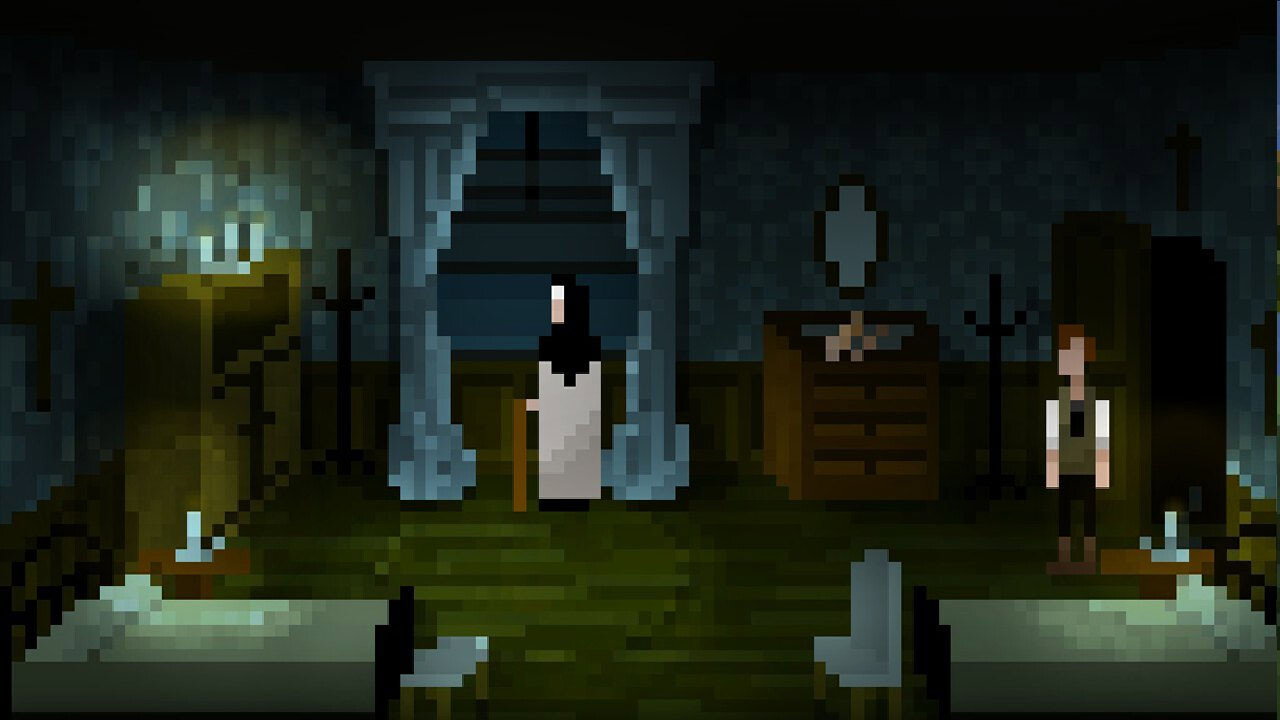
Devitt exploring the convent.

After the amazing intro, depicting some ravens and crows, being an obvious reference to the Poe’s “Raven” and the fantastic music I was immediately into it. Well, the “crow factor” is also something important for me. Wait till you see my game…

The story, made of two seasons, follows two protagonists. Jeremiah Devitt in Season 1 and Dr John Wakefield, Devitt’s physician in Season 2. Devitt’s task is a search for his colleague, Anthony Beechworth and for that, he travels first to the Beechworth mansion, which leads him to some other places in Scotland, featuring the hospital, the school. Mysterious and frightening events lead to Devitt’s dissapearance, and make Dr Wakefield  deeply concerned. He starts following Devitt’s footsteps in Season 2 to uncover even more of the horrible, otherworldly truth behind the curtain.
Znalezione obrazy dla zapytania the last door wright
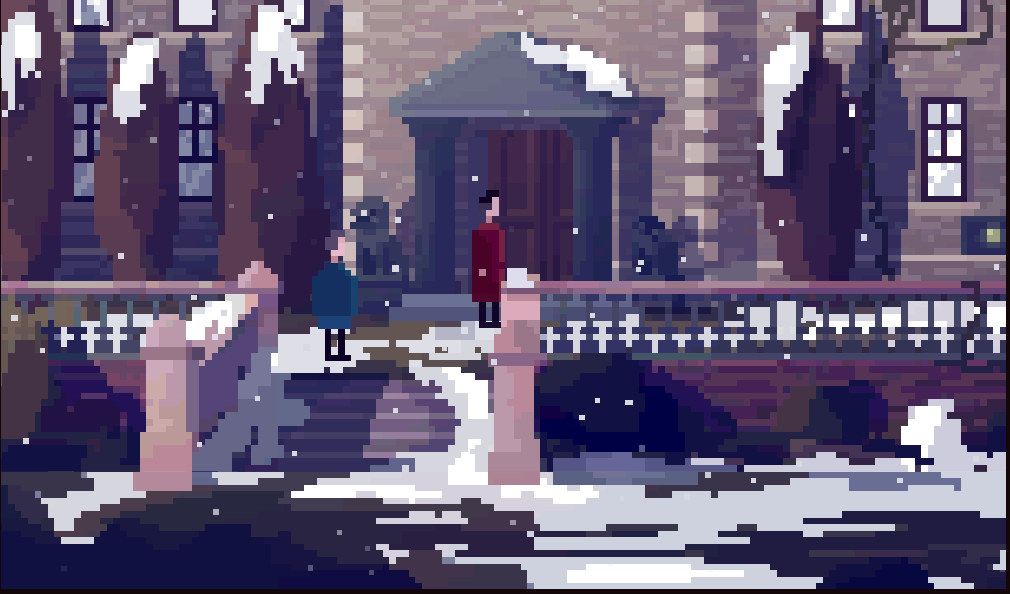
Wright entering the Wright Manor.

I will not spoil it for you, because if you name yourself a Lovecraft and Poe fan, either you already know it (so I don’t need to) , or you just HAVE to play it. I mean it. The wooden, squeeking floors. The dim lantern light in the darkness, the horrible visages and frightening events. It’s masterfully embroidered into the storyline canvas in “Teh Last Door”.

One could ask – frightening visages? In the pixart game? Yes, I say! The obscurity of the pixelart make the scenes even more onirical, even more eldritch and gibbous. The shapes are unsharp and twisted. The faces are expressionless, leaving all the work to our imagination. And it achieves the state of the brilliant synergy with its storytelling, to the point in which the storyline of “The Last Door” consists both of the Spanish developers ideas and player’s imagination, filling all the gaps. The effect is just brilliant.

It’s difficult for me to express how Carlos’ Viola music contributed to the game. I am completely certain the game would be half of what it is today when it comes to its mood, if not for the music he composed. Below I post two YT pieces, first an intro, and the second is the whole OST. Just listen to it. Brilliant. You’ll never forget the insane concerto music from the first chapter after you hear it.

One more shout of respect for the developers. At one point they were creating this game without having any money to continue the project, to the point when several devs left it with broken hearts to earn some money, elsewhere, because otherwise they’d become peniless. Yet they managed to pull it through, this marvelous piece of art this game is. Chapeau bas, gentlemen! Chapeau bas!

As one of the reviews say: it’s a “love letter to Lovecraft”. It’s far more than that.


Davey Wreden’s marvels: “The Beginners’ Guide”

I have written about the most known Davey Wreden’s game before. “Stanley Parable” made Wreden one of those game devs I look up to in my gamedev career. People like him have great stories to tell, create a lot of artistic content in form of both plotline constructs and technical assets and they often do it alone or only with a small team of developers. That solitude makes the creation process less of a software development undertaking and more of an artistic project, not very unlike to the solitude of a painter.

In fact that’s the way games were developed 40 years ago. A publisher, having rights to a certain IP, would hire a developer to code the game for him. In the 8 bit era games weren’t very complicated visually, but it still was a difficult process requiring a lot of ingenuity. The very similar process is within the indie gamedev world today, except it’s devs themselves who create and publish games.

They just want to tell stories and their “amazing worlds”. Right?

The game development proces… In popular imagination gamedev is kinda like a weird mix between a rockstar and a hipster. There’s a lot of truth in that statement, because the medium is very popular and the demand is huge. The hipster part comes from the notion that a dev must be a weird type of nerd. What that depiction completely misses is what is the price of becoming a gamedev.  We all know the trope of a whisky-drinking writer, bathing in cigarette fumes trying to forge a story or overcome a writer’s block. It looks difficult, it looks frustrating and painful, right?

Image result for drinking writer
A writer’s anguish.

“You know nothing of creative pain, kid.” our rockstar-hipster would say if he was to be like the ones from the popculture. Well I certainly won’t because I learned myself all those processes have their pains.

The truth is the gamedev process is painful, difficult, and has a powerful negative feedback. During the creative process, author’s self-validation is immediate and not all skills required to create a game can be acquired by a single person. As a storyteller one might lack the knowledge of tools needed to make a game, or a programming language. Gamedev, similarily to architecture, requires a marriage between the world of artistry and science, the world of mathemathics and creativity. This alone raises the bar, exponentially.

Lets assume one was able to acquire a tool knowledge and has a story to tell.  One starts telling a story by creating a game. Very soon the author will learn about his own limitations. He’ll start fighting those limitations by trying to study harder or simply getting around them. This alone forces him to make compromises, sometimes forces him to abandon whole sections of the story he wanted to tell, because he’s unable to convey it in the form of the game. Then he finishes his product, sometimes the understanding follows that he’s only able to do games like the one he just did. There will never be anything new, the process of replicating the same non-creative formula is all that is left,  not unlike that of a painter’s being able to paint only the lakeside sceneries on sunset with the same colourset to sell those on the local market.

Behold – it’s the gamedev impotence! The soul-eating demon that preys upon my kind.

 “The Beginner’s Guide” is a story narrated by Davey Wreden himself. A player follows Wreden’s story about an acquaintance of his, nicknamed “Coda”, a gamedev, who, since 2008, created a lot of small, interesting games. Narrator wants us to play those games and to try to unravel the psyche of Coda. What makes him happy? What makes him sad? Why does he make those games? Does he even like making games at all? Step by step, the great mystery unravels producing more and more questions, right until the meaningful end. By playing Coda’s games we start seeing patterns, we start recognizing reused elements. Did he reuse those assets on purpose, as an artistic tool, or was he just unable to create anything new? There’s a lot of questions there…

I will not give any further clues to the story. I just need to tell you this – being a gamedev myself, I understand.  “The Beginner’s Guide” for me, just a 2 hrs long experience, was brilliant and difficult to bear at times, it was like a look in the mirror. I think this product is a must play for everyone that ever wanted to be a modder or a gamedev, and it seems Davey Wreden thinks the same, since he named his game “The Beginner’s Guide”…

Beginner, beware! I know you love telling stories and love videogames. I know you are creative. But this discipline is a soul-twisting, blood-drenching experience. It will squeeze you like a sponge, it will make you frustrated beyond belief. It will consume all your free thoughts, to the point you will not be able to go asleep because of the stress. It will unbalance you. It will shatter your self-confidence and turn your hype into dust.

But, if you are lucky, persistent and if you work and learn hard, it will allow you to make something worthwhile and rebuild your self-perception as a better human – the person that overcame self-limitations.

Wreden’s “The Beginner’s Guide” is about that, and more. It’s a must-play for everyone that want’s to be a gamedev. I mean it.

Take a look at the trailer, also narrated by Wreden: