It was some time since the last post but I needed some vacation, both from the game development and blogging 🙂 Sometimes one just needs a break, right?
I wanted to tell you about a game I initially had some problems with. At first, I didn’t quite like the character model, graphical setting and animations to the point everything seemed artificial and, I don’t know, plastic? But then I convinced myself to go forward and every moment of it was worth my time.
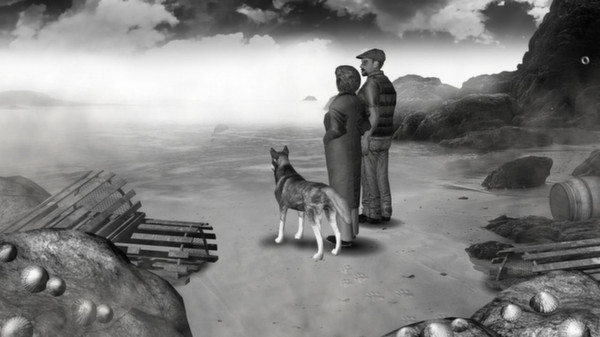
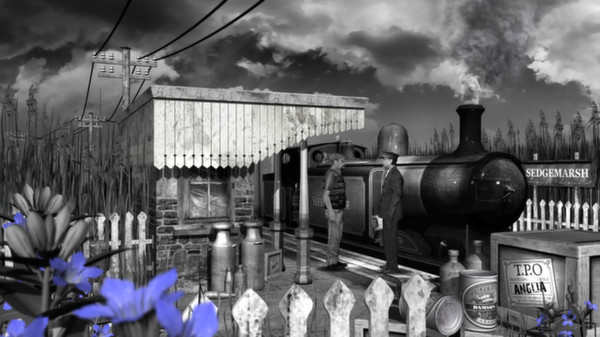
I am talking about “The Lost Crown: The Ghost hunting adventure” by Jonathan Boakes. The game takes us to the English town of Saxton, where as a ghost-hunter Nigel Danvers we try to find a Lost Crown of Anglia. The thing is , Nigel is a paranormal investigator and as such is a somewhat a weird character. Quite soon the player discovers that all other characters are also weird…I know what you are thinking – “Twin Peaks” right? Not really, because Saxton has a distinctive Anglo-Saxon charm. It’s not only bizarre, it’s really unsettling. Regular folks seem to be strangely absent, following their own strange agendas and all of this seems like a really onirical (dream-like) setting. I realized animation stiffness adds to the picture, as well as the fact almost everything in game is black&white, except some really interesting objects and animals like e.g. dragonflies in the marsh, which seem strangely “we do not belong here” because of that.
The fog… It’s unnatural.
The very first time Nigel actually sets up his ghost hunting equipment and start listening to the wavelengths kept me really on edge. Oh, I know – we all hate jumpscares. They are cheap and silly. “The Lost Crown” doesn’t do that often, it does that precisely when it needs to, and I am really thankful for that! Nigel’s ghost hunt, explorations and conversations with denizens lead him to some really unsettling discoveries, during which two worlds start to intertwine and collide. I will not spoil it for you, but after some time the player start to notice a fact that not everything is as it seems in Saxton.
A careful usage of colour produces a marvelous effect!
I still remember the plot line, the puzzles, the events from this game, even though it was several years since I completed it (5?). I could really appreciate it back then and now…Oh, how I now know how difficult the process of being a sole gamedev is! When I see the marvelous work Jonathan Boakes placed in his games (Because “The Lost Crown” has also a special called “The Midnight Horror”, and the prequel called “Blackenrock” is on the way) I cannot do anything else but say “a very great job, Sir!”
The first game made by Wadjet Eye I ever played was “Resonance”. I was drawn to it after seeing several screenshots published on some gaming portal and, as a person very much into pixel art and 90’s style of graphics, I purchased it immediately. What was just a “but a playtest” approach towards one game, quickly became a years long adoration of the Wadjey Eye company and their products.
The game, set up in the near future, features 4 protagonists. First, there’s Ed, an assistant to the prof. Javier Morales, a scientist working on the resonance effects of particles. Anna – prof Morales’ niece, is a hospital nurse having some psychological issues (and in fact she probably should be in one of the “psychological problems in videogames” articles of this blog) and an unbeaten childhood trauma. Detective Bennet is conducting a police investigation on the track of mysterious Antevorta organization. And there’s Ray, a political blogger and a hacker. All four are brought together by a mysterious explosion in the prof Morales’ lab and start acting together to uncover the secrets of the mysterious experiment.
An accident in the lab. An accident? What if…
I normally tend to talk a lot about the plotline of the particular game, but I will leave you deliberately in the dark with this one. It is a detective story, that is most pleasant while uncovering things and matching the pieces of the puzzle together, piece by piece. The game has several shocking plot turns and several dangerous timed sequences – enough to keep the player on edge sometimes ( and far less, than in, say, Telltale games – to my delight). But what makes the game and the plotline really interesting is how actually these 4 people interact with each other and how their personal storylines intertwine. Giving control over all four to the player is a bold move (although not a new one…), and forces player to experiment with different setups and combinations of characters to achieve some goals. Anna’s feminine charms and medical knowledge combined with a press/hacker attitude of Ray give different results than grumpy Bennet combined with awkward Ed, while facing the same problem and situation. The game tells its story mainly through that trial and error, and soon a player starts to feel those characters, starts to be invested in their lives and problems.
Protagonists meet on the stadium to discuss their next steps.
Well, I don’t need to tell you how important it is , especially for those, who like character-centric stories. E.g. “Game of Thrones” TV series was finished recently, and with the books and the show being really Westeros-oriented than character-oriented (as every fantasy with a pretense to be a mythology or a history book of its setting), yet everybody is talking about characters only…
But getting back to the matter – I often tell, times after times, how important it is to leave some things “blank”, so the reader or a gamer could feel it in by himself. The more product relies on imagination the more “blanks” it really needs. And I will be telling more about the subject when I am ready to talk about Tolkien’s “Silmarillion” (not ready yet, for various reasons…even though I read the book dozens of times for 30 years now…). In “Resonance”, player has got plenty opportunities to experiment and walk a mile in protagonists shoes. The player is forced to play a role, yet, the amount of freedom of experimentation, trying to combine various items together or operate various implements and discussing things with people, is huge and so is the amount of player generated story.
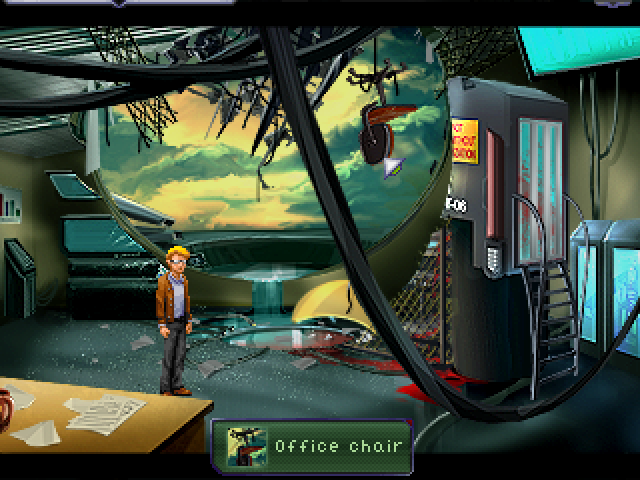
A futuristic touch&feel.
To those of you who played adventure games before, you know exactly what I mean, but for all the rest: imagine the “Sherlock Holmes” story, in which the chronology of Sherlock’s actions is not determined by a shortest possible way to get to the conclusion, while still building the mystery and the climate through narrration, but, rather, by an unknowing narrator, who experiments with the story, not knowing how it will end. This is what happens in games like this one, and this one is particularly good when it comes to its combinatorics.
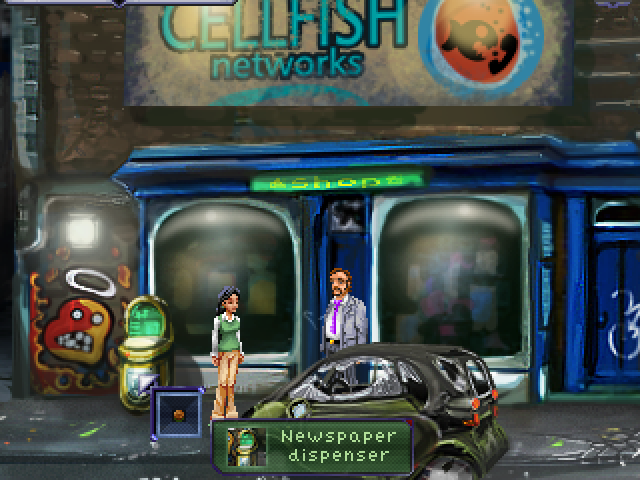
I am not a big fan of conspiracy theories or conspiracy games for that matter, so the subject of this game did not captivate me as the other games did. I also prefer rather traditional detective stories instead of dystopian future theme (there’s just too many dystopian themes in popculture these days…). But, like I said before, this is the game that got me onto the Wadjet train and the game one could learn from a thing or two.
Another 90s Amiga adventure game hit was “Dreamweb”, for multitude of reasons, really. First of all, it strayed from the regular point and click schema and introduced a topdown view, as in RPG games of the era. Secondly, it produced a very, very dark mood. Thirdly, its setting was cyberpunk-ish, yet very mature. The mixture of these these three elements brought the game to attention of the press and audience, but what made it rememberable, was, again, its storyline.
The protagonist of the game, Ryan, is a bartender in a futuristic, dystopian state (implied to be England). He has a girlfriend and lives a mediocre life, being a medicre man. He clearly shows the sickly, maniacal indifference and other symptoms of depression. But it’s not implied anywhere that Ryan struggles with any mental problem: the game allows a player to feel and evaluate Ryan’s mental state only by showing his attitude to his surroundings, which makes it sometimes quite uncomfortable to be in “Ryan’s skin”, from the start. Aditionally, Ryan is having dreams, or nightmares rather. Ryan dreams of the entity called DreamWeb, and its Keepers, the hooded personae who communicate through dreams.
Ryan learns in his oniric state that DreamWeb is a world with a real power. It resembles the Changeling:the Dreaming (a part of my beloved World of Darkness) world constructs like the Dreaming and Arcadia, very much. Ryan also learns that DreamWeb maintains the stability of the real world and that stability is in peril.
DreamWeb featured a topdown view.
The Keepers bestow the world saving mission upon Ryan. He has to find and kill 7 “parasites” that endanger DreamWeb and the world…
This moment got me hooked into the game immediately, as I remember. An average person with a mission to kill people bestowed by a dream… That’s just… nuts! Immediate questions were: is the DreamWeb real, is it just Ryan being sick and depression started taking its toll. It doesn’t get any better when Ryan gets fired by his boss in the bar, and starts to be commited to the horrendous task.
He spots the first “parasite” on TV in the bar…
From that moment onward I was ensnared by the need to learn what is the truth behind all this. Is Ryan a maniacal murderer going on a killing spree, or is the DreamWeb real? I needed answers so I followed the tasks bestowed upon Ryan by the Keepers. And so Ryan started killing using me as a tool – to see the ending I had to pay the price of following the ordered tasks…
One of the most disturbing scenes of the game was slaying a rockstar (a parasite…) while he was having sex on the bed in his suite. Pixel blood and gore splattered and panicking woman had a shocking impact on the gamer of the era and was seen as very controversial, causing some difficulties to authors of the game.
The more player delves into the game the more the climate becomes darker. The last parasite is no longer human but becomes a disgusting huge monstrosity, crawling through the Underground tunnels, which also seem to belong to some monstrous world. It’s not unlike any other lovecraftian horror, and again forces a player to question Ryan’s mental state.
Everyday life is about to be changed forever…
The very last scene provides more questions than answer but is strangely fullfilling. I will spoil the ending now, so stop reading now if you want to play this retro marvel. Spoiler goes below:
3
2
1
Spoiler: Ryan is teleported to DreamWeb and thanked heartily by the Keepers but now the price needs to be paid: when Ryan gets back to the real world he is shot by the police after emerging from the subway. Yes, the quest ends as it should, really, in a quite consistent way. No matter the reasons, he was killing people and had to be put down or arrested, no doubt about that. But was DreamWeb a true entity or was it a delusion? Both answers are really plausible here, but at this point the most important thing from the player’s perspective is no longer the answer, but the sadness for the lives lost.
Clunky as it is by today’s standards, it is still a game worth playing today.
Back in high school, I had a classmate that I really didn’t like. He wasn’t really bright and wasn’t likeable. Coming from wealthy family from a regional capital town he looked down on me, a poor farmboy. We had not much subject to talk about without some ironic or sarcastic statements.But we did not want to fight, as different as we were, so the only common ground we could ever have was: computers. He was wealthy enough to have a new at the time MMX processor and top notch equipment so he boasted a lot. I listened to it, very interested in tech and, of course, in expensive and demanding games he got for his box.
One of those games, coming on 3 CD-ROMs, and therefore unaffordable by me (it was an age before CD-RWs so I couldn’t just pirate it…) was “Zork : Nemesis”. I waited for Christmas of 1996 when my colleague borrowed me the game.
You know, when you’re a kid or a teenager, getting games for Christmas is a special thing, probably remembered well for the rest of life. Especially when you receive a game like this one.
I did not play any other Zork games before this one, so I didn’t have any expectations. Later I learned this one was completely different from other Zork games, often absurd and with lighthearted storytelling. Oh no. This one is dark, very dark, with a tone of sadness throughout the whole story.
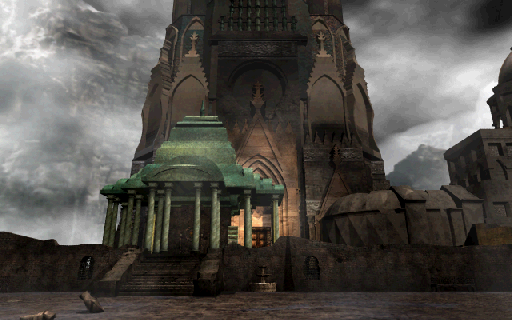
The very beginning is intriguing…
A player arrives at a monumental cathedral, the Temple of Agrippa, a deserted and ancient looking place, the seat of powerful Alchemists. My first feeling was being completely lost – I did not know who I was, what is my goal or what I am supposed to do now. Sure, there was a booklet with the game telling some important things inside, but still the feeling persisted. With everything so alien and absolutely gorgeous surroundings and unforgetabble music I was stunned at first. Then I started exploring.
The game is mostly about exploration and solving logical puzzles (sometimes very, very hard puzzles..), hints to which are scattered around. The very often case is that some part of the environment is blocked or locked until you solve some puzzle, and this forces a player to actually learn about the surroundings, the story and the characters.
Oh, the characters. Not long after the start of the game one finds some sarcophagi with preserved bodies of Alchemists and can communicate with their spirits (which are being played by real actors). They ask for setting them free and warn player about their Nemesis, a grim cloud of anger that manifests right after. A goal is set – reviving the Alchemists.
Bodies of Alchemists are waiting for something, preserved.
The whole journey is a journey through many bizarre and magical worlds (Alchemists’ domains) of wonder. It’s a journey of gaining knowledge of Alchemists, their goals and Nemesis itself. There’s one character that especially captures attention: Alexandra Wolfe, the violinist girl. Traces of her can be found from the very beginning of the story, and the player soon discovers that she’s a focal point of the conflict between Alchemists and the Nemesis, the frail, beautiful, sad girl.
Following the path set up by Alchemists allows the player to visit all the places belonging to powerful sages, each attuned to a separate element: fire, warth, water and wind. As the game introduces the full visual and psychological immersion to the player (you are the protagonist!), it’s in fact the player who visits those locations, making this game a sightseeing experience. Wind elemental Asylum in the cold wastes of the north, fiery Monastery with it’s rivers of lava, the desert fortress of Earth, and, my favourite, the watered musical Conservatory, each with it’s own theme and a plotline allowing the player to understand a quarter of the story.
Oh, I had a huge pleasure solving this puzzle for the first time back in 1996…
What hit me most and still makes a great impression on me is how this game was able to convey the feeling of sadness and the passing of time. “Nothing lasts forever” the game says, from the very beginning. The bittersweet, amazing and yet scary themes make the adventure perilous at times, with an encompassing secretiveness well suited for Alchemists. Everything in the story is encoded – in text, symbols, architecture, sculptures, paintings and music, there’s no straight answer anywhere. Unraveling those mysteries is what makes the game so remarkable, and even at the end one leaves with an impression that was but a first layer of secrets waiting to be discovered there, in the Temple of Agrippa.
This is one of those stories that, by presenting it plot, leaves an impression of the huge lore and world constructed behind it (like Tolkien’s, Middle-Earth, Herbert’s Dune Universe etc…). One just wants to learn more. A pity, the next Zork games did not follow the dark and secretive pattern and went on a comical path instead.
Wanderer, enter the Alchemists’ abode and learn their knowledge. I promise you won’t forget it.
The beginning of the XXth century poses a certain problem for content receivers of XXI century – readers and gamers. With human’s limited capability of grasping the intricacies of the past ages, we often tend to identify the desired period with historical or cultural events of the said era. For example, 1863 is a period of civil war in the U.S.A,January Uprising in Poland, so it’s easy to understand the events and climate surrounding Jules Verne’s “Twenty Thousand Leagues Under the Sea” (a fun fact: the initial version of captain Nemo was : he was a Polish freedom fighter that wanted to kill Russians- that’s why the January Uprising is so important here, but the publisher told Verne that it would pose certain problems with publishing of the book, so he changed Nemo to be a son of Indian Raja), or some works of Ralph Wardo Emerson or Mark Twain. It’s easier to envision the era for the readers also, because we carry with us a lot of metadata: ranging from TV depictions of the American Civil War to paintings. It’s kinda easy for us to envision an English victorian era with all that British Empire glamour, and it’s kind of easy for us to see the slender girl with a pearl chord necklace, bobcut hairstyle dancing charleston of the 1921.
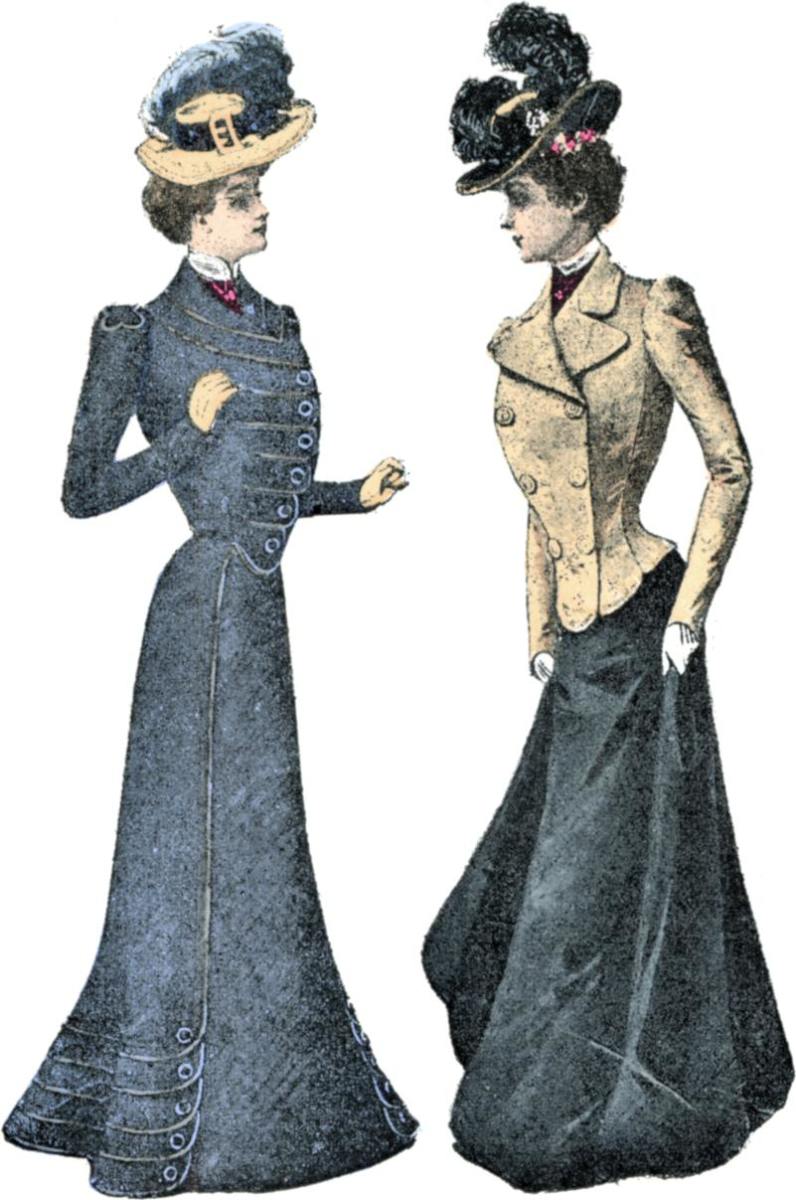
But between 1899 and 1921 there was a completely different era there, with different fashion, culture and mindset, completely overturned by a Great World War of 1914-1918. This is the era where culture, fashion, literature also were on the battleground – where Old World of feudalism and aristocracy was clashing the democratic (and fascist…) new world. In other worlds there’s a gap there that could explain how this:
became this in no more than 20 years:
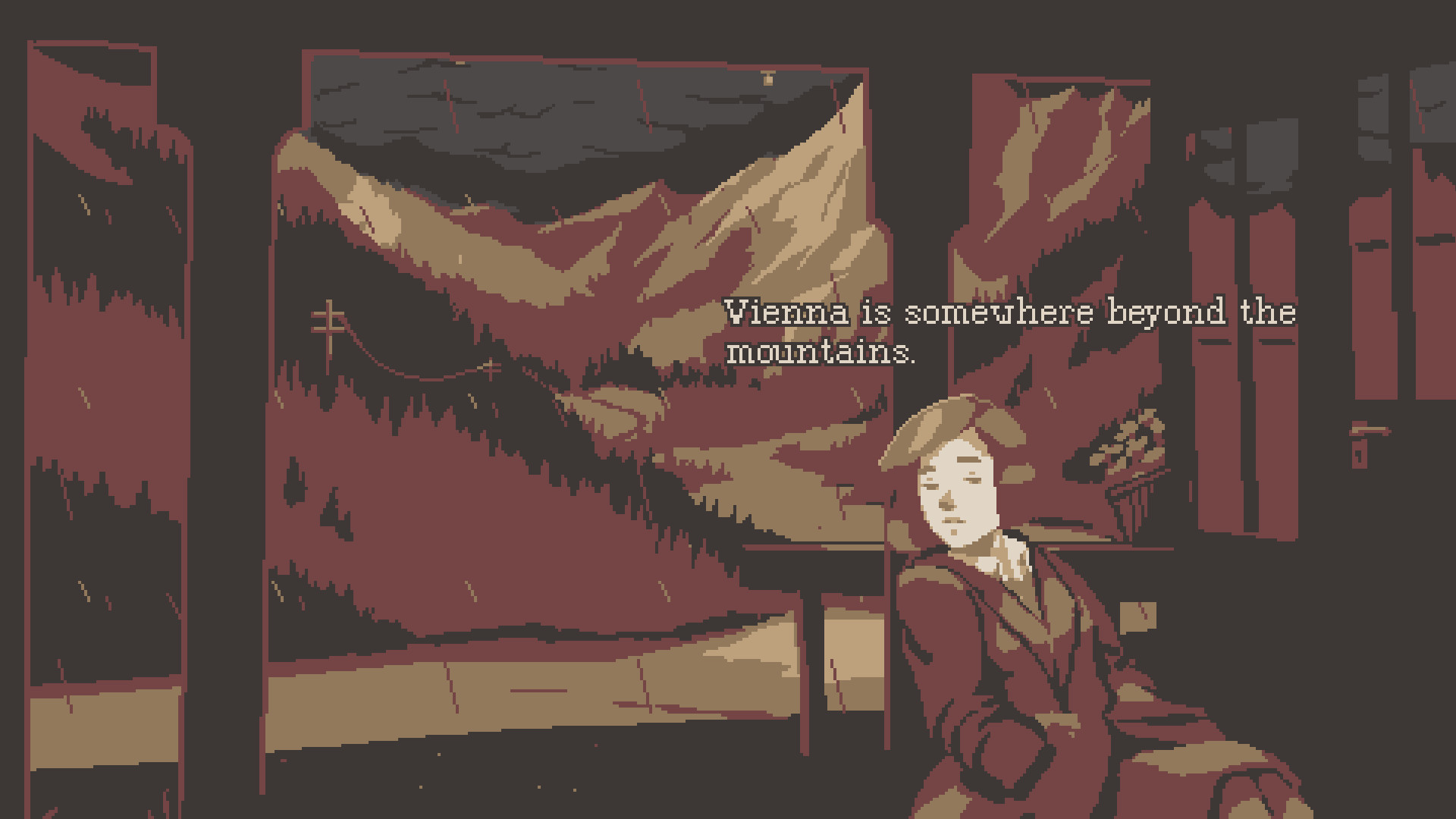
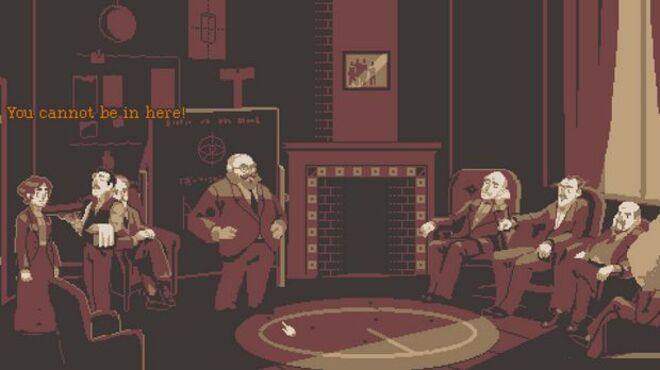
“The Lion’s Song” helped me greatly in this process. The plot evolves around three artists of the era, on the brink of their world coming to an end (WWI), people that make the difference but still delving in both: old and new worlds. These are: a violinist, struggling with a creative block and having a scandalous affair (as judged by the era’s morals…), the painter, who wants to discover the missing psychological element of his works, and a female mathematician, with brilliant mind, but in chauvinistic male world that doesn’t want to believe woman can be better than man. All these fates are placed in the capital city of Vienna – the playground of the Austrian nobility and one of the cultural capitals of Europe.
Have you seen the “Grand Budapest Hotel” movie with Ralph Fiennes? It’s based on the works of Stefan Zweig, the Austrian author depicting the old imperial Austria in his works, the nostalgia of the old, no longer existing world, that for some reasons has great appeal to us in the XXIst century – with it’s morals, demeanor, refined tastes, subtlety. You can expect the same from “The Lion’s Song”
The musician.
The game is an overture – all three fates intertwine, though not directly, and choices do matter – the results of player’s actions lead to the grand conclusion in the 4th act. This is one of the three areas this game truly shines in: composition that shows how culture impact the lives of a common man, how it allows us to survive in the perils of human history – the said historical events mentioned by me above. The second area of brilliance is emotions – the game is able to present a very complicated themes and topics in a grasping and understandable manner, e.g. like the feeling of solitude of the artists overhelmed ith nostalgy.
The painter (and Siegmund Freud).
While we’re at it- nostalgia is probably one of the hardest things to depict in literature and storytelling, that’s why Proust’s works are so excellent – he’s a master of the art.
Third area of excellence is the audiovisual layer. Sepia colour palette used gives the impression of an old photograph, yet is sharp and allows to feel the environment. Music, being the part of the story after all, is brilliant and enhances experiences of dialogues and monologues magnificently.
The mathemathician (and a band of chauvinist professors..).
All things combined, the game is a marvelous trip one hundred years to the past, to the era of Marcel Proust and others, unknown titans of the world of tomorrow, the shapers of culture of today. I cannot recommend it enough.
Playing this game gave me the feeling of a caged pigeon suddenly released into the air with a rapid opening of the cage. How about that?
In a constant search for thrilling and captivating storytelling, I tend to often pick up horror novels or games. With a lot of mediocre and a lot more of bad content out there, one has to be very, very careful while picking something to read or play. So I watched the trailer of “Gone Home”, and understood it was another horror game, placed in the abandoned house, with jumpscares and spectres. I am not a fan of cheap jumpscares, I prefer the psychological horror instead, but the thing looked interesting enough.
I am not sure what made the creators to produce a trailer advertising this game as a horror game. Perhaps they wanted to attract attention (succesfully as you can see…)? Or maybe they wanted to play a prank on an unknowing player such as myself? It really doesn’t matter, because in the end I was able to play that interesting and important story.
The year is 1995, Oregon. Katie, a student, comes back from overseas to her family home in a fictional Boon county. To her amazement she finds nobody there, so she starts searching the house for the clues where her family might be. During the search she finds an objects from the mid 90s era (casettes, Street Fighter videogame etc) as well as other objects reminding her of her family: her father Terry, a failed writer who makes a living by being an electronics handyman, her mother Janice, who pursues her director of wildlife consservation career, and her sister Samantha.
Samantha. Game focuses on her from the very beginning, when Katie finds a note from Samantha on the door, asking not to investigate what happened.
For me it sounded as an invitation to actually investigate…
During exploration Katie finds more and more messages from Samantha, or items shedding light on Samantha’s life. Freshly after moving in to this new house, Sam was estranged. She couldn’t find a common ground with other teenagers at school, she felt lonely and misunderstood. Eventually she met Yolanda, a military school cadet. They started sharing interests like grunge music and Street Fighter game, and, eventually, became romantically involved. When the whole thing was found out by sam’s and Katie’s parents, they started living in denial her daughter was lebian and started imposing some humiliating regulations, like the one Sam’s bedroom has to be opened at all times when Yolanda was visiting.
Again, I don’t want to spoil the story. I just want to highlight that this game is one of the most important games there to depict the LGBT problems of the 90’s, and of the current times, still. I’m a straight guy, so I have to learn about that anguish, feeling of injustice and pain people like Samantha still feel in the world of self righteous idiots who use religion (the worst tool there is) and morality (non-validated morality; morality requires constant validation – Socrates…) to justify their worst behaviour. The evil that actually makes people like Samantha suffer.
Because evil it is. Socrates argued that no one wants to be evil, yet people still are becoming as such. What are the mechanics of evil then? A higher power, like the devil? Highly unlikely – for me the devil doesn’t exist, as there’s no god or gods. One cannot prove god, not with a scientific method, and without scientific method a proof is as valid as me saying that elven warriors rode dinosaurs in the medieval Kraków – a complete and utter bollocks. Lets focus on certainties instead: what is certain is human ignorance and carelesness. Let me emphasize:
Evil is born out of ignorance.
That’s why it is so important to learn .
That’s why it is so important to learn about other people, other cultures and viewpoints. That is why multicultiralism is better than xenophoby and monoculturalism,although not without its own perils (yet still better!). Without knowledge there can be no idea of wrongdoing. Take the SSmen and Wehrmacht military – the German Nazi butchers of the II WW. Did they think themselves evil? No, not until they learned the cause and effect of their actions, and some of them, sincerely understood they were evil, while the rest remained in the darkness. What was the difference? The knowledge about the whole picture.
Games like “Gone Home” are doing the blessed job of letting us, gay, trans or straight, know of the suffering and anguish of another person. The pain that could lead to broken lives, broken promises and depression. The storytelling that makes us feel the problem and by engaging the emotional intelligence, to grasp it better. Shortly – to employ our empathy, and thus, to become a better human.
Building tension in a story is a very hard task. In writing it’s difficult because it’s really hard to compile text the way the tension contained within unfolds in the reader’s mind as expected. In videogames it’s sometimes twice that hard: the first thing is the writing – dialogues and scene descriptions, the second being other media, like sound and graphics. It is to easy to make what was supposed to be a creepy story a ridiculous one. Especially when that story contains supernatural or psychological elements.
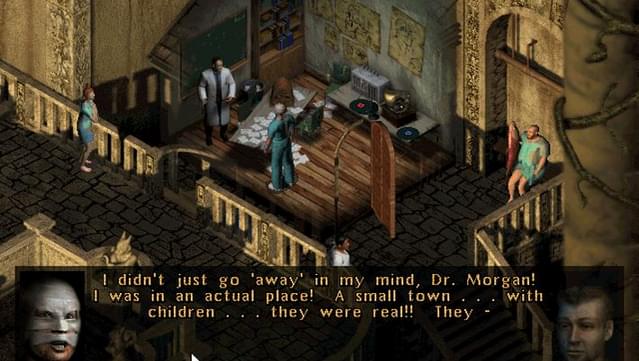
“Sanitarium” is a very special game. Right from the very beginning it builds up the said tension. First of all, after seeing the intro of a doctor trying to get to his office ASAP for some reason we wake up in an asylum. And not the regular asylum, but a heavily overgothicized, grim version of one. Our nameless protagonist has the whole head covered in bandages and an amnesia. The very first contact with the surroundings is based on fear. Fear of the unknown place, unknown people, lunatics in the state of psychotic episode as the tower they are placed in is about to explode.
The tower…. See the patient banging the wall with his head? Brrr….
Then it gets better and better. Our protagonist starts having visions. First of all there’s an angelic figure that embodies the sadness and the genuine care for our protagonist and that is she that takes him away from the exploding tower. Max, because finally our protagonist is able to remember his own name, is miraculously saved. Or rather placed on a perilous journey of finding himself. He lands in the land of heavily disfigured children withour adults taking care for them and exploited by an alien entity. There a player learns an important lesson about Max – he’s empathethic and compassionate. This is the first clue to the puzzle, because at this point a player is completely puzzled what it is all about.
Max journeys through many places having some interludes in the asylum, which makes him believe (which is supported by one o the doctor) he is insane and experiencing just delusionary visions. But world after world he unravels there’s far more to it – he goes throught the comic-book like setting where he has to save the world, the sad memory of his deceased sister (one of the most heartgripping moments in the game, and probably in the whole game industry), the domain of the dead and the Aztec village.
The game constanly builds up tension, the plot thickens, becomes denser as Max and the player move towards more and more answers, which in turn produce more and more questions. The solid world surrounding Max, that at one point makes Max to start accept the fact he is insane, becomes more and more fluid. To the point one can think Max is really shaping the world around him somehow, and the player slowly stops believing in Max’s insanity. Max feels disturbed and hurt, but logical, and in all his logic he’s a feeling and a deeply caring person. This just doesn’t add up.
A medical examination and a psychiatric ward. Something doesn’t feel right though…
Tension is built also by the growing urge of doing something, yet no player nor Max know what it could be. One just feels it, as Max is being forced to solve more and more problems around him, that these problems are but a tip of an iceberg, and in fact, there’s something else to be solved, elsewhere. This uncertainty is the main stressing factor, and the deepest cause of this game being so memorable, in my oppinion.
That feeling that you have to do something, to complete something, but you cannot remember what it was is infuriating. Max directs his attention to other tasks, because idlesness is the one thing here that truly makes both protagonist and the player, insane.
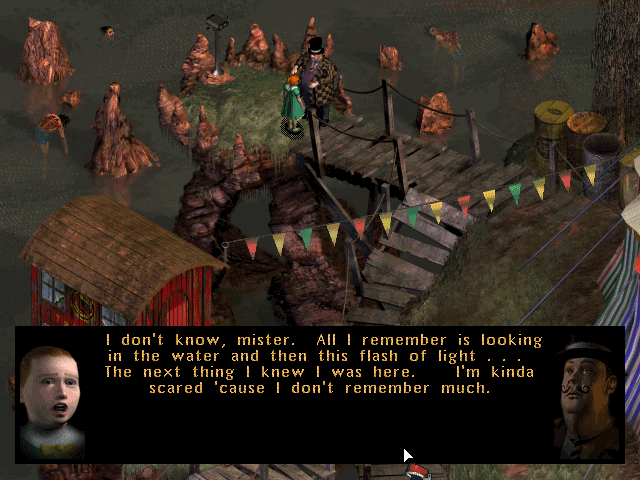
And there’s a moment when Max stops being Max at all. He becomes his deceased sister, visiting a circus on an island. The island and its denizens are cut off form the land because there’s a huge Kraken in the sea surrounding the place, that kills everyone that wants to leave. It’s really hard to express how bizarre the felling of the place is, and how out of place the characters there are. In this oniric place the urge of doing something important, to understand, is just overwhelming.
The journey of the mind goes through many stages in this title. Battling amnesia and trying to understand the symbolism of the world around Max is the true challenge of this game, and the main highlight of it’s writing.
I will not spoil it for you anymore. If you want to unravel its mysteries, learn the truth about the angelic entity and the urge of doing something Max has, then pick it up, play it if you haven’t already. The game aged a little but it’s still beautiful and heart-touching. I replayed it a dozen times and will never forget it.
Sometimes during browsing for a game or a book, an item catches one’s immediate attention. Such was the case with “Stanley Parable”. I think it was the screenshot with a man sitting next to his computer in a darkened office room that kept me instantly interested. Oh, I know that picture all too well – sitting in a dark room, doing work rapidly because of some deadline, or because some software failure. It happens very seldom in my life these days, as I became better and better (and more careful) of what I am doing with age, but I do remember sleepless hours. There was a point in my life (20 years ago, when I was just starting my career) where I had a sleeping bag ready in the server room in case I needed to stay at work for a very long time. The feeling of insecurity, tired, automated performance of the job that should be everything but repetitive (coding is a creative process) causes some minor traumas and makes people very stressed at the slightest possibility of the situation happening again. So, by looking at the screenshot I felt also stress. I needed to investigate.
This is story about a man named Stanley, whose job is to press buttons whenever they appear on screen. Yes. Not the other way around. One day though, commands stop displaying on screen. What did Stanley feel at the moment of leaving the corporate grinder? This is a question a player must answer because at that very moment player becomes Stanley. The quest for answer what actually is freedom, and what are its limitations begin.
Stanley is not alone though. He’s accompanied by the brilliant Narrator. Narrator tells the story of Stanley, urging him to go the predestined route of the story. Stanley (the Player) does not say anything in return but can act. The dispute against the Narrator expectations starts. Narrator tells Stanley to go through a door, but Player may actually never leave the room in a complete act of defiance not only against the Narrator but the game itself! Again, I find no words how brilliant it is. Should one decide to go against Narrator’s wishes with silly behaviour and childish (sometimes) acts of defiance it will always result in Narrator’s comment or riposte. And lead to unforeseen consequences. Free will can lead to bad results after all, it does not guarantee success nor happiness. Following one’s “destiny” though may actually fulfill that destiny, only leaving that person with a feeling of complete disappointment, emptiness and striving for more, even though Narrator summarizes it as “happily ever after” ending. The act of the ordered storytelling becomes boring, and the whole story about Stanley becomes a story about what makes the story (or life for that matter – the most personalized story of them all) interesting.
The answer for that question is not an easy one and open for an interpretation for tens of thousands of years, of course.
For me the answer is: chaos. The ultimate creator of diversity.
Chaos surrounds us, defines all matter and energy and thus life and intelligence itself. And as above so beyond: the stories, whenever they become ordered they become dull. Yet again , entropy is at work here. The more ordered the system, the less happens inside that system, be that thermodynamics or telling tales. In Stanley Parable, player starts to feel obligated to raise the entropy of the system by the childlike “trial and error” and “lets see what happens when I stick the nail into the power socket” attitudes. Narrator scolds these acts of defiance and takes this personally, and , although sometimes it is hilarious to defy him to see what he’s going to say next, the Narrator is not the nemesis here.
The world is. The universe, biology and its outcome: society, are. Systems that shaped us with deterministic fates (not very nice but accurate title of one of the records I’ve listened to in my life sums it up: mate, feed, kill, repeat. ) We, as humans, tend to think we are masters of our destinies, that we are above all that, but are we really? We are born, go to school, go to work, get married, have families, get old and die. With some deviations – this rule applies to every human on the planet.
In the globalized world of corporate cultures, this life has become unbearable for some.
Stanley Parable is a philosophical discourse, recursively focused on the player asking and giving the answers. It’s not possible to play this game without thinking about what culture and the way we are being raised, does to us. At one point Narrator, in genuine act of care…draws a yellow line on the floor to lead us to the happy ending. Isn’t that what parents do for us? Isn’t that what we rebel against as teenagers?
Narrator wants to help us…
Our acts of defiance and urge to explore the world around us sometimes fails. Narrator then restarts the game. The story stops. It is death, in game’s internal language. But after continuing we start to see that it is actually not the end. The world changes which each trial a little. If we decide to enter the broom closet too many times, against Narrator’s wishes, we will find the broom closet door being barred and nailed down after the restart. This makes each trial a part of a one big story.
The game is hilarious (actually, best philosophers of the XX century, according to me , Pratchett and Adams, also chose comedy to share their point of view). Narrator has his own feelings, and with showing those, he gives a player a great feedback on undertaken actions, effectively breaking the walls between reality and the game and the nature of games.
Oh dear, life is a game…
At some point Narrator forces us to play “other people’s” game….
Davey Wreden is a very talented game developer. Even if he stopped developing games – he already took his place in the hall of fame…The goal I am still trying to reach, and probably will never succeed (although I am trying pretty hard, I hope to release my first game this year). I’ll get back to Davey and his second title, equally brilliant, soon.
About trailers. Below I am posting the two trailers of the game. The second, called the Raphael Trailer, is a response to a letter sent by a player, a young teenager probably with ill misconceptions about women, criticizing game for not having enough feels 🙂 A brilliant response, with Narrator’s voice!
There’s a number of games there on the market, touching the sensitive subject of mental disorders and social angst. Some time ago it started to be a general rule that the plot has to be treated with an extreme care if someone even tries to do something around this subject. It’s not only because someone could feel offended, but also because the reason of telling such stories is not to make the ingame observations entertaining (“adventure game voyeurism” – my personal term to depict it), but often to deal with the problem itself, doesn’t matter how futile or hard that problem seems. There’s a sense of mission in these games, a quest for wellbeing, a fight against social rejection and indifference, an uprising against inner deamons, both developer’s and player’s.
A shining example of how to approach the subject is Fran Bow, made by a couple of Swedish developers, Natalia and Izak Martinsson. They hold a special place in my mind and heart, beacause as a subscriber to their Facebook page, Twitter account and videos I am continously impressed by them and their ventures, which in turn gives me a heckton of inspiration.
Fran Bow is a girl living in an asylum. She looks pretty normal, “kawaii” one would say after the Japanese, but there’s something unsettling about her from the very start. Maybe that’s how she reminds me of the Beetlejuice and Lydia Deetz? The deeper concern for the character appeared after she received her medication. The simple mechanic of hallucinating after taking a pill to unravel the whole new world with its scary denizens makes one go deeper and deeper the rabbit hole. Fran is traumatized by a loss of her parents, that, according to an intro scene, were brutally murdered, but the more one delves into the story, the more one realizes that the real past, the truth, is obscured. It is obscured by memory and the thin barrier between what is real and what is not in Fran’s mind. It is obscured by self-centered denial, and the justification of acts performed by seeing herself in the light of blissful innocence. Finally, there’s this strong perception of Fran being a victim, not only in her own eyes, but also the player’s. Asylum is a bad place and the alternative world is sometimes worse. Sometimes it is the opposite though – the alternative world gives much more option, friendly interactions and the false feeling of security.
Because there’s Remor out there, an immensely scary entity who toys with her and haunts her. The first time Remor appeared onscreen, even I was startled.
Fran is a victim of many things, but what was depicted greatly by game’s creators is how Fran additionally self-victimizes herself in an inescapable loop, going deeper and deeper to the black abyss of despair and lack of self-confidence, as she wanted to punish herself additionally. But there’s part of her there that is still fighting. That part becomes strongest in the alternative world of medication pills, but even there deamons lurk that make her helpless and weak. At one point she’s made completely unable to act, being only at the mercy of the things she cannot control. This is a true art of storytelling – because the only idea how that feels like I have in my life comes from games like this one. I have never been struggling with PTSD, I know myself enough to withstand some difficult things and I understand a lot, but I have not a slightest idea how an orphan, whose parents were brutally murdered, or a gravely hurt girl (physically or mentally) for that instance, feel like. In us, consumers of adventure games (and storytelling in general), there often is this dark urge to go farther on the lane of empathy and be able to feel things a regular person wants to escape from. Some of those disguise themselves as such with a sinusoid of the presentation of contradicting emotions (cheap TV series these days…), but this story is different.
It really gets you to walk a walk in Fran’s shoes.
Fran meets some very interesting characters. Even more questions arise…
And there’s that thing – as Fran delves deeper into her own story, there’s no way to tell which of the worlds is the real one. The border gets thinner and thinner, and even player has a problem of determining what is real and what is not. This schizophrenic uncertainty is followed by a weird feeling of stillness, that again, brings Beetlejuice to my mind. Is Fran even alive..?
Following Fran’s steps the player is exposed to the immense lore and a gallery of bizarre characters of the protagonist’s world. Here comes another layer of the problem – an addiction to exploration of that everchanging place with it’s own rules and rulers. Even if ego, id and superego are somewhere there to find and bind together as a solid personality, there’s so much more distractions in there, providing the false feeling of coziness and socialization with others. A mind trap.
As mentioned before in the article about Monkey Island, I was gradually exposed to adventure games in the 90s. The Iron Curtain fell, and with it the regimes that surpressed the development of private companies and businesses. The age of overflooding the market begun and computer dealers, software dealers and computer-related magazines started to appear on the market in unbelievable quantities. It was like a dam break – everything just started pouring in, and what a wonderful days these were for a teenager like me.
One of the titles I first saw in the best magazine of the early 90s (“Top Secret”) was Indiana Jones adventure games by Lucas Arts. First I tried to get my hands on the gamification of Indiana Jones 3 (The Last Crusade), but i couldn’t find it anywhere. At one point I thought I got it but after purchasing it, so overjoyed I did not realize that in fact it was a platformer, not an adventure… What a dissapointment it was.
But some time after I finally got my hands on the Indy 4. The gossip was that Indy 4 was to be a movie first but for reasons it was never produced as a movie, and Lucas Arts got the rights for it. One would say its unfortunate, and so did I. Before playing this game that is, because after finishing it I couldn’t be more happy it ended this way and not the other. And by the way, the plot of this game has nothing to do with the dreadful movie about the skulls.
Instead, we follow Indy on the puzzling case of Atlantis. Our brave and grumpy archeologist traverses the impossible places and dangerous mazes to uncover the legendary city, described by Plato in his Dialogues. But he’s not alone. In fact he requires help of a psychic and a celebrity, red-headed beauty Sophia Hapgood, that may have some strange connection to Atlantis. Additionally, she was a member of one of the archeological expeditions with Indy and left, well.. a lasting impression on him. Love & hate relationship, yes, yes. It’s never easy with Indy, but on the other hand, one can expect the a lot of chemistry and passion between the protagonists.
The adventure leads our heroes to a very interesting places – Yucatan, Iceland, Azores, Crete, Middle East, and it’s one of the areas it truly shines. With a lot of adventuring comes also a lot of knowledge. Even if the game fails to teach you anything it will definitely pick your interest on some things – like ancient sites and cultures. Of course always being hunted by evil nazi Germans, that dream of making a superweapon out of the mythical orichalcum metal.
Oh, Knossos!
One of the most interesting concepts in this game is actually making it branching into 3 separate games/storylines at one point, converging in the end. At one point Marcus Brody asks Indy how does he want to proceed, and Indy has three possible answers there: that he is going to use wits, that he is going to puch through with his fists, or he will create a team with Sophia. It is strongly advisable to do the 3 playthroughs to see it all, as these are really different. Fists is based on many brutal interactions with nazi soldaten in a form of fist fighting minigame, fun and hillarious and totally in spirit of Indy Jones, but not really my style. What I would like to spotlight are wits and team modes. Wits will really tests your wits, duh! Indy is alone and puzzles are really hard (the Cretan Labirinthos, ugh…) . Challenging these may be – but also equally rewarding. I especially like teaming with Sophia though. Puzzles often demand interacting with Sophia (that tension and love&hate, yummy…) and solving puzzles together. Professor Costa in Azores will not talk to Indy, but he likes beautiful women, and a gambler in Monte Carlo loves paranormal, and Sophia is a psychic celebrity… In this mode of narrative this game truly shines, engaging the player both intellectualy and emotionally. Below two pics (a picture stands for a thousand words, right?):
FistsTeam
Beautiful artwork also adds up to the general climate. Dark ancient places feel as they should and are in fact sometimes fatal.
One more thing is that there’s a talkie game version out there , and although it’s not Harrison Ford’s voice that Indy talks with, it’s close enough! Totally worth it!














 Amazing Worlds