“Indiana Jones 4: The Fate of Atlantis” – the best adventure of Indy.

As mentioned before in the article about Monkey Island, I was gradually exposed to adventure games in the 90s. The Iron Curtain fell, and with it the regimes that surpressed the development of private companies and businesses. The age of overflooding the market begun and computer dealers, software dealers and computer-related magazines started to appear on the market in unbelievable quantities. It was like a dam break – everything just started pouring in, and what a wonderful days these were for a teenager like me.

One of the titles I first saw in the best magazine of the early 90s (“Top Secret”) was Indiana Jones adventure games by Lucas Arts. First I tried to get my hands on the gamification of Indiana Jones 3 (The Last Crusade), but i couldn’t find it anywhere. At one point I thought I got it but after purchasing it, so overjoyed I did not realize that in fact it was a platformer, not an adventure… What a dissapointment it was.

But some time after I finally got my hands on the Indy 4. The gossip was that Indy 4 was to be a movie first but for reasons it was never produced as a movie, and Lucas Arts got the rights for it. One would say its unfortunate, and so did I. Before playing this game that is, because after finishing it I couldn’t be more happy it ended this way and not the other. And by the way, the plot of this game has nothing to do with the dreadful movie about the skulls.

Instead, we follow Indy on the puzzling case of Atlantis. Our brave and grumpy archeologist traverses the impossible places and dangerous mazes to uncover the legendary city, described by Plato in his Dialogues. But he’s not alone. In fact he requires help of a psychic and a celebrity, red-headed beauty Sophia Hapgood, that may have some strange connection to Atlantis. Additionally, she was a member of one of the archeological expeditions with Indy  and left, well.. a lasting impression on him. Love & hate relationship, yes, yes. It’s never easy with Indy, but on the other hand, one can expect the a lot of chemistry and passion between the protagonists.

The adventure leads our heroes to a very interesting places – Yucatan, Iceland, Azores, Crete, Middle East, and it’s one of the areas it truly shines. With a lot of adventuring comes also a lot of knowledge. Even if the game fails to teach you anything it will definitely pick your interest on some things  – like ancient sites and cultures. Of course always being hunted by evil nazi Germans, that dream of making a superweapon out of the mythical orichalcum metal.

Image result for indiana jones 4  fate of atlantis
Oh, Knossos!

One of the most interesting concepts in this game is actually making it branching into 3 separate games/storylines at one point, converging in the end. At one point Marcus Brody asks Indy how does he want to proceed, and Indy has three possible answers there: that he is going to use wits, that he is going to puch through with his fists, or he will create a team with Sophia. It is strongly advisable to do the 3 playthroughs to see it all, as these are really different. Fists is based on many brutal interactions with nazi soldaten in a form of fist fighting minigame, fun and hillarious and totally in spirit of Indy Jones, but not really my style. What I would like to spotlight are wits and team modes. Wits will really tests your wits, duh! Indy is alone and puzzles are really hard (the Cretan Labirinthos, ugh…) . Challenging these may be – but also equally rewarding. I especially like teaming with Sophia though. Puzzles often demand interacting with Sophia (that tension and love&hate, yummy…) and solving puzzles together. Professor Costa in Azores will not talk to Indy, but he likes beautiful women, and a gambler in Monte Carlo loves paranormal,  and Sophia is a psychic celebrity… In this mode of narrative this game truly shines, engaging the player both intellectualy and emotionally. Below two pics (a picture stands for a thousand words, right?):

Fists
Team

Beautiful artwork also adds up to the general climate. Dark ancient places feel as they should and are in fact sometimes fatal.

One more thing is that there’s a talkie game version out there , and although it’s not Harrison Ford’s voice that Indy talks with, it’s close enough! Totally worth it!

10/10.

Image result for indiana jones 4  fate of atlantis sophia
Convincing Sophia…. ❤


The “World of Darkness” – the introduction, and why I love it so much.

I have been a gamemaster (GM) for more than two decades now. It would be probably more if only we, here in Central Europe, would be exposed more to these phenomena. Back in 1980’s kids in USA were perfectly accustomed with Dungeons&Dragons and other systems, but we were living behind Iron Curtain. Don’t get me wrong – we were exposed to fantasy and sci-fi for decades now, and we had our own great writers, so it’s not that we were completely in the dark. On the contrary – there’s a number of things that enriched also the western world after the curtain fell, coming right from our yards here. But I digress… Even though I am a member of a very rebelious nation and we had introduced a lot of “western junk” (as our government back then wanted us to believe) back in the 60s till 90s, like 8bit PC computer revolution, RPGs appeared here very late.

I remember there were references both to wargaming and rpgs in the oldest fantasy related magazine published in Poland – “Fantastyka”, often introduced by some well known critics and writers. But it was not until 1993 that I actually learned about it.

Being in high-school and a very invested (to say the least…) in Tolkien’s literature, I was all about elves and dragons too, of course, and after being introduced to Warhammer rpg (I will write about it later) I discovered the whole new world or roleplaying. Immediately I was exposed also to a system that changed my life completely, on many levels.

First of all – I was a “fin-de-siècle” kid.  So I was into all that was dark and gothic. I started listening to death/black metal, reading all manners of dark literature, along my beloved sci-fi and fantasy. The feeling of isolation I had in high-school was quite deep. Oh I had a lot of buddies I was having wild parties with, but, as a romantic spirit, I longed for something deeper than party-laughing-drugs-alcohol-dancefloor-sex activities. Additionally I was writing for some time back then, and I was imagining my future as that of a writer, and in the whole highschool period there I had maybe two people with whom I could talk about this. Movies like the “Crow”, “Interview with a Vampire”, “Dracula”, “Highlander” or “Lost Boys” got me immediately captivated.

And then I was exposed to the “World of Darkness” megasystem. Created by Mark Rein-Hagen, Stewart Wieck, Christopher Earley, Stephan Wieck and many, many others as a number of systems, all masterfully intertwined and sharing the same world, but with different viewpoints on it.

It started with vampires in Vampire The Masquerade. The gothic – punk methodology introduced shaped the way its world was created. Punk stands there for a dirty, problematic ways of living of the lowest strata of society- drugs, prostitution, mobsters. Gothic stands for a gothic story in a overgothicized city – monumetal cathedrals, gargoyles on corporate buildings, dark alleys and clubs, but also for it’s mood and character insights, especially when it comes to monsters. Mary Shelley meets Miami Vice or sometimes “A Midsummer Night’s Dream” meets “The Fall of House of Usher”… Blending these ingredients together lead to creation of a psychological horror setting that can introduce a certain grim mood almost immediately.

s
Gothic – punk. Self explanatory.

The World of Darkness (and I am talking about the old WoD, there was an offshoot called nWoD – Chronicles of Darkness, for a completely different generation and while mechanically better in  some oppinions, far worse in storytelling) consists of several subsystems, each introducing a new viewpoint on a horrible world of monsters our planet is:

Vampire: The Masquerade – the nocturnal vampires, Childer of Caine, the first murderer, play the endless war for sustenance, called the Jyhad. The world of politics, murder and eternal struggle with the horrible powers outside and within. An endless query trying to find an answer – how can one find balance in the darwinian predator-and-prey world.
Kindred of the Ebony Kingdom – vampires in Africa. The old veves and rituals of Benin and Congo may have more to them than meets the eye.
Kindred of the East  – bizarre, eastern vampires and their secluded lands.
Werewolf: The Apocalypse – werewolves, the servants of Gaia, one of the spirits of the Triat, fight an endless war against Wyrm’s agents (they consider vampires one of those..)
Mage: The Ascension – mages, humans that Awoken or Ascended, know no boundaries and can shape the world. But human spark is a capricious one…
Wraith: The Oblivion – after death one can face a horrible fate – imprisonment in the Shadowlands. Even worse – being abused by a necromantic vampire. Even worse – have one’s own soul forged into Shadowlands’ currency… And there are still worse fates…
Changeling: The Dreaming – changelings are faerie away from home. And they want to get back and fix the world. World is losing it’s magic, inevitably it’s glamour is being squandered under the hard proceesing engine of futurism. And faeries are mad.
Hunter: The Reckoning – old  Church organizations and organizations preceding the Church hunted vampires and other abominations to clean the Lord’s world from them. They do not rest and have some powers beyond comprehension.
Mummy: The Resurrection – muumies of Egypt and South Africa have their own agenda…
Demon: The Fallen – demons from Hell want to possess and win the endles struggle with heavens. They will use anyone willing or depraved enough,.
Vampire: The Victorian Age (set in the late 19th century)
Werewolf: The Wild West (set in the 19th century)
Mage: The Sorcerer’s Crusade (set in the late 15th century)
Wraith: The Great War (set during and immediately after World War I)
Vampire: The Dark Ages – the true lords of medieval realms  are powerfs behind the throne…

Needless to say , it’s a very dark setting. Discretion is advised, as is maturity. The subjects depicted are sensitive – vampiric Embrace is like rape, and there’s still Auschwitz shade running in the Shadowlands, where the countless dead are being punished with this limbo for eternity.  What stands out however is how big the metaplot is. It’s massive and absolutely tasty.

But a part of my shelf, and a percentage of the corebooks:

Obraz może zawierać: 1 osoba, w budynku
I have more coming this month…


I will delve deeper into the subject later on, going through subsystems, but I wanted to add the mechanics is pretty neat. 10-sided dice is used in all of these, and  the way skills are depicted makes it very easy to perform dice rolls and test almost any situation that comes to imagination of GM (here called Storyteller) and the players.

Like I mentioned, it’s a dark setting of roleplaying a very miserable creature. Of course, creature that has almost god-like powers at times, but still miserable. The internal struggles for humanity (or  the contrary – for an absolute alienation) of the vampires create the anguish and the pain that is a perfect basis for tales of what defines humanity at all. Werewolves can have noble motives ( ecological saving of the planet) but they still have the primal urge to kill and brutality of the rabid animal. Changelings are mad, insane to the point they create the world around them as insane as them.  Mages wage a horrible war with the ultimate weapons of mass destruction, war that spans far beyond the Solar system…

And somewhere out there, legendary powers dwell. Waiting for something. Eldritch powers beyond all comprehension that perhaps wait for their time to awaken and devour everything in a cosmic cataclysm.

Or they don’t. It’s an RPG game after all.  It’s all there waiting for your imagination to add to it. Just imagine these tales…

“Edna & Harvey” – psychological problems in videogames – part I.

Videogames are there on the market for several decades now. It’s hard to think about this medium as a new one anymore.  The current generation of 40-60 years old people grown along the rise of the 8 bit personal computers, and these people are no longer younglings videogames are attributed to. Because for several reasons, the medium is still considered “for kids”. Whenever a parent sees PEGI’s markers they think about videogames in terms of gore, sexual content, violence and swearing in general, thus creating a binary mindset in their heads: a) games for kids, b) games not for kids created by deviants. It might sound severe but that is still the truth. You would be amazed how often I still stumble upon “aren’t videogames for kids?” ignorant question.

Games are a storytelling medium – like a movie or a book. The medium itself does not define it’s contents. Of course, it’s a game so some elements of it could be predicted and that’s a good thing, otherwise we would be exposed to the constant information chaos (as it is with TV series these days – 90% being the same stuff with different configurations of the same tropes – it’s very hard to pick a good one, and by good I mean not only emotionally but also intellectually captivating; needless to say I no longer even try to watch those).

With this article I am starting a series of describing videogames absolutely not for kids, and not because of their gory contents, but because these require a degree of maturity to comprehend. Over last decade many titles were made with the sole idea of depicting problems that normally are very hard to show in the other media. Like psychological issues and mental health. The subject is so sensitive, I know but a number of books and films that can deal with it in a compelling and inoffensive manner. Oh I know a lot of creators try to show those, but only a small percentage is succesful. The numbering does not rate the products  because all are equally captivating and valuable (of course I do have my favourites but that information can be read between lines I believe…)

I learned about the German developer Daedalic Entertainment from some other game I hope to write about in the future as well. After becoming a fan of creations of these fabulous, creative and unbelievably talended people I naturally searched for more, and found one of their older productions: “Edna & Harvey: The Breakout”.

After running the game a player starts as a young woman Edna, dressed in a hospital gown in a… solitary padded cell. That was an immediately unsettling view for me. The uncomfortable feeling grew bigger with time, especially after understanding that Harvey, the plush rabbit mascot Edna carries with her… talks back to her. The beginning of this story is a small masterpiece on it’s own: the player immediately wants to leave this too bright, unpleasant place. In the beginning one knows nothing about Edna, Edna’s past and character, but two things: that she believes she is healthy but kept against her will for some nasty experiments by dr Marcel. That basically is all that is needed to convince the player to leave this place ASAP. The breakout begins. The story leads Edna to interact with other denizens of the asylum she is in, as well as dr Marcel, always perceived as an evil person, view supported by Harvey. And there goes an another unsettling part of the story that comes with gradually learning how indifferent and empty Edna feels. Something is just not right about how she treats other people’s misery and that, in fact, she’s exploiting the others. After this realization I gradually started to suspect she’s in fact sick.  The game made me believe Edna is well and being abused, especially by showing retrospections of her childhood. Then I realized how devoid of an empathy she truly is and that her self-centered demeanor could be really a mental disorder.

Image result for edna and harvey
Edna, Harvey and dr Marcel

The problem is she manages to escape the asylum with the help of other patients, including a serial killer. In the very end the player is exposed to the truth about Edna and dr Marcel – that whatever sympathy player might have for her she does need professional help and is unable to live a normal life in society. That in fact, she’s dangerous and that was the reason of her confinement and hospitalization.

What makes it brilliant is how game allows a player to get in “Edna’s shoes” and realize how a part of schizophrenia can feel like – he feeling of fear, of being abused by the people actually trying to help you and learn how difficult it is for such a person to tell the truth from lies in a subjective perception of the world.

The second part of the game, “Edna & Harvey: Harvey’s New Eyes” follows Lily, a small, extremely shy girl from a convent orphanage governed by a very harsh sister-superior. Lily is so shy she only starts saying sentences in the game! Every person she interacts with always know better than her what she want’s to say so she is never allowed to complete any sentence. Even Edna, that shows up in a very, very unexpected way, especially for the people that completed the 1st game acts towards Lily is a bizarre manner. The first disonance here is how the environment is depicted like and how it is explained. It’s a contradiction, because of colourful scenes depicting harsh living conditions. This got me in red alert stage and I focused extremely, just to see what happens when one of the characters dies and how Lily reacts to it: the little, nice gnome appears over the mutilated corpse that we never see, and paints it pink. Yes, what we, and Lily see is a pink blob whenever something nasty or gory happens. Lily supersedes all wrong things from her life, she just doesn’t want to see it. Additionally there are only two persons that actually seem to care about her, and both are rather peculiar to say the least. I don’t want to give to much spoilers, so I’ll just add that Harvey is also here and he gets a pair of new, evil, hypnotic eyes. Harvey embodies all awkwardness of the mental anguish and all the horror of insecurity of an infant in the world of matures. It’s really hard to write more about it without giving to much spoilers, because, as the 1st one, also this game allows player to realize things during gameplay, with it’s crafty storytelling and events exposure.

Image result for edna and harvey
Lily and the mother superior

When I completed the 1st one I said “Oh sh*t…” to myself. When I completed the 2nd one I yelled : “Haha! Finally!”.  Showing such grim and difficult subject with a pastel colour palette and cartoony characters seemed impossible for me, until I played this marvelous production.

Some trailers:


“Sinuhe” or “The Egyptian” – an emotional journey through perils of humanity.

“I, SINUHE, the son of Senmut and of his wife Kipa, write this. I do not write it to the glory of the gods in the land of Kem, for I am weary of gods, nor to the glory of the Pharaohs, for I am weary of their deeds. I write neither from fear nor from any hope of the future but for myself alone. During my life I have seen, known, and lost too much to be the prey of vain dread; and, as for the hope of immortality, I am as weary of that as I am of gods and kings. For my own sake only I write this; and herein I differ from all other writers, past and to come.”

As an avid book reader I have always a stash of books being read ( I tend to read several simultaneously) or waiting to be started, so it’s a seldom thing for me to discover something completely new and unheard of before. It’s seldom, but sometimes it does happen. I would probably never discover Mika Waltari’s books if not for my wife telling me at one point to read it. I was reluctant at first – I had my unending book stash waiting to be read after all… She found a 20+ years old edition of “Sinuhe” and gave it to me.

I have to say one thing – I am a cynic. I don’t believe in gods, fate and afterlife. I generally perceive humankind as flawed, morality as a side effect of evolution and cause-and-effect chain as random and nondeterministic. This might make it easier to understand why I love this book so much. I am also an archeology and history geek so just shouting “ancient Egypt” makes me instantaneously interested.

“Sinuhe” is a life story told by Sinuhe the Doctor, a bitter man who has been-there-done-that to loose it all, including his freedom. It’s a chronological life journey from his youngest years till senility, and his life is full of personal drama intertwined with historical and political events of the age he lives through. And an interesting age it is – Sinuhe was born just before Akhenaten‘s religious reforms and the social and religious turmoil afterwards.

Image result for nefernefernefer
Edwing Long’s “Love’s Labour Lost” – Nefernefernefer…

J.R.R Tolkien once said that the most interesting stories are the stories of falling from grace, the fall of humankind or a fall of an individual. I agree and it is so in this case. Sinuhe makes mistakes and learns life the hard way. He has a privileged start and knows no pain or hunger, but his teenage rebellion and lust towards Nefernefernefer (probably one of the most scary femmes fatales in literature…) set’s him on an unforgetable and painful journey of re-evaluation of human condition. Love and innocence yield the horrible outcome as Sinuhe loses everything really important in life to learn it after the loss. Make no mistake, he is not an idiot! On the contrary, which he proves by becoming a scholar and a pharao’s doctor. His mistakes come from another source – human inability to know the outcome of our actions and frailty of life. The protagonist reaches the bottom of the human existence (the description of his time in the House of the Dead is one of those unforgettable pieces of literature in my life) to lift himself up again with the tremendous force and will. At first vengeance and regret are the motors of his actions (like in “Monte Christo”). He has his revenge but then he discovers that there’s so much more to life than that. Forced to travel with a slave he broadens his horizons by visiting the countries of the Akhenaten’s era – Babylonia, Hittites and Minoans to learn their ways and the ultimate truth – no matter where people live and what are their beliefs – they are still humans. He learns perfect love and friendship just to lose them, he receives power to learn that power comes with a price, and all that humans search for in their life can be very close, yet sometimes one has to travel the world to learn how to find it. The wise Sinuhe learned everything too late and so he writes his papyrus so a potential reader could learn from his life. This is the altruistic act of a human (even though he denies it himself) who wants to spare another human and save him from the pain and loss.

Saying Mika Waltari’s “Sinuhe” is interesting would be like saying that the Sun is somewhat warm. The feels, the events, characters are brilliant and the lesson one receives from our good Doctor is invaluable.

“For I, Sinuhe, am a human being. I have lived in everyone who existed before me and shall live in all who come after me. I shall live in human tears and laughter, in human sorrow and fear, in human goodness and wickedness, in justice and injustice, in weakness and strength. As a human being I shall live eternally in mankind. I desire no offerings at my tomb and no immortality for my name. This was written by Sinuhe, the Egyptian, who lived alone all the days of his life.”


The “Monkey Island” saga – an interactive comedy.

Back in 1991 I barely spoken any English. I was in an elementary school, 4th grade. Russian was one of a few foreign languages taught at school at the time (it was but 2 years after the Iron Curtain fell) but my parents started sending me (somewhat forcefully) to private English classes. As a kid back then I had so many better things to do that sitting with Mrs Joanna, an extremely patient teacher, and doing a homework for her. So I spoke better English than my colleagues at the time, but still neglected a lot of homework and treated it as an optional activity. Carelessly.

At one point in 1991 circus was visiting my hometown. Lions, acrobats, arcade machines, flippers set up in the area of hastily assembled mini amusement park around the tent were always very tempting for a kid like me. But this time was different. That was a day i did not want to go to the circus at all.

Because earlier that day I inserted a freshly copied game disquette (we did not have any copyright law at the time in a post-communist state – we had still wait 2 years to get the first version) into my Amiga 500’s drive. I knew enough English to understand perfectly one of the first words in the game:

“My name is Guybrush Threepwood, and I want to be a pirate!”

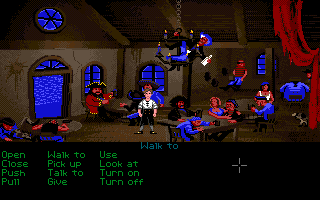
I was stunned. Enchanted. Beautiful pixel artwork and nice music were the one thing. What completely won me over was actually the …text. To this day I fail to understand what was so captivating about the beginning. Of course, I have many possible explanations: the boldness and the likeability of the protagonist, the world of pirates etc. But none of those was ever as important as this one:  the humour.

Almost immediately after starting the game I was overflown with hillarious dialogues and pictures. The chandelier swinging pirate and the dog at the Scumm Bar, the local tavern of the Melee Island, then the first really demanding puzzle – Fettucini brothers, owners of the circus (and yes, I had an alternative circus ingame!), need Guybrush to test their human-canonball concept but only if the tester brings his own helmet. It took me hours to finally understand that this game makes a lot of jokes, not only on screen but within it’s mechanics and often with a witty wordplay. For example I had no idea that one of the tools, known in  Polish as a “french key” in English is actually a “monkey wrench”. It was ages until I understood I actually need to use a real monkey on a valve to open something…It is a “monkey” wrench after all…

Image result for monkey island scumm bar
The iconic Scumm Bar.

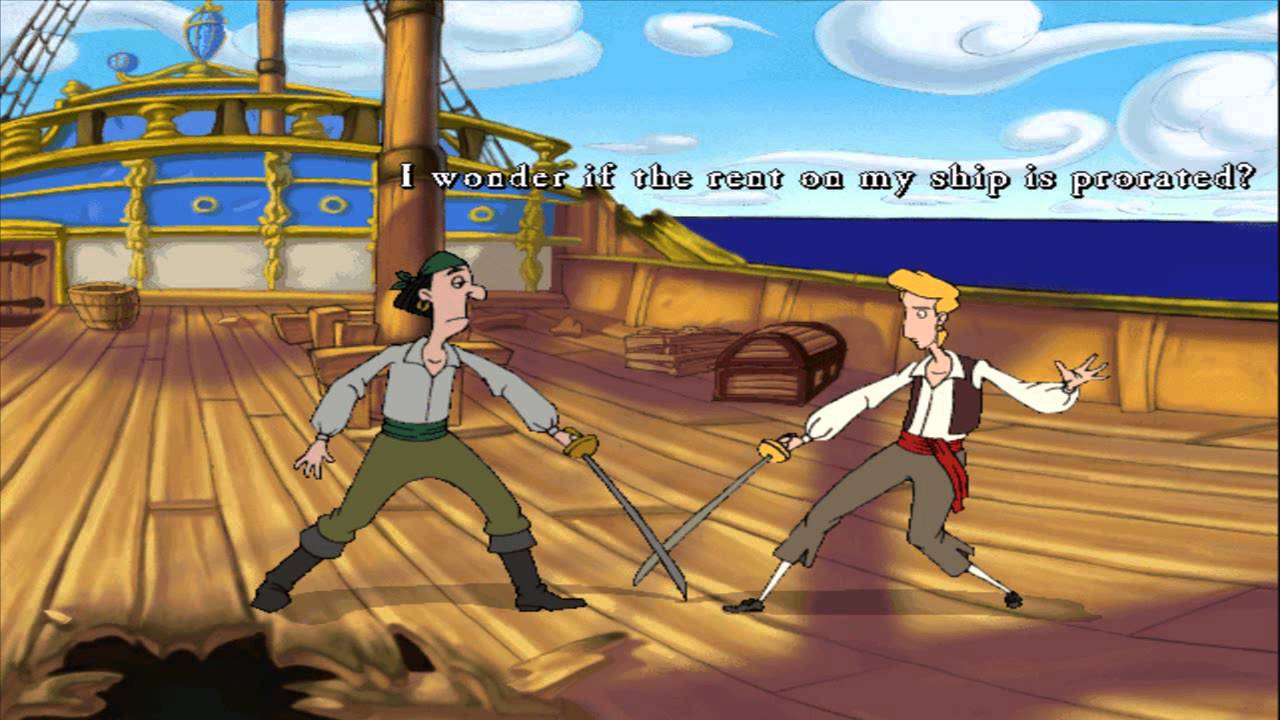
Then the swordplay. Wordplay-swordplay. The whole concept of becoming a master swordsman by acquiring a repertoire of witty repartees was just brilliant. Let me give you some examples of the Insult Sword Fighting:

– Nobody’s ever drawn blood from me and nobody ever will.

– You run THAT fast?

– You have the manners of a beggar.

– I wanted to make sure you’d feel comfortable with me.

Image result for insult sword fighting
Insult Sword Fighting part 1 (The Secret of Monkey Island”)…

And then in the 3rd part – “The Curse of Monkey Island” player learns that these actually have to rhyme when fighting at sea:

– You’re the ugliest monster ever created!

-If you don’t count all the ones you’ve dated.

-En garde! Touché!

-Oh, that is so cliché.

More can be found here.

Image result for insult sword fighting curse
and part 3 (“The Curse of Monkey Island”)

Ron Gilbert’s and LucasArts’ games are generally very hillarious but this series is a gem. To this day we tend to joke with my wife using jokes known only by the ones who actually played the series. For example we still call someone extremely pale, or starting sunbathing a “Palido” (Domingo), because it’s the name of one of the very pale characters in the 3rd game.

Image result for le chuck's revenge
The spitting contest in the 2nd game “Le Chuck’s Revenge”

Guybrush is a very likeable fellow. As is the villain zombie pirate LeChuck, Guybrush’ love interest Elaine and…basically every other character! Who doesn’t love Murray the Powerful Demonic Skull and His Evil Plan to Dominate The World or poor piratefolk scared of El Pollo Diablo (The Devil Chicken)?

After “The Secret of Monkey Island” there was “Le Chuck’s Revenge”. Then After several years, the very best “Curse of the Monkey Island” and then still quite good “Escape from Monkey Island”. Then Telltale inbtroduced their “Tales from Monkey Island”, very faithful to the original.

The voiceover cast also does the job. Domini Armato’s voiced Guybrush in all games, also 1 and 2 remakes. And he has given Guybrush a soul. Truly.

Image result for escape from monkey island
The school for pirates in the “Escape… ” (the 4th)
Image result for tales of monkey island
Guybrush likes good conversation partners  -“Tales…”

The story itself…Well, I will not spoil it for you. Guybrush wants to be a pirate. That’s it. Now go and play it till the very end. If you like a witty comedy (e.g Terry Pratchett’s kind of jokes) you’ll be laughing yourself to tears.

So lets get back to 1991. I finally went to the circus but I could not focus. After the show finished I didn’t want to stay to watch animals nor I did want sweets from a stall (even tho my sister insisted that we stayed). What I wanted is to get back home ASAP and insert the disquette into Amiga’s  FDD again.

I remember I spent next 2 months of a vacation with an English vocabulary on my knees, delving into the hillarious world of Tri-Island pirates more and more.

Till this very day, when someone asks me what my opinion on how to start teaching foreign languages to their kids  I often answer: give them Monkey Island (or something similar).

I replayed the saga probably a dozen times now…

Btw, it’s worth mentioning that 1 and 2 were remade with commentary so you can get those on new machines with both old and new graphics(that you can switch between during play freely), with full voiceover.

And finally watch the intro of the 3rd one:


The art of storytelling – pen&paper RPGs

Pen & paper roleplaying games are there in the culture for half a century now. Semi-randomized storytelling is far older that that of course. The idea is as old as humanity itself I dare to say. Following Cohen, Pratchett and Stewart I also think that naming humans homo sapiens is giving our species far to much credit, and I also would rather name it “pan narrans” – “a storytelling chimpanzee”. From the hunter-gatherer tales near around the bonfire, through the recipient-oriented “One Tousand and One Nights” (to the point were Scheherezade has to adjust her stories accordingly so she could survive!) till 19th century, when Von Reisswitz created Kriegsspiel to teach Prussian officers tactics (a fun fact is that King of Prussia ordered every regiment to have a copy of Kriegsspiel).  Kriegspiel had many editions (at least 3) with revised rules, but all introduced some randomness into how the events developed. In the 1st and the 2nd revision it were dice, in the third, impartial experts. And thus, the role of a Game Master, an individual with knowledge, an arbiter of events was introduced in the 3rd version of Kriegspiel by du Vernois . American military followed with it’s Jane’s Fighting Ships and it was revered for it’s detailed unit descriptions (get it here) which started to serve as a first full-fledged rulebook ever . Then the wargaming  – tactical and narrative games with random elements, basing on scaled reproductions of battlefields with toy soldier miniatures – came into gentlemen homes. Important fact is that ancients (Minoans, Egyptians) also were fond of the miniatures so it’s possible the concept is also quite ancient… I absolutely adore the fact that the author of the “Time Machine” H.G. Wells was a wargamer:

Tactical and randomized elements of wargaming were used to a varied extent by many armies, businesses and organizations. But it was not until 1970s were an actual idea of unit or organization based storytelling shifted towards individuals. At first as a decision-helping roleplaying.Then into “man-to-man” wargames in the gaming world, where individual-based rules were used in a tactical environment.

Then came Dungeon & Dragons (and later Advanced Dungeons & Dragons) and what was a dice based boargame like entertainment started to shift into a storytelling based events. Players started to delve more and more into the “lore” – the setting of the fantastic worlds, expanded by numerous book supplements, descibing flora and fauna, politics and culture of those worlds. Within several years the amount of content, both produced by game developers and the players (as background stories for gaming events) was so big, it started to become a basis for novels. Works like the brilliant Raymon Feist’s “Riftwar Cycle” and Salvatore’s Drizz’t novels filled the bookshops next to the renowned books like “The Lord of the Rings” (which most of the rpg systems were based on to some extent).

The 80’s and the 90’s brought  true breakthroughs in RPG. Heavily climatic storytelling systems emerged. Warhammer in the Great Britain started to tell the dark story of an uneven fight with Chaos on an slowly dying world, in U.S.A the World of Darkness was created (myu personal favourite) which shifted the balance even more towards storytelling, to the point where dice were no longer that important, what really mattered was the story. Till this very day a multitude of systems and settings sees the light of day allowing tens of tousands of players to delve deep into magnificent worlds together on  problem solving quests.

Related image
A troupe of contemporary vampires- L.A By Night, Vampire the Masquerade

The sheer amount of systems is so big it’s really hard to review them or advertise them all. It’s sufficient to say there’s at least one system (and of course often hundreds more…) for each branch of prose fiction created – be that fantasy, horror, science fiction, mystery, criminal etc. If someone wants either an interactive whodonnit or a vampiric possesion there’s a system for it somewhere out there. With everything, rules, background, information and true, extensive knowledge to posses to create new, interesting stories. I will be telling more of those, later.

Some of those evolved into Live Action RPGs which are basically a custume-based, theatrical plays with interactive storytelling…

People still don’t understand it sometimes it seems. And they are quite amazed when I tell them about popular writers who were rpg gamers first or learned RPG during interest in writing. Andrzej Sapkowski, the creator of the Witcher, Raymond E. Feist, the creator of Riftwar and many many more. Is it really so bizarre that storytellers practice in an interactive storytelling environment?

I’ll give you a deeper look into the subject, later.

Sources worth looking at: https://crpgbook.wordpress.com/


“À la recherche du temps perdu” – a masterclass narrative.

One of the greatest pieces of literature on the planet (according to literature scholars) and probably the best one ever written (according to me), is Marcel Proust’s “À la recherche du temps perdu”- “In search of Lost Time”. This masterwork consists of 7 tomes so hard to read for some readers, it’s become a  subject of many jokes and it is considered to be quite snobistic to even know it. I cannot express how much I disagree with that notion and how much of an intellectual laziness I consider not reading this one.

The best review of the saga I have ever heard was a single phrase by a Canadian policeman protagonist Benton Fraser in the “Due South” TV series in 90’s. “It basically a one long phrase.”. Indeed it is…  Tomes, published between 1913 and 1927, are a work of life of Proust. It is probably one of the best refined and edited pieces of work ever created in literature. The popular story says that the publisher had to force the author to stop editing and actually publish the thing. One may ask – what made it so important for mr Proust to edit and refine his work continuously and endlessly?

First of all it’s imperative to know that all saga is a … fractal. A literary fractal. Yes. I have analyzed it wide and long for several years now and some things are more and more visible as the story progresses:

a) as a “one long phrase” the work is a “stream of consciousness” of sorts, as author/narrator is reviewing his life and the past (the time he had lost)

b) the progression of the narrator’s review is majorily linear and steady in pacing, but only until one of the focal points (“milestones”) are reached. One of those is the famous “madeleine” cake, that allows the author to switch the memory lane traversal to another path. It’s linear until the subject is exhausted, and then it goes back to the last uncontinued focal point.

c) the storyline is a combination of elaborate, interconnected “slices of life”. This is important, because as narrator explores his own memory, the more and more intertwined events or story arcs there are. For example, the earliest memories of narrator’s grandfather’s female companion from the first tome will return later on as a sudden realization of her role, appearing with a review of other events.

d) it’s extremely consistent. To be honest I don’t know any other piece of literature as consistent as this one. All 7 books are in fact a one “solid”.

e) as depicted in point b – one thing becomes immediately visible: the book is recursive.

Now look at this fractal object, to visualize what I have in mind:

Image result for fractal

The study about human behaviour says that brain is extremely focused and processing every byte of information when it stumbles upon chaos (and therefore a big entropy! – the term also applicable to plot analysis, according to me) – this also makes it really hard to process the information as there is no immediate pattern to be recognized (at least in the beginning).  This may be an explanation why actually it is so hard to read for some. However, every fractal is chaotic only locally (take a look above again). After one realizes there are patterns everywhere, the bigger picture becomes a “cathedral of meanings”.

And what a beautiful and interesting patterns these are! First of all, the internal homosexual anguish and the neurastenia of the author marks the narrator, also named Marcel, but also allows him to view things not accesible to another viewer. His neurotic reactions allow him to feel every moment tenfold, and in fact act as an enhancement,  reinforcement of his memories, allowing deeper and deeper insights on an internal voyage. He becomes a voyeur of his internal life and the externals. Observing others makes him learn psychological aspects of the individuals he meets. This becomes almost an obsession when he analyzes the immoral yet distinguished baron de Charlus and his lover Morel. When Marcel meets his lover Albertine Simonet, the keen observations of the human nature become a sinusoid of an intellectual boredom mixed with the jealousy and lust. With events passing by and timeline being explored we, readers, receive a gallery of psychological portraits of insanely interesting people.

And all of it is dipped in the cultural and political sauce at the turn of 19th and 20th centuries. The Dreyfus affair,  aristocratic meetings, the gap between various strata of society – it’s all there.

Mathematically, the function of the story is always the function of time. It evolves with time, it takes time to show the effects of actions. As said before, this story is recursive, meaning – there are multiple events taking place in the same time in the story, but also – events are chronological but not shown chronologically. But these are there as the same function of time, but enhanced by additional parameters and called recursively by the author, if you forgive my information theorist’s argot. As Marcel learns some new truths (or rather – rediscovers them in his memory) he often “rewinds” to the desired moment to enrich it. This is just brilliant in my oppinion. The lost time he searches for, the forgotten events he tries so remember so eagerly, are in fact but another dimension he uses – the same as he does with space and characters populating said space. It’s hard to express how immensely absorbing for the reader it is.

This strict approach, and perhaps my analysis of it, might seem cold and…well, mathematical. But above all – the saga is beautiful. Expressions and language author uses is just this – amazing. The stories and characters – engaging and interesting.  The lost time – re-acquired, and in the end, with Time (a capital letter for a reason), one truth is exposed: no matter how difficult, complicated and “neurastenic” the human existence is – it’s worth living through as memory is all we truly have.


“Gabriel Knight” trilogy, or how to write paranormal secret cult stories.

One of the best examples of writing when it comes to sinister mysteries, secret societies and cults is a mystery adventure game series Gabriel Knight. Produced by Sierra and written by Jane Jensen, this game is one of the shiniest examples of point and click adventure game storytelling that was ever created. The richness of the metaplot, the paranormal cleverly interwoven with the historical background deserves the highest praise. Of course, what we get in return is somewhat a “Dan Brown-ish” type of plot (but long before Dan Brown) , where our knowlegeable protagonist solves the mystery, accompanied by a female helper, fights the evil cult and then tries to understand what actually happened. And it would be just that, if not for the likeable protagonist, cleverly written dialogue, a lot of “fluff” information (for example, the amount of the information about voodoo one can learn from the first part of the trilogy is enough to be able to explain voodoo religion basics to anyone, the same goes for Bavaria related knowledge in the second) and an absolutely absorbing climate.


Image result for gabriel knight
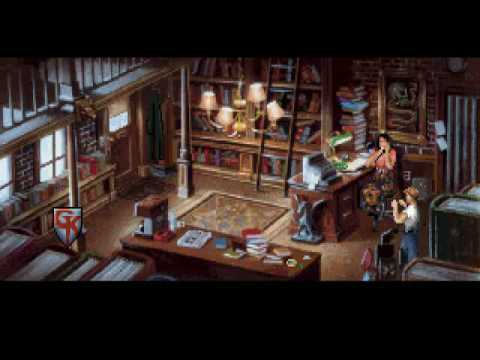
GK1: Sins of the Fathers original…

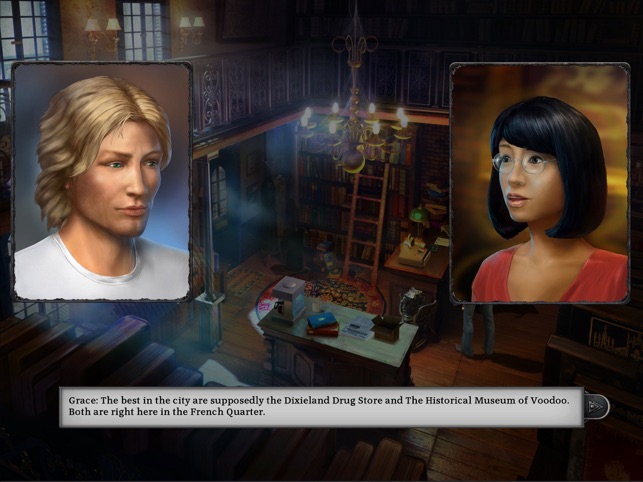
The story follows a young writer, called Gabriel Knight, initially running a bookstore in New Orleans and trying to write his next novel, this time about voodoo murders currently happening in the city. His quest for a storyline ( a quite recursive and a delicate thing it is to write a storyline within a storyline!) and dealing with a writer’s block turns into a regular murder investigation, during which he is helped by his bookstore employee Grace Nakimura – a smart student of arts, and an old pal, detective Mosely. Investigation leads Gabriel to uncover the secret legacy of his family, that of a schattenjaeger ( a “shadowhunter” in German), a crusader to fight the paranormal evil. The first part culmination goes with a boom (literally) and Gabriel follows his schattenjaeger path by moving to Bavaria where he solves the supposed werewolf attacks case in the second installment. The third one takes us to Languedoc to Rennes-le-Château, and to the well known case of the Grail (dame Jensen used the same background material here that Dan Brown used, but she did it much better) and a child kidnapping.

Image result for gabriel knight
…and the remake.

Technically the three installments are different from each other, the first being a 2D point and click, the second a full motion video adventure game (an FMV) and the third one a 3D point and click, so everything is different- art, controls etc. What is consistent is a story, and those games in fact should be treated as trilogy. Tim Curry’s voicework on Gabriel in the 1st and the 3rd is just marvellous. The 2nd one has some quirky actors that can be quite awkward at times, but it is still a great game.

Visually the most pleasant is GK1, both original and the remake. Pixel era drawn 2D is more comic-book like and character visages are more pleasant. By the way, it’s quite interesting that a comic book was in fact shipped with the GK1. It depicted events taking place 200 years before the events of the game. The least pleasing is the 3rd game, with an early 3D era graphics. Today it’s almost unbearable and aged really bad.

Image result for gabriel knight 2
GK2: The Beast Within. Gabriel and Grace.

What about those secret cults and the paranormal?  The whole trilogy involves at least 3 such cults (1 per installment) with Gabriel forced to use different methods to learn about them, infiltrate them and fight them. And here we can see the true power of Jensen’s writing – from the first to the last moments a player can feel the mystery. Not everything is explained – a lot is left there to ponder on by both the protagonist and the player. The mysteries, even revisited (as in my case, by playing again and again) still don’t loose their charm even after 2 decades.

Gabriel Knight 2 added yet another layer of artistry to the picture. A big part of the game evolves around music and architecture. There’s an extensive plotline related to Richard Wagner and Ludwig II of Bavaria. The first is a composer of monumental, heavy pieces, the second a builder of Schloss Neuschwanstein, an architectural marvel (and a kitch to some). Yet again those subjects are added to the plot with an artistry and are very interesting. It’s very sad that one of the chapters, focusing on Ludwig II only, was cut from the fina lversion of the game from financial reasons.


Image result for gabriel knight 3
GK3: Blood of the Sacred, Blood of the damned. Ugly 3D Grace, Mosely and Gabriel… the story is still excellent though!

Extremely difficult part, that dame Jensen finished with great result, is romance. Gabriel, being a womanizer and a jerk at times, is an extremely difficult material to work with to create a convincing, mature relationship with female characters surrounding him. The way mrs Jensen did it is similar to the japanese tsundere (a character that is nasty in the beginning but then develops maturity and is becoming gradually nicer). Gabriel is flirting every girl to find out he was lovestruck with Malia. In fact his relationship with Malia, and then slowly recovering and finding even more mature feelings towards Grace are one of the best written romantic pieces in all games ever.

The story is quite dynamic, as expected from a “Dan-Brownish” action oriented product. However it somehow manages to balance the moments of respite and learning with the action. Action scenes are used to build up the mystery, to add up rather than resolve, which produces the feeling of depth one would not expect from this genre. this is one of the titles revisited by fans and always pleasurable to experience again. And that is a characteristic of a good story.

Take a look at the trailer:


Video games, or rather – computer games as a storytelling media.

I am a long time gamer, so this medium will take a big place on this blog. Everybody got familiar with the existence of videogames in the present world, however these still are considered as a simple pleasure for simple people (even Andrzej Sapkowski, the creator of the Witcher world and a long time pen & paper rpg gamer said some nasty things about this medium). Truth be told, this view is upheld by so called AAA industry games. These are game-world equivalents of the most popular movies-  often inambitious, filled with special effects, silly plot,quite empty and therefore forgettable. This is because games, just like movies and books, are merchandise that has to be sold with large quantities, often without any regard to the quality.  That’s the biggest woe of the storytelling nerds of the videogame industry today.

Such view on videogames is causing much damage to the medium. That’s because, as with books and movies, there are different genres of videogames, with varied quality. This blog, being a storytelling blog, will focus only on storytelling aspect of the games, also touching the artistic parts of those (because a picture, a digital painting or a digital sculpture can stand for tousand words, as a popular proverb says).

Storytelling in games is not something new, in fact it was there from the beginning. The first game considered to have a plotline was Donkey Kong (1981). It was followed by text adventure games, then story based rpgs then by point & click adventure games. In parallel other games evolved too, but often with much smaller storytelling focus.

Image result for adventure games text
A text adventure game example


It’s 37 years since then and the genre evolved greatly. They evolved so much, some are no longer considered games at all, but “digital experiences”.  Above all, interactivity of the medium gives a whole new level of experiences to the recipient of the digital content. Sometimes it’s just the simple scene navigation tool (as in the visual novel types of games) and sometimes it’s a very sophisticated algorithmic content creation logic, producing random storytelling encounters with cause-and-effect, as in many computer role playing games (that of course take their roots in traditional pen&paper rpg).  Needless to say, enabling the recipient to be the actor, the true variable that unveils, or even directs the story to it’s end, is something that was achieved only by traditional pen&paper roleplaying games and video games so far.


Image result for daedalic dialogue
A contemporary point&click adventure game (Deponia series)

The most important genres I will be talking about here are 3 genres:

1. So called “adventure” games – these games vary in shape and definition, but almost always share the following things:-

  • are heavily story-oriented or story-based, to the point that story told is large, often containing a lot of dialogue, narrative text, descriptions etc.
  • offer some degree of interactivity (as stated above)
  • the goal of those games is “solving” them – completing with one of often many available endings. There’s seldom any other indicator of winning or score (however some older games, like Sierra games have both)

2. Computer role playing games – a computer version of pen&paper roleplaying games.

  • these by the very definition of roleplaying are heavily story oriented
  • interactivity is often much greater than in adventure games when it comes to character management and much smaller when it comes to environment interactions (there are however many games that provide both – e.g. Divinity Original Sin series)

3. Not-games.  – yes, sometimes digital entertainment can become so artistic or so bizarre it no longer submits to the other definitions, but almost always having the storyline or some consistent symbolic anchor.

  • artistic games – art in a form of an interactive,  digital content
  • digital experiences – “walking simulators”, games that are more passive in terms of interactivity but often telling a quite deep story.


All above have many subgenres, much like books, from fantasy or fairy tale focused, through a “slice of life” stories, to very grim stories, often touching sensitive subjects like insanity, rape or even mass murder.

Examples of the above will follow on this blog. The main idea behind it is to provide more storytelling options for people in need to digest more and more plotlines, like myself.


Gene Wolfe’s the “Soldier” trilogy

Gene Wolfe is probably one of the best fantasy/sci-fi authors of the XXth century. After all his “Urth” series was named the 3rd best fantasy novel written before 1990 by the “Locust” magazine. However, there’s a  Wolfe’s series that had a bigger impact on some people.

The “Soldier” trilogy, consisting of “Soldier of the mist”, “Soldier of Arete” and the “Soldier of Sidon” follows the story of a mercenary called Latro (“a scoundrel”), suffering from amnesia, caused by a head wound he received during the battle of Platea. And what a protagonist he is! A swordmaster, an excellent fighter, yes, but his biggest qualities don’t come from these combat abilities. To reader’s amazement and delight, it’s Latro’s amnesia what gives so many storytelling opportunities to G.Wolfe.

Probably everyone heard one way or the other the statement that memory  (or the lack of thereof) defines a person. We’re living in a world affected by the Alzheimers merciless disease (who took Terry Pratchett, one of my beloved authors, from us) . We are often exposed to the heartbreaking stories of families that are struggling with the care after persons who no longer recognize them and slowly fade away into oblivion. These are full of details how personality is also affected and the person that was is no longer there.

However, there’s also a study that bases heavily on the Alzheimer experiences that says that it’s morals, not memory, what defines who we are.  Although the study and its results are new,  what this study proves is one of the major points defining who Latro is. Yet again, a sci-fi/ fantasy author’s foresight shines in his novels.  And the method the protagonist is rendered is also brilliant – as Alzheimer affected person is dependent of his/hers family such is Latro’s case. Without his “friends”, persons who join him on his journey (for multitude of reasons) he would be helpless. It’s them who tell Latro every day he should read his scroll, the papyrus diary that is his real memory, and that he writes and carries with him every day. It’s them that really give the background to Latro’s choices.  Finally, it’s them who define the characteristic of Latro’s voyage, his “odyssey” if you will.

Because an odyssey it is! “Soldier” series events are based during the Persian incursion to Greece of 480 B.C. so historical setting is there from the beginning, in everything – names, events, descriptions. One thing that really needs to be mentioned here is that Wolfe is playing with ancient Greek language, showing the same love for the linguistic aspects of storytelling as Frank Herbert in “Dune” or J.R.R. Tolkien in his works, even if Wolfe’s work is not as exstensive as the latter two writers. Latro’s understanding of his world and it’s names is that of an outsider, for example he constantly names Sparta “a Rope”, because of a common mistake made by non-Greeks – “sparton”  means “a rope knot”. He gets other names right though, so he names Akrokorinthos “the Tower Hill”, Attica a “long land” and Athens “a Thought”, which gives an absolutely amazing, familiar feeling to the Greek world, often obscured by undeciphered, exotic names in other sources. It’s hard to express how important it is for it’s storytelling. Thanks to this method, ancient Greeks are no longer strangers, or at least, they are not as strange to the reader as in other sources. One can finally start understanding their culture, their politics, their fear of gods and superstitions.

Gods and religion takes a very important part in the books. Latro is seeing things, which makes superstitious people around him very cautious. God-touched he seems to be, the clay shaped in the hands of mythical superpowers. A true ancient hero, lead by the Olympians to his fate he seems. Or is it just the head wound and hallucinations caused by it? Readers struggle with the answer along with the characters from the books.

The Odyssey and Argonaut mythos similiarities are many. References to Leonidas and his “Rope” people, Olympian trials, necromancy, Sparta vs Athens tensions, mythical creatures. It’s all there. And it pushes Latro to the ends of the world (Thracia in the second book and Egypt in the third) in search for his identity.

Does man have any control over his fate? What defines us as humans? Our memories? A soul? Morals? “Soldier” trilogy storytelling brilliantly forces the reader to ask these questions and therefore go, even unwillingly, in Latro’s search for an identity.  As such, it remains one of the best pieces of  fatasy literature there is.

An absolute jewel.


Design a site like this with WordPress.com
Get started