I have written about the most known Davey Wreden’s game before. “Stanley Parable” made Wreden one of those game devs I look up to in my gamedev career. People like him have great stories to tell, create a lot of artistic content in form of both plotline constructs and technical assets and they often do it alone or only with a small team of developers. That solitude makes the creation process less of a software development undertaking and more of an artistic project, not very unlike to the solitude of a painter.
In fact that’s the way games were developed 40 years ago. A publisher, having rights to a certain IP, would hire a developer to code the game for him. In the 8 bit era games weren’t very complicated visually, but it still was a difficult process requiring a lot of ingenuity. The very similar process is within the indie gamedev world today, except it’s devs themselves who create and publish games.
They just want to tell stories and their “amazing worlds”. Right?
The game development proces… In popular imagination gamedev is kinda like a weird mix between a rockstar and a hipster. There’s a lot of truth in that statement, because the medium is very popular and the demand is huge. The hipster part comes from the notion that a dev must be a weird type of nerd. What that depiction completely misses is what is the price of becoming a gamedev. We all know the trope of a whisky-drinking writer, bathing in cigarette fumes trying to forge a story or overcome a writer’s block. It looks difficult, it looks frustrating and painful, right?
A writer’s anguish.
“You know nothing of creative pain, kid.” our rockstar-hipster would say if he was to be like the ones from the popculture. Well I certainly won’t because I learned myself all those processes have their pains.
The truth is the gamedev process is painful, difficult, and has a powerful negative feedback. During the creative process, author’s self-validation is immediate and not all skills required to create a game can be acquired by a single person. As a storyteller one might lack the knowledge of tools needed to make a game, or a programming language. Gamedev, similarily to architecture, requires a marriage between the world of artistry and science, the world of mathemathics and creativity. This alone raises the bar, exponentially.
Lets assume one was able to acquire a tool knowledge and has a story to tell. One starts telling a story by creating a game. Very soon the author will learn about his own limitations. He’ll start fighting those limitations by trying to study harder or simply getting around them. This alone forces him to make compromises, sometimes forces him to abandon whole sections of the story he wanted to tell, because he’s unable to convey it in the form of the game. Then he finishes his product, sometimes the understanding follows that he’s only able to do games like the one he just did. There will never be anything new, the process of replicating the same non-creative formula is all that is left, not unlike that of a painter’s being able to paint only the lakeside sceneries on sunset with the same colourset to sell those on the local market.
Behold – it’s the gamedev impotence! The soul-eating demon that preys upon my kind.
“The Beginner’s Guide” is a story narrated by Davey Wreden himself. A player follows Wreden’s story about an acquaintance of his, nicknamed “Coda”, a gamedev, who, since 2008, created a lot of small, interesting games. Narrator wants us to play those games and to try to unravel the psyche of Coda. What makes him happy? What makes him sad? Why does he make those games? Does he even like making games at all? Step by step, the great mystery unravels producing more and more questions, right until the meaningful end. By playing Coda’s games we start seeing patterns, we start recognizing reused elements. Did he reuse those assets on purpose, as an artistic tool, or was he just unable to create anything new? There’s a lot of questions there…
I will not give any further clues to the story. I just need to tell you this – being a gamedev myself, I understand. “The Beginner’s Guide” for me, just a 2 hrs long experience, was brilliant and difficult to bear at times, it was like a look in the mirror. I think this product is a must play for everyone that ever wanted to be a modder or a gamedev, and it seems Davey Wreden thinks the same, since he named his game “The Beginner’s Guide”…
Beginner, beware! I know you love telling stories and love videogames. I know you are creative. But this discipline is a soul-twisting, blood-drenching experience. It will squeeze you like a sponge, it will make you frustrated beyond belief. It will consume all your free thoughts, to the point you will not be able to go asleep because of the stress. It will unbalance you. It will shatter your self-confidence and turn your hype into dust.
But, if you are lucky, persistent and if you work and learn hard, it will allow you to make something worthwhile and rebuild your self-perception as a better human – the person that overcame self-limitations.
Wreden’s “The Beginner’s Guide” is about that, and more. It’s a must-play for everyone that want’s to be a gamedev. I mean it.
Take a look at the trailer, also narrated by Wreden:
Almost everyone in the world knows Winnie the Pooh and the Piglet. A.A. Milne’s work became one of the most important pieces of western literature of 20th century. What started as a story based on Milne’s son – Christopher’s, childhood plays, literally helped to raise children in the whole Europe (and beyond). The rich storytelling, emotional depth and a plethora of interesting and memorable characters just had to produce a hit. The value of behavioral programming in the books was understood and appreciated by educational ministries of almost every government, and “Winnie the Pooh” plus the “Pooh’s House” became mandatory lectures in primary schools, such as mine.
I remember I knew it so well, that when the Winnie the Pooh animation was first played on Polish TVP1, I was able to recite almost all its contents along with the dubbing…
So, we, the children, who were programmed by that book, we acquired a lot of archetypes and moral stands by following the adventures of the Pooh. We’ve seen the not-so-wise Owl, grumpy and negative Eeyore, silly Tigger and all the rest of them. And we analyzed their behavior and the interactions between those characters. Which itself is probably the greatest achievement of the author – being able to show various problems and problem solving children might have while interacting with the world. It’s all there, fear, selfishness, trying to become an alpha-child, but also appearing compassion and empathy. And, in the end, the sadness of leaving childhood behind, never to return.
So, with those archetypes and stories in our heads we were better prepared for whatever was awaiting us in the future. We also always kept those pictures with us, sometimes without self-knowledge.
Benjamin Hoff exploits this state. As “Winnie the Pooh” is all about interaction as is Mr Hoff’s work. With the slight difference…
Benjamin Hoff tries to explain Taoism to the western reader by using the Pooh and the Piglet. Yes.
A very difficult task, because our western minds are so focused on individualism and materialism it’s really hard to grasp the very idea of that philosophy. There are thousands of years of history and layers upon layers of cultural metainformation enveloping the Far Eastern philosophical systems, adding to the difficulty. In fact, without dozens of years of studying and trying to understand all there is about the Chinese culture, grasping Taoism would be probably impossible.
But we have Winnie the Pooh and its archetypes, ideas and emotions, remember?
Unwilling taoist philosophers.
What the author does here is just brilliant. He based his work on the tacit knowledge (oh how I love the subject, I wrote my thesis on the tacit knowledge in computer science and done some other scientific work in the area 🙂 ) of the human brain, the things we learned from the Pooh, and that’s how he made it possible for us to understand things, that, otherwise, would require a lot of studying.
First, let me explain you a little about that tacit knowledge thing, so you could easily understand what’s going on. Did you ever listened to hydraulic heaters being filled with water? Did you ever listen to the DVD or CD drive reading a particularly difficult medium? Remember the sounds? Remember how they were able to tell you if everything is going well or not (especially with the drive case)? Visual example: some individuals are able to tell that it’s going to be raining by observing the change of the colour of the air by looking at some background. That is the thing – it’s very hard to explain it to others, but you just know. Another word that is tightly connected to tacit knowledge is a meme. I am not talking about the Internet cat pictures here. A meme is the package of information that defines itself and can be digested and transmitted internally and through socialization in an unchanged manner, involuntarily, and for some, difficult to explain, reason it’s valued by brains enough, to store that information indefinitely. Beethoven’s 5th – “ta da da dam” – everybody knows that, rigth? A meme. Indiana Jones theme – its first notes – a meme.
“Winnie the Pooh” produced a lot of memes that are stored inside our brains.
And this is what is going on in Hoff’s works. Pooh seems to be the perfect character to explain the wu wei and the pu principles to the western reader.Winnie the Pooh embodies those principles. He is doing things the way a taoist master would do, and he perceives the world in the same way. Simply, accepting the world for what it is and not trying to change it. Just living along it. As opposed to the Pooh, Eeyore is a taoist anti-example, the western man, unhappy, changing the world, trying to get into the depth of things that cause him only sorrow (he’s basically me :)).
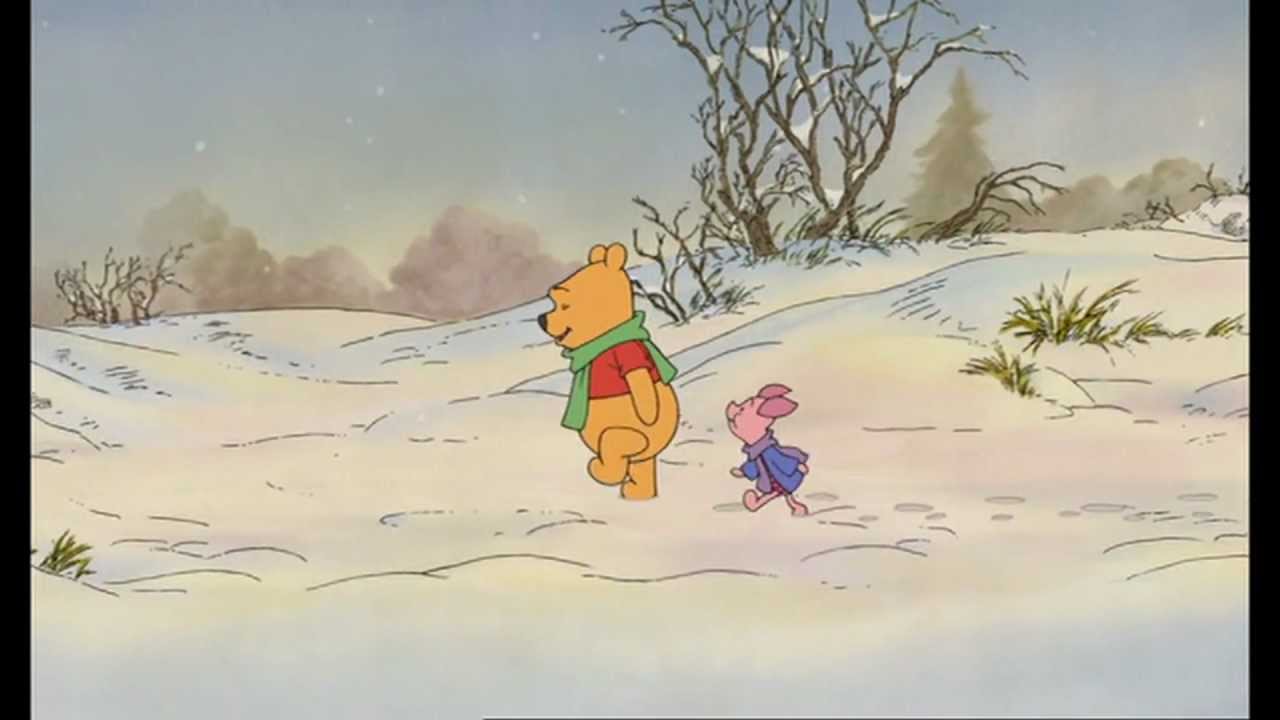
“The more it snows (Tiddely pom), the more it goes (Tiddely pom)” – says the Pooh. Uneducated, silly, empty, he lives the life the taoist way. And the “tiddely pom” says everything is there to say in taoist way.
The tree just is, grows, and that’s that. The rain just falls, and that’s that. People die, and that’s that. Don’t try to fight it, don’t try to understand it, it’s the tao.
I am not a taoist myself (obviously, I’m Eeyore), because I compulsively fight for understanding and truth, and that leaves me more and more frustrated in life. This is what tao wants us to avoid in lives. Well, I do my things because I chose so, as I chose to understand taoism, and I prefer my option but it’s a hard, hard road…
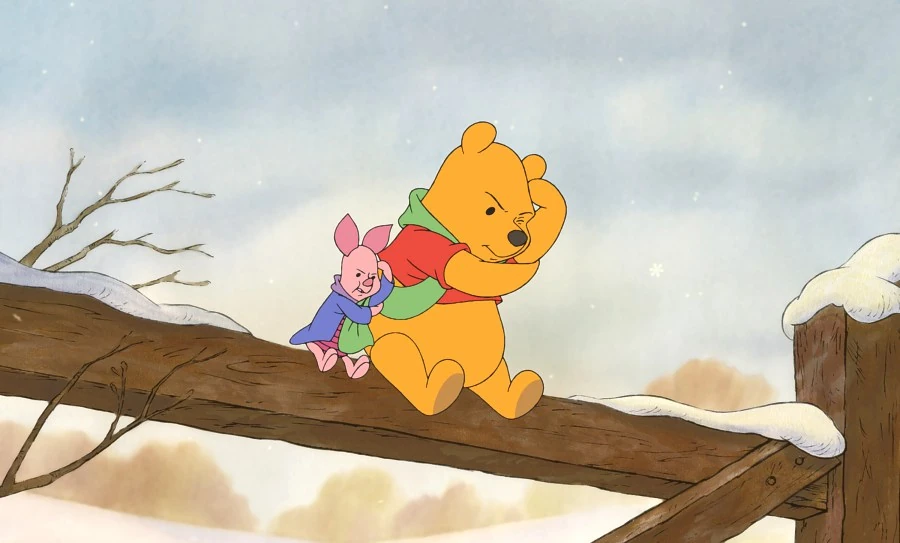
My face everyday kinda looks like that of the Piglet on this pic…
The Piglet is a completely different story in Hoff’s works, one much closer to my heart. The ideal of te introduces the concept of what is known in Poland as a proverb “when you have a soft heart, you need to have a tough butt”. But adds to it one important idea- that one cannot be a hero without being soft, without care for the people. In fact, Hoff proves, the Piglet is the only character in the books who is able to do anything. All others just talk or do nothing. It’s the Piglet who saves Eeyore who fell into the river. The small creaature, without self-confidence, always scared, in fact is the only character who conquers his own vices, steps out as a true hero of the day. And whenever I think of the real life heroes, they were always Piglets, people who cared, people with flaws but they were able to conquer themselves for the cause.
I don’t want to bring everything out to you, because it would be best if you consumed these two booklets together, absolutely worthy of doing so, especially if you’re interested in philosophy, as I am. And if you’re not, it’s one of the examples how deeply in us the Pooh resides, even today.
Lets talk about another not-so-forgotten masterpiece.
The second half of 80’s was a special time in Poland. Iron Curtain did not fall yet, but, thanks to several Polish IT specialists that lived in U.S.A, market started to be ripe for 8 bit computers like Atari and Commodore. I’ve been exposed to the 1st computer in my life when I was 6 years old in 1986. It was a ZX 81. My father would participate in a radio-amateur club SP2KFW in Radziejów, and these guys, mostly related to business areas like automation, electronics, electrics and soon to be computer-science, were the first people that actually had personal computers and seen the necessity to add computers as tools helping with their hobby. I had my Atari 65 XE presented to me in 1988. When we delved into 8bits and discovered programming (which remais to be my main source of income to this day), the West already learned the ways of the new, 16 bit, generation of machines.
One of the fruits of that generation was the “Loom”, made in 1990 . The wonder child of the 16 bit era was a computer called Amiga (“a (female) friend” in Spanish), with its superior graphical AGA board and sound card, when it came to present audiovisual content that computer was second to none. Before the Amiga, computer graphics reached the 256 colour palette at times, with some quite elaborate graphics too, but the age of computer-based storytelling was just about to start.
Amiga 500 allowed 4096 colours and the sound chip was 4 channels with sampling frequency up to 28 kHz. This was really something. It would be hard to believe for a new reader what difference it made to see the new pictures and music from that machine in comparison to the previous generation.
The Great Loom in the new age of graphics. The above is the newer version of the game, but the original was no less impressive.
So, with this marvelous piece of equipment everyone hopped on that new creativity train. Previously only movies could use the three media in semi-realistic or realistic manner, but now, computers no longer would “beep-bop” but instead they would play Tchaikowsky.
Yes, the first thing that immediately made us focus in the “Loom” were Tchaikovsky’s “Swan Lake” fragments. Never before would any author attempt to use classical music to the same scale in a videogame. Of course, chiptune short fragments of classical works were used in 8bit games before, but never to cover the whole longplay soundtrack of a game, with all its diversity of moods and scenes.
Swan motifs are in a lot of places in the game.
The second thing that would pick my interest as an 11 years old boy (I got my Amiga in 1991) was the protagonist: the hooded Nazgul-type, secretive weaver, Bobbin Threadbare. Nazgul-type, with his eyes only visible under the dark hood, because the same year I started reading “The Lord of The Rings” for the first time, which had a huge impact how I treated the whole scene and what my expectations were. And I expected an epic adventure in an original world with it’s own background and story. And “Loom” has provided. Weavers were a caste of magicians with an ability to weave reality from music (the same motif is in Tolkien’s “Silmarillion” when Ainur are creating the Arda from music), and they are a secretive bunch – whoever looks under the weaver’s hood is destined to die horribly. Bobbin himself is an orphan and a mesianic type, living somewhat on a verge of the weaver society, because of its Elders who perceive Bobbin as a threat to their culture and to the reality itself.
The original Amiga loom.
The reality of the “Loom” is special. It’s not visible at first, but apparently it’s the future of humankind, far after we killed ourselves in major conflicts and shattered the world to its current state – an archipelago of guild islands: weavers, glassworkers, sheperds, smiths. The world ingame feels very desolate and sad. Bobbin meats some people on his journey but, even though, there is still the feeling of solitude encompassed into the story, wherever Bobbin goes. The world is so strange, it’s cultures are so bizarre yet the game isn’t trying to explain it all. That creates the feeling this world has its own rich story, and makes the player to receive it in a completely different manner that a player would otherwise. It’s a secret of every major saga out there – make them believe that the world has a rich background without explaining everything.
One of the things impressing me greatly in game was the sky. Beautiful.
You knew Harry Potter’s Hogwarts was ancient before actually you learned its history, haven’t you? That’s what I am talking about here.
The analogy is not a random one, because the cultures of “Loom” use magic to do the work. Weaver weave sound, smiths chant the smithing, sheperds heal the kine with their staves. But along the adventure one starts to suspect there’s more to that magic than meets the eye- that, in fact, it might be a sophisticated technology no longer understood fully by its users. As Arthur C. Clarke said: the advanced technology may be perceived as magic in the unknowing mind.
Technology or not, there’s amout of pure magic to this world. There’s an evil power-hungry villain that tears the reality with his ignorance, causing the embodiment of destruction: Chaos, to appear and haunt the world. There’s a malicious dragon there too. But the most important part of this game’s storytelling is, and always will be, its mood. Sad, full of solitude, desolate. With the feeling of something gone, lost forever. The game starts with Bobbin seeing the last leaf on the tree, and the falling of the leaf spells the end of things. The game elevates that sadness and makes it follow the player at all times, until the very end wich is the peak of that feeling and brings a devastating hit of absolute loss, even though the world was saved.
The last leaf…
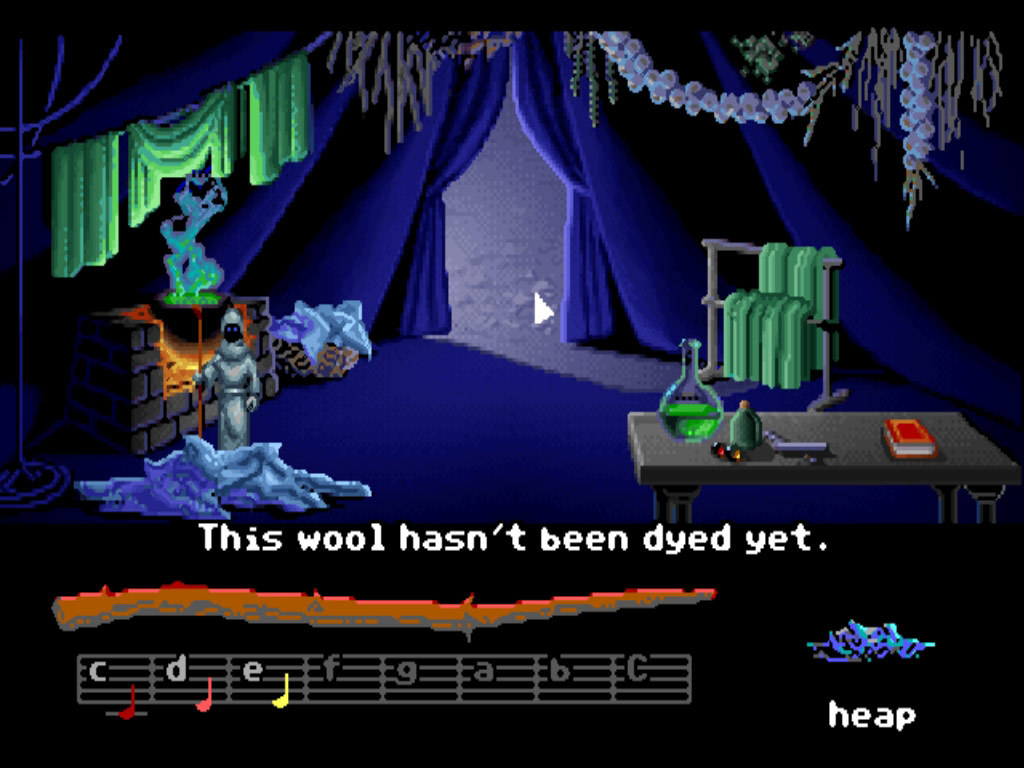
The game doesn’t have point&click item mechanics. Instead, it uses the distaff and the system of notes a player must play to cause an effect. So, if 3 notes dye the cloth, the same notes played backwards make it undyed again. Simple yet effective and majority of games puzzles is being solved that way.
Bobbin and the distaff notes
As for the graphics, the game had animations never seen before in any game. Adventure videogames slowly stopped to be “children’s toys” and raised their hand for their rightful place in the storytelling world of the mature humans.
They say movies were the 10 Muse, TV the 11th. With games like “Loom” videogames became the 12th.
I wasn’t able to convince any people to play this game. There’s something pushing people away in it. Perhaps they feel that the journey, although very rewarding, will leave them sad and thoughtful? True, but still, very, very rewarding. An absolute cult classic.
You need to see Brian Moriarty’s (the game’s creator) GDC lecture, you’ll learn of the creative process he went through on Skywalker Ranch:
Well, I mentioned Mr Poe before, but there’s definitely much more to be said of the author. It is difficult to write about known authors, especially those who are taught at school in many countries (not Poland, Poe is briefly mentioned only, but it’s understandable with the plethora of Polish masters of literature starting from early medieval times to this days, and then European masters…), because it’s really hard to tell anything new about works and the author. But if I learned anything at all from Tadeusz Boy-Żeleński, the famous Polish writer and critic, is that analysis of any masterpiece is an unending processes. One uncovers layer after layer of meaning and content, without end.
We all probably know Poe for the master and the progenitor of modern horror stories. Some, perhaps, know him for his grim depictions of passionate, ill, abusive and obsessive love. Popculture absolutely and completely aligns him with his parody of romanticism “The Raven” poem is. I think what is worth showing is how Poe excelled at every subject he touched.
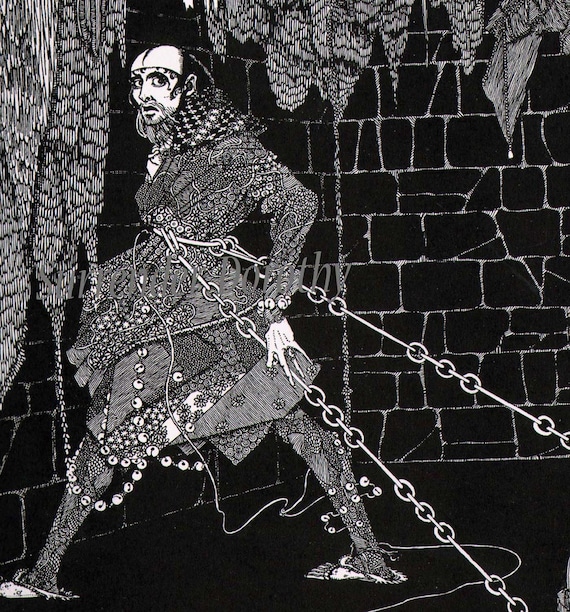
Make sure that Poe books you obtain have Harry Clarke’s illustratons…
First of all. The language. I am not a native English speaker (which you can probably already tell by my silly, overlooked writing mistakes or funny constructions I’ve been using in this blog) yet I am able to fully enjoy and evaluate the style and the quality of English Poe used in his works. Shortly: he used the writen language medium perfectly. Enveloping human emotions, psychological states and unspoken fears was always the function of poetry, yet Poe was able to encapsulate those in prose, convincingly. This alone is a tremendous achievement. Psychological study of Poe’s characters is flawless and the climate of the spoken phrases and depictions of the surroundings paints the picture in the way brains of readers are able to immediately grasp the concept and paint every scene acurately with reader’s own imagination.
Then there are psychology and empathy. Yes, these two factors determined the authors ability to tell those stories in such convincing and interesting manner. A reader, who heard about Poe but did not read his works yet, almost always starts reading it convinced what he is about to consume is a supernatural horror. A story after story one discovers that it is not the case, or not fully, perhaps. Majority of the thrills produced by Mr Edgar comes from psychological anguish alone. Just think about “The Pit and the Pendulum”, one of the best known stories Poe created. It tells about the torture inflicted on a prisoner enslaved by the Spanish Inquisition, locked in the pitch black cell, with a seemingly botomless pit in the middle. There’s nothing supernatural in this one, yet readers own empathy frightens and shocks from the very start to the very end. It’s easy to reconstruct the feelings of a prisoner, when he uses an animal fat on his hand bonds to allow rats in the cell to bite through them. Rats of course bite his hands as well… The effect is similar to the effect of the Room 101 from Orwell’s “1984”… In Poe’s works a natural phobias sometimes s e e m supernatural, to the point both the reader and the narrator are unable to tell what is truth and what is not, what is real. It’s like a self generated schizophrenia, that comes from a natural brain function – the function allowing us to convince ourselves we see things (think Shakespeare’s “Hamlet” and the ghost case).
Another example of psychological artistry is “The Barrel of Amontillado”, which allows us to study the development of a mortal grudge, of the cunning vendetta, carefully preserved hate which ends up with a cruel, unbelievable murder. What matters is that when the murder happens a reader both is shocked and sympathizes with an executioner rather than the victim. Poe allows us to feel the murderers reasons, and that’s the main source of the horror for the reader here. Oh how I often hear things like “I wouldn’t do such horrible things” or “only deviants could do it” when speaking about war atrocities, for example. Poe understood perfectly that everyone could and can do it, it’s just a matter of cioincidence mixed with a specific context. Again, humans are machines and will act like machines very often. It’s in our genes and that really makes us afraid of ourselves.
Want to argue on this? Deal with the consequences of the Zimbardo experiment first.
Harry Clarke’s “Morella”
One could say Poe’s characters are overpassionate, in the romanticism style of character building. They have far too many internal monologues, are being torn by too many contradicting emotions. It’s a valid point, however consider this: in the last 10000 years people don’t change, what changes is their surroundings – technology and context. I am saying this after studying historical eras and people throughout the history for 30+ years now. It’s so important let me put it again:
People don’t change. Only context and technology does.
That means you and me are not different from people living 1000 years ago. Our problems are different because a Norse warrior didn’t have to worry about a fuel pump, obviously, but he was equally concerned about the board pegs of his longboat.
Harry Clarke’s “Ligeia”
We often think such monologues are archaic and very awkward, but we do exactly the same thing when we face any difficult problem. And when one compares what e.g. one feels in difficult situations to the feelings of Poe’s characters it’s immediately visible how brilliant the author was.
Then there’s climate of the stories. I said Poe’s depictions are a food for thought and allow brains to immediately depict the scene. Grimdark mansions, brick walls, dunk, wet cellars, an uneven cobblestone, sweaty clothes, musky earth and a decomposing corpse… He was able to put it all there to his works, and the reader, often disgusted, can feel it.
Poe wrote a great deal about love, but he treats this state also clinically. Love in Edgar’s works is obsessive, dark, bordering with unhealthy desires and insanity. Love clinically is very similar to illness and it can be seen in e.g. “Berenice” and the narrator’s fixation about Berenice’s teeth…
Other love related works like “Ligeia” and “Morella” that deal with a drama of a loss of a loved one. And yet again, the psychological trauma borders with supernatural, with Ligeia’s transformations, Morella’s dying twice. Emotional exhaustion of the narrator and stages of grief he faces make the border between reality and delusion to dissapear.
I named Poe the “minstrel of the darkest love” once and I still continue to do so.
C. Auguste Dupin, the predecessor of Sherclok Holmes.
Then there’s the “Poe, the science fiction” writer. Before Julius Verne it was Poe who fantasized about the balloon travels to unreachable places (“The Baloon Hoax”) or exploring the poles of the Earth (“A Descent into the Maelström”). Some concepts he was writing about in those sci-fi works are awkward today (the same way robots from 50’s sci fi films are awkward to us, metallic cans walking strangely..) but the way his logic worked is flawless and should be applauded.
Poe, the cryptographer and a mathematician, is also worth mentioning. In “The Gold Bug” I adore very much, he actually describes how the Viegenere’s method works, in an “Indiana Jones-like” adventure.
Are you a programmer, like yours truly? Take a look at some code if you’re curious 🙂
I will briefly remind you again that detective stories would not be the same today if not for Poe.
Poe, the romanticist… Well that’s a hillarious one because “The Raven” is a response to the fellow writers who accused Edgar of being unable to write according to epoch’s decorum. He proved them wrong, used the trochaic octameter in 18 stanzas each 6 lines long, with a subject mocking the era a little. Funny thing is trochaic octameter is characteristic to Polish literature mainly and to Polish romanticism. That’s makes “The Raven” sound very nice for a Polish reader 🙂 Duh!
Edgar might have liked the joke 🙂
The doomsday feeling in “The Fall of House of Usher” and “The Masque of Red Death” affects many other works, including my beloved World of Darkness franchise I wrote about before. When we’re at it, think about how colourful are Poe’s work. In “The Masque of the Red Death” he uses colours to depict the various chambers of the mansions, but also the stages of the illness, the epidemy that is about to kill everyone. The same goes for “Morella” and the narrator observation of the colours on the face of a dying woman. The realism of colours in Poe alone is worth consuming his works in full.
And there’s my game – the game I am currently implementing and I will write about some more in the future, heavily inspired by Poe’s works. Is there a bigger homage than a pupil wanting to be like the tutor?
The range of game types I play is very wide. I generally avoid mindless shooters. I know mammals love combat in general (look at your cats and dogs how they spend their time together…) but human combat-related leisure time (as disgusting as it sounds) sometimes can be filled with absolutely mindless slaughter. For that reason I hated “Quake III” back then, and I still hate it now – if it’s just sport then why add blood to it? Why one needs such a level of realism if not for the sake of blood itself? I have been playing games for decades now and I KNOW it’s the case: the thrill of digital blood without consequences of killing makes us digital butchers. From the era of “Moonstone”, through “Mortal Kombat” and “Doom” it was always about the same thing. Blood.
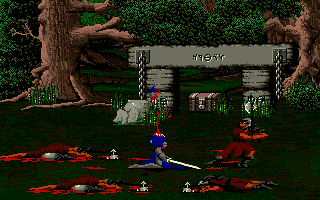
It’s just “Moonstone”. I started playing it in 1992 when I was 12 years old…
Recently I checked statistics from Assasin’s Creed: Odyssey. My character hero, during the time of the story, killed 4500 digital enemies. Digital people. Stop here and think a little. Did I say my character? I was the one controlling Alexios…
I don’t do platformers, mostly because I am absolutely lousy when it comes to the skill needed to play those. However there were some platformer games in my life that actually made me attached to the screen for long hours, especially those story-based. “Flashback”, “Another World”, “The Lost Vikings” or “The Inner Worlds”. I played these for the story.
“Inner Worlds”
There’s a number of other game types I generally don’t touch. But I mentioned these two genres above for a reason. One being a combat, or war, oriented, the second being a platformer. The reason is “Valiant Hearts”, of course, that blendes these two areas together.
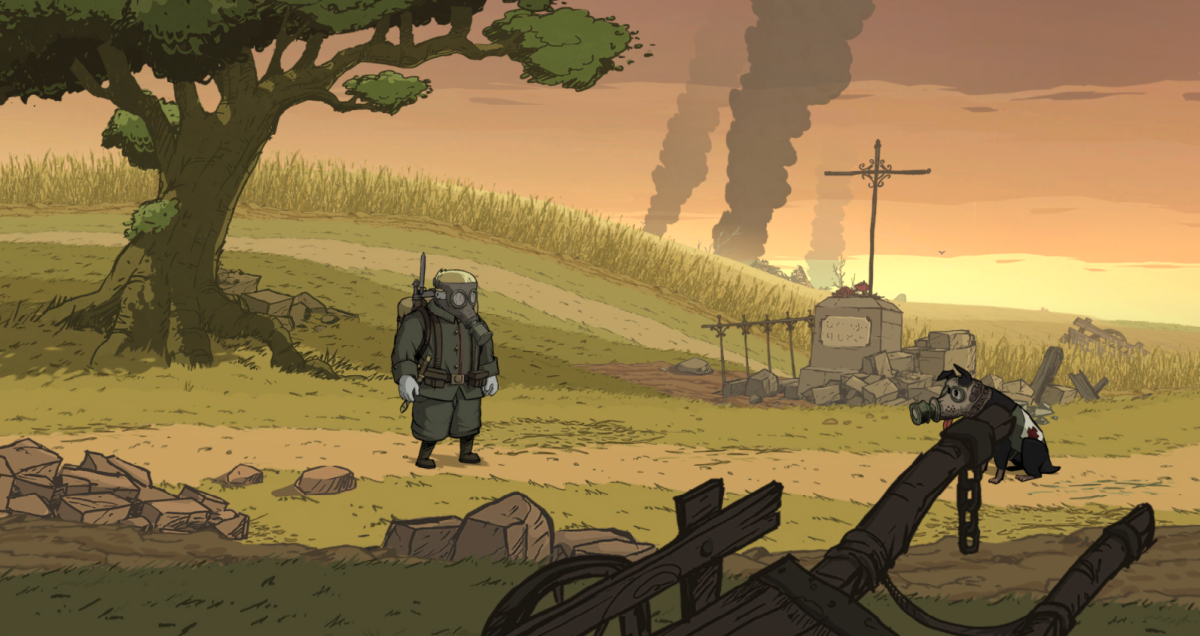
The game tells a story of several people and their lives forever changed by the Great War 1914-1918. These people don’t know each other and the story is being told from a perspective of a dog, a brave animal interacting with our protagonists. The game is also a puzzle sidescroller-platformer, with jumping , using items and shooting.
Anna. Look at the backrounds and the foregrounds. They also tell a story…
To tell the truth, I did not expect the magnitude of impact this game had on me. I did not think that I would be so moved after following Emil’s, Freddie’s, Anna’s and Karl’s stories. It’s partly thanks to this game brilliant depiction of war – it uses the cartoony style to show exactly what a player needs to see. And not only in a foreground, the background is also filled with pictures, each standing for 1000 words. The ruins, the refugees, the wounded and the dead. We see it all in this game. We see ordinary people with their lives broken and their possesions and relatives lost in an insane war machine, we see the randomness and pointlessness of death in the artillery barrage. We see how hate and vengeance takes over the minds and hearts of the otherwise ordinary people.
Eddie. The rage fuels vengeance. Vengeance solves nothing.
Our protagonists share one thing – they did not want to participate in this madness. Sure, Emil enlisted all by himself, but he did not do so because of politics. He did that for his daughter. Karl doesn’t want to fight at all – as a German on a French ground he was first expelled from France, then drafted into Prussian military. Anna is a medic, she’s saving lives. And Freddie… Freddie, a black-skinned, always smiling American, he lost everything in the war… He no longer smiles.
I told you before that we play warlike, mindless games for the sake of blood itself and a joy of a battlefield domination. It’s not by accident that these games are so devout of higher thinking processes. It’s a biological impulse – to disable those functions during combat, making all possible brainpower being taken over by a simple task – to kill and survive. For example, my wife is a seasoned Player versus Player gamer in Guild Wars 2, and it just takes a few minutes to observe what happens with her during the tournament against other players. From the nice, likeable person she changes into someone completely different. The digital killer. A very frightening digital killer.
Emil. An act of sacrifice for the family.
“Valiant Hearts” does an opposite thing. It surrounds player with death, destruction and war, but manages to give a player that feeling of “I want to leave this place”, “I want to be in a safer world”. According to many batllefield historians this is one of the first things to come to a soldiers mind after being exposed to the horrors of the war for the first time. The game manages to show us the same blood other games do in a completely different manner. In the manner, that we, biological machines, don’t want to look at it anymore.
It’s all in our heads, isn’t it?
The tension of this game is unbearable at times. A player very soon begins to understand that war is hell and death can happen anytime. It forces a player to play the game very carefully, as his own life depended on it, with a feeling of every step being fatal, and yet, a player is compelled to push on. Because there are things worth fighting for. Not a nation, not religion and definitely not political ideals.
In the wartime it becomes obvious for a common man what is really important: family.
Karl. Not a prison camp nor fields of killer gas can make him stop trying to reach his family.
Coming from a country that was war-torn for decades in the past, my point of view is biased. Though I did not live through war myself, my elders did. I know the stories. I know the cost – they told me about it. And “Valiant Hearts” strangely looks very similar to those depictions . “War is hell” – you see these words everywhere these days, but people actually forgot what that means. One day a person says that we should avoid war, and the second day the same person says that war can be justified sometimes.
Propaganda and political agendas of our rulers never take dramas of a single person into account. Anjd whoever says starting a war can be justified is either a politician with little care for individual lives (even if it’s according to Sun Tzu’s “Army is the only way to oppose evil” rule), or an ignorant idiot. The latter should play “Valiant Hearts” immediately. I mean it, like, now!
What this game does actually is to show us lives and tragedies of an individual. It tries to show us the price, and with that, I don’t know anybody who would like to pay that price after finishing this game.
This is one of those that will make your eyes wet. One that will make you ponder about humanity for hours.
I have no idea what is the most often behavioral model of choosing a book to read or a favourite genre in the era of electronic globalization. Whether one just goes to the GoodReads portal and checks the number of stars? Check the bestseller lists? I really don’t know, because my model is completely different. For example: I very rarely use any online rating system. Instead, I go for a hunch.
Back in high school I used to visit the public library in the city of Radziejów quite often. Normally I would hurry for the next bus going towards my home, but sometimes I deviated from my regular schedule and went to the library instead. There I would stare at the bookshelf for some time to pick something that “feels good”, either cover giving a good vibe or a short description.
That’s how I picked up “The Colour of Magic”. I assumed it to be an adventure fantasy, which I liked very much at the time, but it has proven to be something completely different.
In fact, the whole saga is one of the best philosophical works and most sober looks at humanity (after all Pratchett invented the “knurd” mental state (“drunk” backwards) – an opposite of being chilled out, the state of complete clarity, making some shout for hours in despair…) and our existence I have ever read, and Terry Pratchett, unwillingly, remains one of the greatest philosophers of XXth century in my eyes.
Where do I start…Well, it begins with the setup of the world that evolves with time – and that setup is: the Discworld is a parody of our real world and other fantasy worlds (by other authors). It’s a disc, supported by 4 elephants standing on the great turtle A’Tuin. It’s flat. It’s Creator’s joke (and an extension of another concept of Pratchett from “The Layers of the Universe”). It’s ridiculous to the limits of absurd and would normally fall apart if not the greatest law of the Universe that trumps the laws of physics – narrativum. The power of storytelling. Or maybe I should say: The Power of Storytelling, having in mind what this blog is all about. You, see, Pratchett understood what it means for humans to tell stories. He perfectly understood that we, humans, program ourselves socially and psychologically by telling stories. Example? Consider yourself being born in exactly opposite side of the planet (or the nearest landmass, because my exactly opposite point is somewhere in the depths of Pacific…) and think about what your beliefs would be and how you gained your own beliefs. Yes. Somebody told you a story about how the world works. Someone told you not to cross the street while the red light is lit. Someone told you it’s not nice to hit other children.
Josh Kirby was an iconic illustrator of Pratchett’s works. “Mort” cover.
So, the turtle, the flat world and the narrativum. What else? Oh, the regular fantasy setting with dragons, witches, dwarves, elves, werewolves, gnomes, trolls, humans, gods, Nobby Nobbs (fans will appreciate listing him as a separate species 😉 ) and many more… But’s just a first layer, scratch the surface and it’s completely different. Because Sir Terry wanted to tell another kind of story. Not just an adventure of a warrior or a wizard on a perilous journey for the sake of sudden plot twist and heroic deeds. No.
Sir Terry wanted to ask: what’s the point of it all?
What is the point of heroism for example? Why do we revere Conan the Barbarian? Or maybe: why people tend to know and revere characters like gen Patton more than Euler? Or, if you prefer, Hector instead of Socrates. You disagree? Well, watch all Marvel comic books and movies and tell me what is the percentage ratio of characters falling into Patton and Hector archetype against the other archetype… Why does Icarus trump Daedalus?
The main protagonist Pratchett started with (oh, because there’s a gallery of unforgetable characters in his works..) is Rincewind, an antihero. A wizard with no power, a goofy coward, made special by a random event. Rincewind never wanted to be a hero, he just wanted a peaceful wizard’s life, but being chosen of the gods and the greatest spellbook of the Disc makes him a target for everything and everyone: demons, lovecraftian entities, political powers and Death himself. With Rincewind constantly on the run, and falling into more and more heroic situations we explore this marvelous, rich and hillarious world. The humour of Pratchett’s works can be compared only to Douglas Adams’ “Hitchhiker’s Guide to the Galaxy” and perhaps, “Monty Python” comic group. It’s abstract, it touches the core of the matter and requires a level of intelligence to understand.
“The Light Fantastic”
Some of the jokes are multifaceted and multilayered… Sometimes after you understand a joke, live some more and gain life experiences, re-read the book you find there was a joke inside of a joke…
I mentioned Death, the antopomorphic personification of the process of the Universe. Well, remember about the narrativum, it rules the universe, so there’s more anthropomorphic personifications of processes in the books, like the Tooth Fairy or a Hogsfather (Disc’s Santa Claus), but it’s Death that shines most. Terry Pratchett was able to make Death look friendly, sympathethic and needed. Discworld novels are probably the best literature to deal with the concept of death philosophically, how it affects our whole lives and if should we fear it at all. Death hilariously tries to understand humanity, sometimes be like a human, with funny results: he builds a mansion, has a servant Albert, likes cats, tries his strengths as a farmer and … has a daughter and then granddaughter, Susan, who inherits some of the skills that, er…, run in the family.
Then there’s a matter of politics, both domestic and international. These are embodied by various archetypes like a romantic Verence, a righteous king of a small kingdom, lords and ladies of Ankh-Morpork, religious fundamentalism of Omnia, democracy of Epheb and… lord Vetinari. Vetinari is another story, because he is a “Machiavelli’s wet dream” – a man of the state and for the state on the one hand, and a cruel tyrant on the other, balancing between the two so the “system could work like a watch”. A person everyone fears but also a person that actually solves all of the state problems brilliantly.
Vetinari sometimes needs help of the newly formed police – the most progressive formation on the whole Disc. A noir style detective – commendant Vimes and his posse of multiracial, multigender, multispecies policemen bring constant joy to the reader. The way police works in the Discworld is a very moral compas not only to all police formations, but to humans in general. Vimes, after all, is the first person in the history of the Disc, who arrested the whole army during invasion for “distrupting the peace”. It was made possible with assistance from captain Carrot, a descendant of the old Ankh-Morpork kings with the charisma allowing him to bring two fighting gangs to tears of shame and Nobby Nobbs – the only human that needs a certificate of belonging to the human species. Vimes is the person that allowed peace talks between dwarves and trolls – and to calm the tensions between them – a long lasting hatred devoid of all reason. Finally, Vimes is the person that fiercely fought against racism by helping goblins – he countered unjust prejudices based on ignorance and used his authority to help the poor, abused goblin-people.
Everybody loves witches.
Who read the Discword novels without loving the witches? Probably no one: granny Weatherwax, the most powerful witch of the Disc and her sidekicks, nanny Ogg – a femme fatale that had many men and now is a head of the mightly family, Magrat Garlick – soon to be come a Lancre witch-queen, and Agnes/Perdita Nitt, a chubby opera singing witch with inclinations towards goth style. It requires a lot of brain power to fully understand how hilarious is what witches do to logic itself, how they bend it and break it sometimes. As mistresses of psychology they solve an average man’s problems, and, they show what is the foundation of the society and civilization – what is the true area all problem solving should start with – the said average man. Everything else comes to this – feed the bellies of men, calm the fears, teach and there will be no wars…
There’s a lot of Discworld characters there, as there is a multitude of topics Pratchett discusses, but I need to mention some more – Brutha the Prophet in the “Smaller Gods”, an excellent book about belief and religion and how they differ and, my personal favourite, Moist von Lipwig, an ex-thief turned into manager of post office at first and then into a head banker. His charisma never goes to waste for the better of Ankh-Morpork citizens. And Cohen the Barbarian laughs at Conan the Barbarian and his barbaric principles, saying that a soft toilet paper is far important than honour.
“Discworld” novels go through every possible subject of importance. Author’s deep care for humankind, his humanism and amazement of the world and the people is heart warming. Pratchett was able to show how insignificant we are and yet, how beautiful it is to be able to talk about our insignificance at all! Of course, with existence comes an inevitable pain – of sickness, of dying, of loss, but the author believed in the humankind, believed that some of that pain can be taken away. If only we all started to listen what he wanted to tell us, world would be a totally different place.
The Disc changes a lot in the books – starting as a fantasy world it becomes an industrialized and computerized environment. We see the Disc version of cinematography, the rise of new age music, and remote communication. And with it we see a lot of arising problems affecting the denizens of the world – like chauvinist opression and the rise of feminism. But our Discworld counterparts are always able to overcome it. In a good way.
Escarina becomes the first female wizard. Not a witch. A wizard! The triumph of Discworld feminism.
Then there’s a “Science of Discworld” trilogy, co-written with Jack Cohen and Ian Stewart – a science book for people that would like to take a look at various scientific puzzles of the new era, intertwined with the neat plot of Rincewind and the wizards trying to save our Earth from various threats.
Pratchett saw what humankind is. He saw everything that is good and bad. What makes people become warmongering savage beasts? Biological conditioning and ignorance. What makes traditionalists fighting for their ideas to the death or suffering of others? Biological conditioning and ignorance. What makes progress so difficult? Again the same two things.
Evolutionary legacy and ignorance… If we only could take away the second part of that equation, how much better our world would be!
Yet, Pratchett learned to love humankind, for all its flaws. As Death states many times – one cannot weigh compassion, there’s not a single atom of love in the universe, yet humans created these abstracts and these are worth fighting for and worth saving. Is our species special? No, we are but members of a huge family of animals of the world of organisms, but we are special in some ways. Do we have a soul? Perhaps not, because everybody intelligent there knows we are but complex machines, yet our behaviour sometimes seems to exceed our programming. We create our soul.
Death becoming a Hogsfather? A Santa Claus? Yep..
Sir Terry convinces us every single person is worthy and valuable, every single life matters. We don’t need a masterplan in the chaotic universe because in the end everything dies, even universes. We don’t need to try to preserve old ways, because the arrival of the new is imminent. What we need is to try to be decent people to each other, to receive some warmth from another everyman like ourselves in this cold, unknown, empty space we live in.
We are but trapped butterflies flying towards the candlelight, hopeless and doomed to perish, but our flight is epic, our wings beautiful and we deserve some love, Pratchett convinces us.
Here’s the list of the books Sir Terry wrote before the illness, an Alzheimer’s disease, took him. It struck me hard when he passed away, because I knew who he was, I knew what he cared about. He was a close person to me, even though I did not know him personally.
And I bet every fan of the series says the same about the author and the books.
Now, this one is a bit of a challenge. I am about to talk about the game that has so many interpretations and such psychological depth that it’s really challenging to even start writing about it. I have an equivalent of those hiperventilation moments when one tries to tell someone everything about his favourite book or game. Except this is maybe not one of my top 5 favourites, but has a visible place in my gallery of stories with an impact – at least in top 20.
I did not play any other Silent Hill game, before and after completion (multiple times) of SH2. My experience of the foggy and grim town of Silent Hill is based solely on this one game and I don’t see any other references to other titles of the saga. That’s beacause I did not know of the franchise before I played Silent Hill 2, and after I knew there’s just no possiblility that any game from the series could beat this one up in anything. This one is a shining gem and the best of all in the series. Probably also the best storytelling survival horror there is as well…
It got me hooked up from the very start – a man, John Sunderland, is washing his face and looking in the mirror in an obscure public toilet in Silent Hill. It’s not his first visit to the town, his wife was in a hospital and a hospice there. But this time, John arrived in Silent Hill, because he received a letter from his wife Mary to meet him there.
The problem is Mary died.
And so we start by looking at the face of a man, who knows he’s doing something insane – he follows the letter from a dead woman. We can feel his pain of the lost love, the many layered feeling of guilt (one layers of which is a guilt of being alive), and the insane and hopeless hope he has for meeting his deceased wife.
And that town…That town is covered with the thick fog, reducing visibility but to several meters. There are monsters in the fog, hideous creations that are twisted oversexualized, multilegged heaps of flesh… And so John explores the city in a hopeless journey of the mind.
He ocassionally stumbles upon others. People deeply disturbed and with serious psychological problems. There’s Eddie, a bullied, ridiculed for his entire life, young man with a complex of how he looks, absolutely self-councious of how he looks. There’s Angela, a girl with severe case of depression and suicidal tendences. There’s Laura, a little girl, all alone in the city. Mental problems these characters have are depicted in a very, very detailed manner, one can immediately see that devs did their homework. Nothing here feels fishy or is a laughing matter. They disturb player greatly, they scare from time to time, as a player wants to get inside their heads, to understand them or perhaps, to help them.
And there’s Mariah…
The moment I met Mariah in game I was startled and intrigued at the same time. She looks exactly the same like the late Mary. She has her voice. She has a different personality and different haircut though. Imediatelly after meeting her ingame I slowly fallen in some weird player moe love for that character and yet, I was scared of her to the bone. I started to follow her lead.
This game is so briliant on so many levels I just cannot fathom. Because that moe effect was intended from the start. Devs wanted the player to feel torn apart, to have doubts and yet, to follow the same fantasy John has – to reunite with his dead wife in life rather than death. The player is forced to delve deeper and deeper into that strange attachment, and learning that town actually might be creating all this characters and they might not be real does really nothing apart from strenghtening doubts – player still wants to protect Mariah, wants John to be with her.
The deeper into the rabbit hole the more knowledge about Silent Hill is aquired by the player. And that knowledge comes from various sources – from paper clippings, graffitis, books, conversations, from one of the scariest moments in videogame history – the elevator quiz… you name it. But the greatest knowledge comes from the little details, masterfully designed thingies that connect dots together. After some time player starts to realize that other characters don’t see each other even in the same room. While for John city is full of monsters he actually has to fight with, for Laura Silent Hill is a safe place, without anything scary or to worry about. The realization is so powerfull it adds to the horror. Is this happening in Johns head only? Is he mentally ill? What is this place that plays a different show for every person that visits it. Is what’s happening even real? The game balances on the edge and gives time to ponder on those things – and yet, player is unable to decide if Silent Hill is real or not.
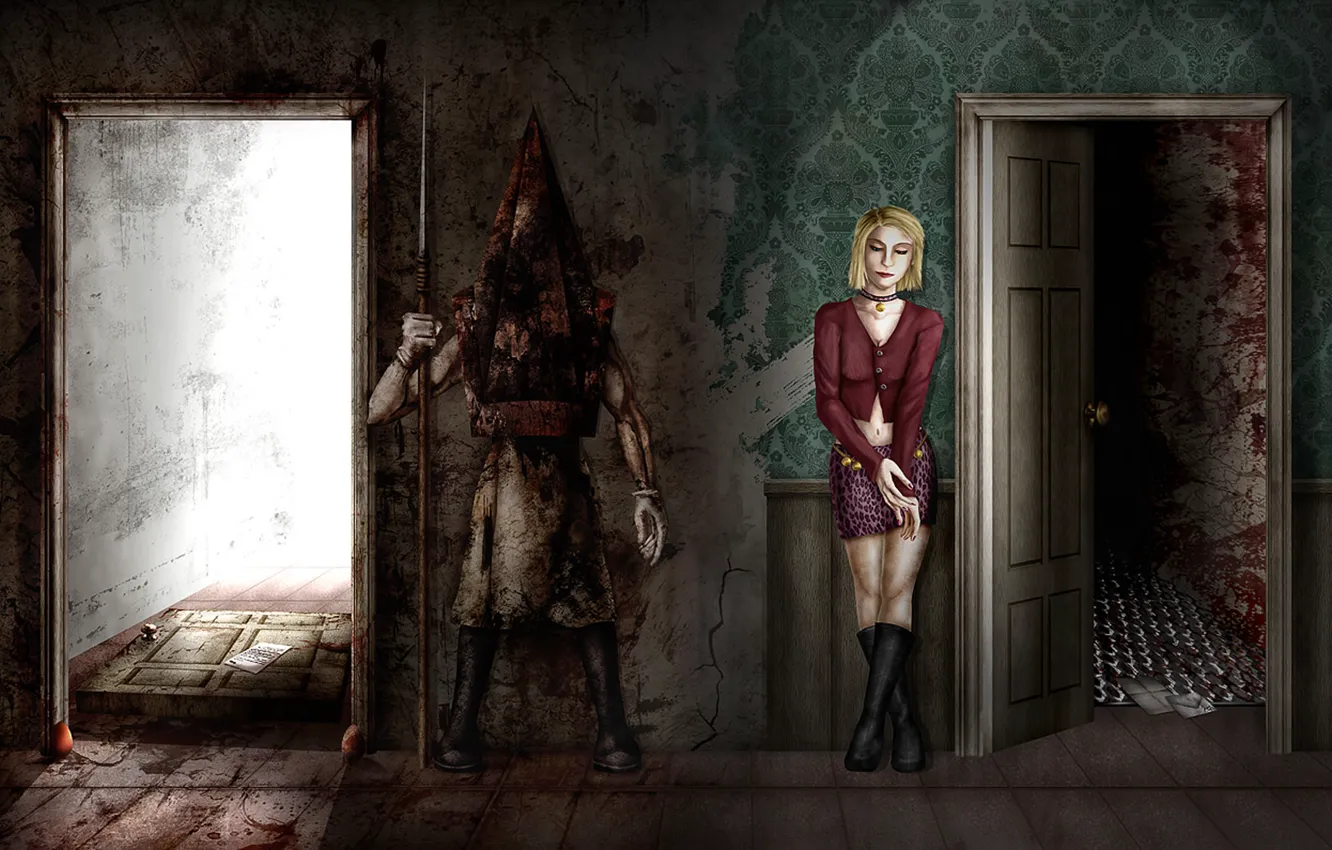
And then there’s an infamous Pyramid Head. One of the most iconic monsters in videogames. Its notorious presence in the game frightens the player and John so much, it almost immediately causes sweaty palms and the raction often is to fight or run. Primal instincts. Recently I watched a material about Pyramid Head by RagnarRox, who I am a big fan of, and I completely agree with his keen observation. Pyramid Head looks scary, we see him how he brutally, sexually exploits other monsters and it’s frightening and disgusting.
But it wants to help John.
You see, the more one thinks on what’s happening in game, the bigger the feeling of “this isn’t right” is. Following Mariah and the fantasy of regaining happiness is like an addiction. We know it’s stupid, we know John needs help and yet, we follow, unable to say “no”. John loses his senses, and the player loses his reason. Visiting Silent Hill is not helping John to overcome his grief, it makes him detach further from the reality. The need to protect Mariah is toxic, because there are multiple times where it cannot be accomplished.
Pyramid Head appears always before a turning point, and if player overcomed his insticts he’d see that Pyramid Head attacks only when attacked, or if player is in its path. Pyramid Head wants to block John from progressing on the futile path Mariah sets before him. He fights and abuses the very monsters that attack John. He’s the only friend John has in this town.
This graphic says it all. (by Max888)
I couldn’t understand at first why actually following the Mariah’s path is the worst ending for that game. But then I replayed it again and again to see them all. The understanding left a lasting impression on me. And I promise it will on everyone else who plays it…
Art. This is an early 3D game so everything looks retro for todays standards, but still, cutscenes are beautiful and directed excellently. But the biggest strength of game’s art is actually that it uses its full potential to tell te story. It’s depicting exactly what we need to see and know. For example – monters. If we look close enough we’ll see how they depict the obsession John has, how they reflect what he’s trying to accomplish. Arts shows exactly how John’s mind is creating the world around him. And yet, it seem so real (just horror-infested…), player starts questioning it’s realism only after going deeper into the story.
This brilliant game really is about a dark side of being a man. The popculture depicts males as hunters-gatherers and brutes but it forgets about the real darkness of being a male. Romanticism, sentimentalism and the feeling of accomplishment are good, but only if everything goes well. Yes. Men are sentimental and romantic, and very goal-oriented, and when things go wrong these feelings become frustration and pain instead. A true, overwhelming pain. Then add to the picture the knowledge that with great love often comes great pain, the pain of losing. A simpleminded brute is a just this: a brute, predictable, but frustrated, hurting masculinity is far worse: it’s toxic and dark. It hurts other people. It fights back, like a trapped animal. It snaps out of control. It causes the domestic violence and wars. It’s the very Hell.
See how brilliant this thing is?
This marvelous piece of work is probably one of the best games ever made. I can’t recommend it enough.
The mythology of the World of Darkness is a very complex thing. It was developed by a legion of people for 30+ years now, and it consists of many books, novels and supplements. The new plotlines were added and the existing ones refined. Of course, it often resulted in contradictory effects, like e.g. some metaplots events happening in only specific revisions of the setting, but overally it’s a smart and deep lore.
The whole setting is a one doomsday story. It really doesn’t matter when one places one’s sessions – be that ancient times, medieval, victorian or contemporary – there’s always a feeling of impending doom present. The fear for destruction of one’s being and the world around. The End of the World, the Apocalypse (Werewolf), the Oblivion (Wraith), the Banality (Changeling) and the Gehenna (Vampire). This one thing defines the whole mood of the each story told in that universe.
Is it true what I just said? On the second thought – not really, because, as always, it depends of the players how and what they want to play. As with every other setting, Vampire (and the whole WoD) allows one to tell all kinds of stories. You want comedy? No problem, you want action movie? Easy peasy. You want a slice of life? Absolutely.
The thing is all of those somewhere, somehow have always the bitter aftertaste. The comedy could be silly or really funny but sooner or later the vampire has to feed. Hunt or be hunted. That’s why one of the first most visible things in the lorebooks is how a vampire cannot maintain the relations with his mortal family. Well, she can try, but it won’t do good to anyone… On the contrary.
The vampiric state in VtM is a peculiar thing. No vampire knows for sure what are it’s origins. Many tried to explain the thing scientifically (Malkavian vampire Dr Douglas Netchurch…) to fail – there’s so many mystical and paranormal elements to the problem it’s just not possible to use just science to explain it. Some perceive it as a superhuman eveolutionary adaptation. The ultimate predatory state, if you will. Some see it mythologically -as a curse. Such is the case of those western vampires, mostly from the Sabbat sect, believing that vampires come from the first murderer, Caine who slew his brother Abel, and was curse by God., and as such was condemned from the very start as was any offspring he dared to create.
And here’s the problem. It’s not the only possible explanation to it. First of all, Chinese vampires do not share that belief, and in fact, they are so bizarre in comparison to their western brethren, it sometimes makes the Caine story completely invalid. There are also multiple beliefs around how Caine came to power around western vampires (as stated in the most important vampiric text: “The Book of Nod”). One says he got his power from Lilith, who, predated him as a vampire (“Revelations of the Dark Mother”). There’s an Egyptian strain, believing in Set as the first and the most powerful one, there’s an Arabic one, believing in Haqim as the progenitor… Many, many cults and beliefs, completely blurring the truth, whatever it may be.
The major belief, and the subject of coflict is the notion that Caine has created their first offspring, three vampires at first (the Second Generation) that created their offspring (The Third Generation) and lived with them in an ancient city of Enoch. But vampires are not nice, and curse or not, The Third Generation slain and eaten the Second. Caine left with grief and anger and the mithical Deluge was sent by God to cleanse the Earth from vampiric disease.
But some vampires from the Third Generation survived. These are known as Antediluvians, one of the scaries entities in the World of Darkness. Hidden, unbelievable powerful, godlike, always scheming and pulling all the strings.
All vampires fear that, if in fact Antediluvians exist, one day they will rise from the vampiric slumberstate – Torpor – and devour everyone, human or vampire. That is known as Gehenna in vampiric mythos.
Caine, Second and the Third Generations…
Aparrently only but a number of vampires believes in the whole Caine and Antediluvian thing. Camarilla sect vampires does not, and treats the thing as an allegory, or a myth only. Sabbat, very nietzchean in their ways, on the contrary – the very existence of the sect is dedicated to oppose the Antediluvians. That makes them thing of the organizations like Camarilla pawns in the hands of Antediluvians, and therefore, an enemy.
That is the genesis of vampiric Jyhad, the everlasting war. That is the mechanic that brings the doom to vampires. That is the mechanic that makes them destructive beings, unable to create in the long run, and, by looking at the bigger scope of WoD – tools in the hands of godike creatures of the night.
Now add another brick to the wall: 13 base vampiric clans come directly from Antediluvians. This makes the war a patricide war, and what can be more psychologically weighting than a mortal combat with one’s family? Aditionally, each clan bears a flavor, something of their progenitor is in their blood, giving them their powers and the curse.
The implications of that are grave. Just imagine – a part of your scary grand-grand-grand-grand-grand-grand……. -grandpa is a part of you…
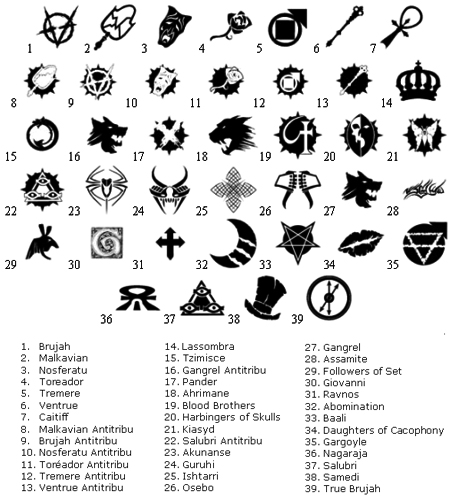
The clans…
Lets list the clans:
Ventrue – the vampiric nobility, and creators of the Camarilla.
Brujah – the rebelious warriors, in the days of old believing in humanitarian pronciples, now reduced to bravos.
Gangrel – beastlike Gypsy nomads.
Malkavian – deranged nutjobs, but there’s an immense knowledge on their madness.
Toreador – artists and poseurs. Vane.
Nosferatu – hideous and monstrous on first look, but in them the humanity burns the brightest.
Giovanni – necromancers
Tremere – warlocks. Mages of old turned vampires. Their magic changed too, for the better or worse…
Assamite – arabic assasins.
Followers of Set – Egyptian serpents.
Ravnos – Roma (Gypsy) tricksters and illusionists.
Tzimisce – Central European shapeshifters and body sculptors (literally..).
Lasombra – shadowmancers.
And there are bloodlines there too. They differ from the normal clan structures and their genesis is so bizarre they have to be treated separately, almost as clans with their unique powers and heritage.
Even more symbolism..
This makes VtM a dance macabre (because vampires are undead..) of different flavours. This makes vampires very deterministic, with an illusion of free will and an overwhelming feeling of being but tools in hands (or tentacles…) of greater powers. In the scope of the whole WoD, vampires are unwilling servants of the very force that want to destroy everything – with a normal circle of life – creation, destruction, decay – which creates material for creation again, vampires do not participate in it. They are a pathology, a deviation. These attributes make them actually make Gehenna self-fullfilling prophecy.
In fact, there are scholars in the vampiric metaplot that learn that (Beckett) Gehenna might not be a one time doomsday scenario – that in fact it’s periodical or happening over extended period of time. In other words – Jyhad is Gehenna.
As for the one time event, Gehenna was introduced as a supplement for the players to choose from 4 options, should they want to end their world in traditional style:
“Wormwood” (God destroys all vampires save for a few, who are given a chance at redemption)
“Fair is Foul” (Lilith takes her vengeance on Caine and his descendants)
“Nightshade” (the Masquerade is broken and the Camarilla divided as the Antediluvians awaken)
“The Crucible of God” (the Antediluvians rise up, ruling over or destroying most of the human race)
With the 5ed out on our doorstep though, I personally opt for Beckett’s point of view…
So, it’s the doomsday that marks unlives of the vampire (and all other denizens of the World of Darkness for that matter), with every step and on every occasion. The rope tightens constantly and this is the kind of storytelling players and storytellers alike search for by playing this system. They want ot be scared and feel hopelesness. And they want to fight it.
Is there a way to escape the doomed fate? Is there a way to somehow escape the endless loop of Jyhad? Perhaps. But this is a subject of another post, sometime. In the meantime, listen to the rhymes of ancient vampiric texts and arm yourself, Kindred:
On these signs, you must know,
that Gehenna waits, even at the door,
as an actor waits in the wings
It is coming! It is near!
Shine black the sun!
Shine blood the moon!
Gehenna is coming soon!
Back in high school, I had a classmate that I really didn’t like. He wasn’t really bright and wasn’t likeable. Coming from wealthy family from a regional capital town he looked down on me, a poor farmboy. We had not much subject to talk about without some ironic or sarcastic statements.But we did not want to fight, as different as we were, so the only common ground we could ever have was: computers. He was wealthy enough to have a new at the time MMX processor and top notch equipment so he boasted a lot. I listened to it, very interested in tech and, of course, in expensive and demanding games he got for his box.
One of those games, coming on 3 CD-ROMs, and therefore unaffordable by me (it was an age before CD-RWs so I couldn’t just pirate it…) was “Zork : Nemesis”. I waited for Christmas of 1996 when my colleague borrowed me the game.
You know, when you’re a kid or a teenager, getting games for Christmas is a special thing, probably remembered well for the rest of life. Especially when you receive a game like this one.
I did not play any other Zork games before this one, so I didn’t have any expectations. Later I learned this one was completely different from other Zork games, often absurd and with lighthearted storytelling. Oh no. This one is dark, very dark, with a tone of sadness throughout the whole story.
The very beginning is intriguing…
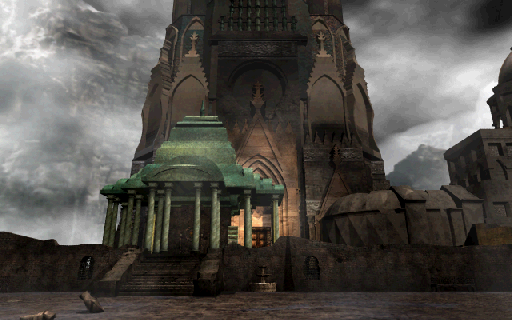
A player arrives at a monumental cathedral, the Temple of Agrippa, a deserted and ancient looking place, the seat of powerful Alchemists. My first feeling was being completely lost – I did not know who I was, what is my goal or what I am supposed to do now. Sure, there was a booklet with the game telling some important things inside, but still the feeling persisted. With everything so alien and absolutely gorgeous surroundings and unforgetabble music I was stunned at first. Then I started exploring.
The game is mostly about exploration and solving logical puzzles (sometimes very, very hard puzzles..), hints to which are scattered around. The very often case is that some part of the environment is blocked or locked until you solve some puzzle, and this forces a player to actually learn about the surroundings, the story and the characters.
Oh, the characters. Not long after the start of the game one finds some sarcophagi with preserved bodies of Alchemists and can communicate with their spirits (which are being played by real actors). They ask for setting them free and warn player about their Nemesis, a grim cloud of anger that manifests right after. A goal is set – reviving the Alchemists.
Bodies of Alchemists are waiting for something, preserved.
The whole journey is a journey through many bizarre and magical worlds (Alchemists’ domains) of wonder. It’s a journey of gaining knowledge of Alchemists, their goals and Nemesis itself. There’s one character that especially captures attention: Alexandra Wolfe, the violinist girl. Traces of her can be found from the very beginning of the story, and the player soon discovers that she’s a focal point of the conflict between Alchemists and the Nemesis, the frail, beautiful, sad girl.
Following the path set up by Alchemists allows the player to visit all the places belonging to powerful sages, each attuned to a separate element: fire, warth, water and wind. As the game introduces the full visual and psychological immersion to the player (you are the protagonist!), it’s in fact the player who visits those locations, making this game a sightseeing experience. Wind elemental Asylum in the cold wastes of the north, fiery Monastery with it’s rivers of lava, the desert fortress of Earth, and, my favourite, the watered musical Conservatory, each with it’s own theme and a plotline allowing the player to understand a quarter of the story.
Oh, I had a huge pleasure solving this puzzle for the first time back in 1996…
What hit me most and still makes a great impression on me is how this game was able to convey the feeling of sadness and the passing of time. “Nothing lasts forever” the game says, from the very beginning. The bittersweet, amazing and yet scary themes make the adventure perilous at times, with an encompassing secretiveness well suited for Alchemists. Everything in the story is encoded – in text, symbols, architecture, sculptures, paintings and music, there’s no straight answer anywhere. Unraveling those mysteries is what makes the game so remarkable, and even at the end one leaves with an impression that was but a first layer of secrets waiting to be discovered there, in the Temple of Agrippa.
This is one of those stories that, by presenting it plot, leaves an impression of the huge lore and world constructed behind it (like Tolkien’s, Middle-Earth, Herbert’s Dune Universe etc…). One just wants to learn more. A pity, the next Zork games did not follow the dark and secretive pattern and went on a comical path instead.
Wanderer, enter the Alchemists’ abode and learn their knowledge. I promise you won’t forget it.
From the earliest days of my life, even before I learned how to read properly, I was conditioned by my parents towards the specific view of Japanese culture. You see, it was still before the event of the Round Table discussions, and the life in Poland was circulating around the Central European style, with scarce amount of western culture influences. As rich as the culture is (1000+ years of literary and art history of Poland makes it one of the culturally richest countries in Europe) the exposure to western or far eastern lifestyles was limited.
Being in the Warsaw Pact had one drawback – everything that was from the “imperialist” zone of influence was considered inferior. Literally: “why are you using this west-german junk, buy Soviet Junost TV set instead” was a common discussion between tech-savvy people for some time. Everything was political. The point of view also included Japan (although I’ve seen one or two Hitachi radios at the time..), with its culture alien to Poles for a long time. That was about to change…
About the Polish-Japanese relations. After II World War Poles knew Japanese were an Axis power, and therefore, an enemy. Before that, there were some diplomatic relations that did not fruit any cultural exchange. There was one Japanese person and a one Pole that made some difference. Major Fukushima Yasumasa was probably the very first Japanese to ever visit Poland, and he composed the “Porando kaiko” (“The memory of Poland”) popular poem and later a song, known to this day. The second, was a brother of marshall Józef Piłsudski – Bronisław Piłsudski, the man that saved the Ainu people of Hokkaido culture from extinction. Nothing more than that.
Akira Kurosawa was well known, shown in the old movie block of Polish TV (“The Pearls of Old”) which had only 1 channel at the time (2nd channel was added some time after the 1st), but the ideas presented by Kurosawa were sometimes too alien to understand for a viewer, even though Kurosawa used also Shakespearean storylines in his works (“Ran”, “The throne of blood”).
And then, in the 80s, someone decided it’s a good idea to show a TV show “Shogun” to the Polish receiver. No one could foresee what impact it had on an unknowing viewer. After the emission almost all magazines started publishing ladies in kimonos, which were carefully cut out with scissors and used do decorate one’s kitchens (I remember my grandma doing this). Everyone was talking about samurai.
And this caused to yours truly, 4 years old Northon, to be dressed by his parents for a kindergarten ball (during which everybody else was either a princess, a cowboy or an American Indian archer) like this:
1984/85..There was a huge red sun painted on my back…
Yeah, I am saying I might be biased a little while talking about the “Shogun”. The TV series was (and stil is) a magnificent show, but it’s the book that matters for me. I started my first reading of the “Shogun” around 1995 and it was so immersive and so consuming, I remember just sitting there during school holidays and reading the thing, heavily supplied with delicious Kuyavian bread with butter and plum marmelade and a teapot with Indus tea, to eat something from time to time while reading.
I might be more than biased, because even now when I think of the book I can remember the taste of that delicious marmelade…
The book tells the story of an English sailor John Blackthorne (lossely based on the historical figure of Will Adams), one of the leaders of the expedition to find the western route to Japan. After landing he and the Dutch crew find out Japan is heavily influenced by Portugese Jesuit monks, which immediately leads to imprisonment of the protestant crew for piracy. John, being a brave and a very intelligent person, manages to convince the daymyos (lords) one by one that he can be a valuable asset, a wildcard in the domestic war of Sengoku Jidai. Kasigi Yabu, the bloodthirsty daymyo, wants to gain superiority by naval power and he wants to use Blackthorne, an excellent pilot and shipbuilder, as an asset. But then, Toranaga Yoshi, based on Tokugawa Ieyasu, appears, claiming Blackthorne from Yabu. Toranaga is a patient sage, not only a lord an a warrior – he’s a person Sun Tzu would think of as of a perfect pupil of his works. The moment in which Blackthorne boldly expresses to Toranaga, that there’s one excuse for rebellion against a liege lord – a victory over him, is the moment Toranaga sees Blackthorne in a different light. Blackthorne becomes an Anjin-san, a Sir Pilot of Toranaga. More than that, the relation between Toranaga and Anjin-san becomes more and more…friendly. They dance together, swim together and speak together.
Then there are Ishido, the Toranaga’s nemesis, Portugese with their political and religious schemes, christian daymyos… The war is bloodthirsty and lasting for decades now, so expect many heads falling down from their necks.
Oh, there are ninjas there too. Did I mentioned the ninjas?
Richard Chamberlain and Yoko Shiamda as Anjin-san and Mariko-san in the TV series.
Initially Anjin-san doesn’t know Japanese, so everything is translated by a Portugese monk (and Blackthorne’s nemesis) Tsukku-san, until Anjin-san protests against biased translation. Then Toranaga introduces Mariko-san, a beautiful lady of the court, a catholic, as his translator.
Mariko-san forever changed my view on women. The thing is she’s a Japanese woman as Japanese society expects her to be (calm, and bowing always..), but only as her tatemae (the facade). Truth is, she’s a last member of a rebellious family, that never forgiven for her family’s demise and the loathing she received after the rebellion. She’s strong and magnificent. She’s uncontrollable and brilliant. Toranaga sees that, and he makes her his most important asset.
That’s also why Blackthorne finds her mesmerizing. That’s why she, the only Japanese person in the book, is able to understand the western idea of love.
Their romance is one of the most beautiful and emotionally engaging romances in literature, and they are probably the best written couple ever in my eyes. Oh the sweet drama! She has a bloodthirsty elite samurai husband who beats her and looks for an occasion to slaughter Blackthorne, Japanese society doesn’t look kind to barbarians, and yet they are together, against all odds. The Japanese concept of sex and how important it is in social terms only spices up things. Then there’s a number of dramatic events during which a reader would just like to drop the book and somehow go and hug them/pat their backs.
The couple in Anjiro village, where their love evolved…
The thing is Clavell’s experiences with Japan are complicated. He was an Allied soldier, captured by Japanese during II WW and imprisoned in Singapore in P.O.W. camp, which caused him to write his bestseller “King Rat” (tbh whatever Clavell wrote was a bestseller, really..). Yet he was able to write about Japanese like no other western author. With amazement and the need to explain their culture and motives. And he succeded.
The “Shogun” is a novel about Japan and the Japanese, and reading it made me enter the path of slowly understanding the people – the path I follow to this day. This was probably one of Clavell’s masterplans – force reader to follow Anjin-san on his mentality-changing experience and become less gaijin and more – samurai.
But most of all – it’s one of the most important books of my life.
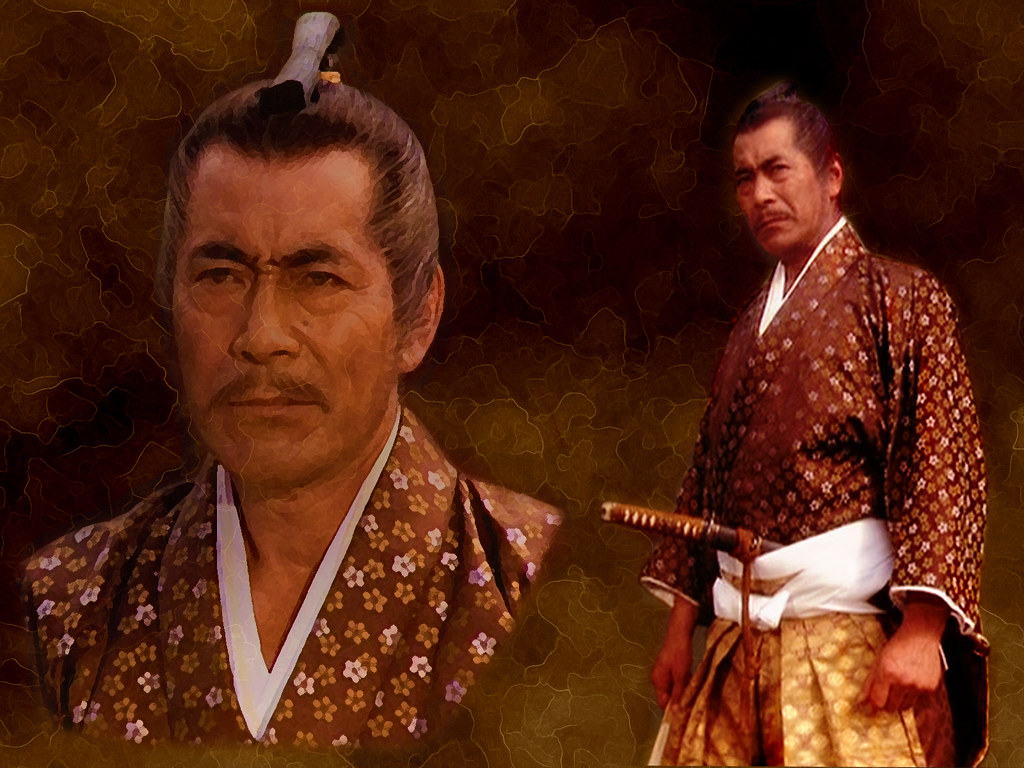
Toshiro Mifune is glourious as Toranaga in the TV series. Damn, he’s glorious in every movie he played in…
















 Amazing Worlds