It was some time since the last post but I needed some vacation, both from the game development and blogging 🙂 Sometimes one just needs a break, right?
I wanted to tell you about a game I initially had some problems with. At first, I didn’t quite like the character model, graphical setting and animations to the point everything seemed artificial and, I don’t know, plastic? But then I convinced myself to go forward and every moment of it was worth my time.
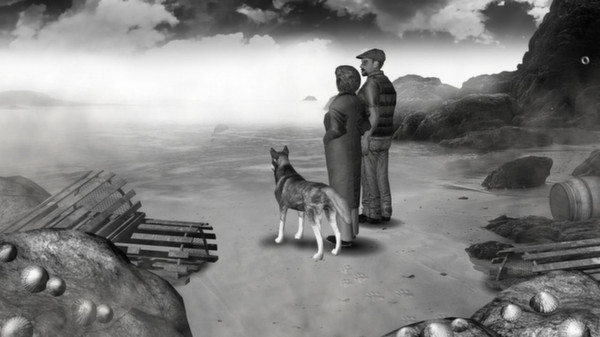
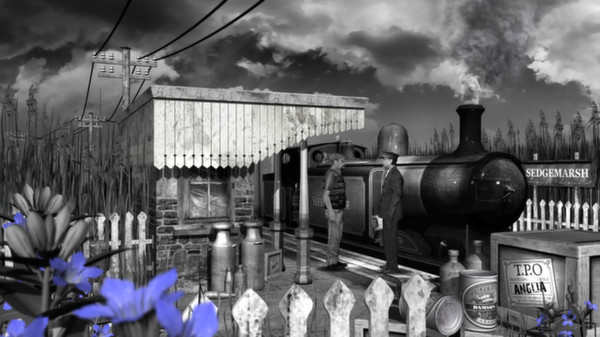
I am talking about “The Lost Crown: The Ghost hunting adventure” by Jonathan Boakes. The game takes us to the English town of Saxton, where as a ghost-hunter Nigel Danvers we try to find a Lost Crown of Anglia. The thing is , Nigel is a paranormal investigator and as such is a somewhat a weird character. Quite soon the player discovers that all other characters are also weird…I know what you are thinking – “Twin Peaks” right? Not really, because Saxton has a distinctive Anglo-Saxon charm. It’s not only bizarre, it’s really unsettling. Regular folks seem to be strangely absent, following their own strange agendas and all of this seems like a really onirical (dream-like) setting. I realized animation stiffness adds to the picture, as well as the fact almost everything in game is black&white, except some really interesting objects and animals like e.g. dragonflies in the marsh, which seem strangely “we do not belong here” because of that.
The fog… It’s unnatural.
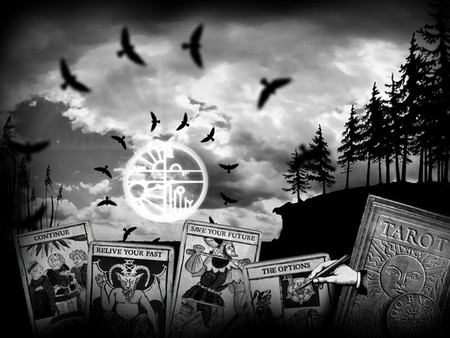
The very first time Nigel actually sets up his ghost hunting equipment and start listening to the wavelengths kept me really on edge. Oh, I know – we all hate jumpscares. They are cheap and silly. “The Lost Crown” doesn’t do that often, it does that precisely when it needs to, and I am really thankful for that! Nigel’s ghost hunt, explorations and conversations with denizens lead him to some really unsettling discoveries, during which two worlds start to intertwine and collide. I will not spoil it for you, but after some time the player start to notice a fact that not everything is as it seems in Saxton.
A careful usage of colour produces a marvelous effect!
I still remember the plot line, the puzzles, the events from this game, even though it was several years since I completed it (5?). I could really appreciate it back then and now…Oh, how I now know how difficult the process of being a sole gamedev is! When I see the marvelous work Jonathan Boakes placed in his games (Because “The Lost Crown” has also a special called “The Midnight Horror”, and the prequel called “Blackenrock” is on the way) I cannot do anything else but say “a very great job, Sir!”
The trilogy of games that had a real impact on me is definitely “The Devil Came Through Here” trilogy, by Remigiusz Michalski (Harvester Games). This games were a long inspiration for me as a gamedev and also a lighthouse in the dark seas of storytelling. I had a pleasure of exchanging some thoughts with Mr Michalski, about game engines etc, and his insights on one of the forums helped me resolving a collision puzzle in my own project.
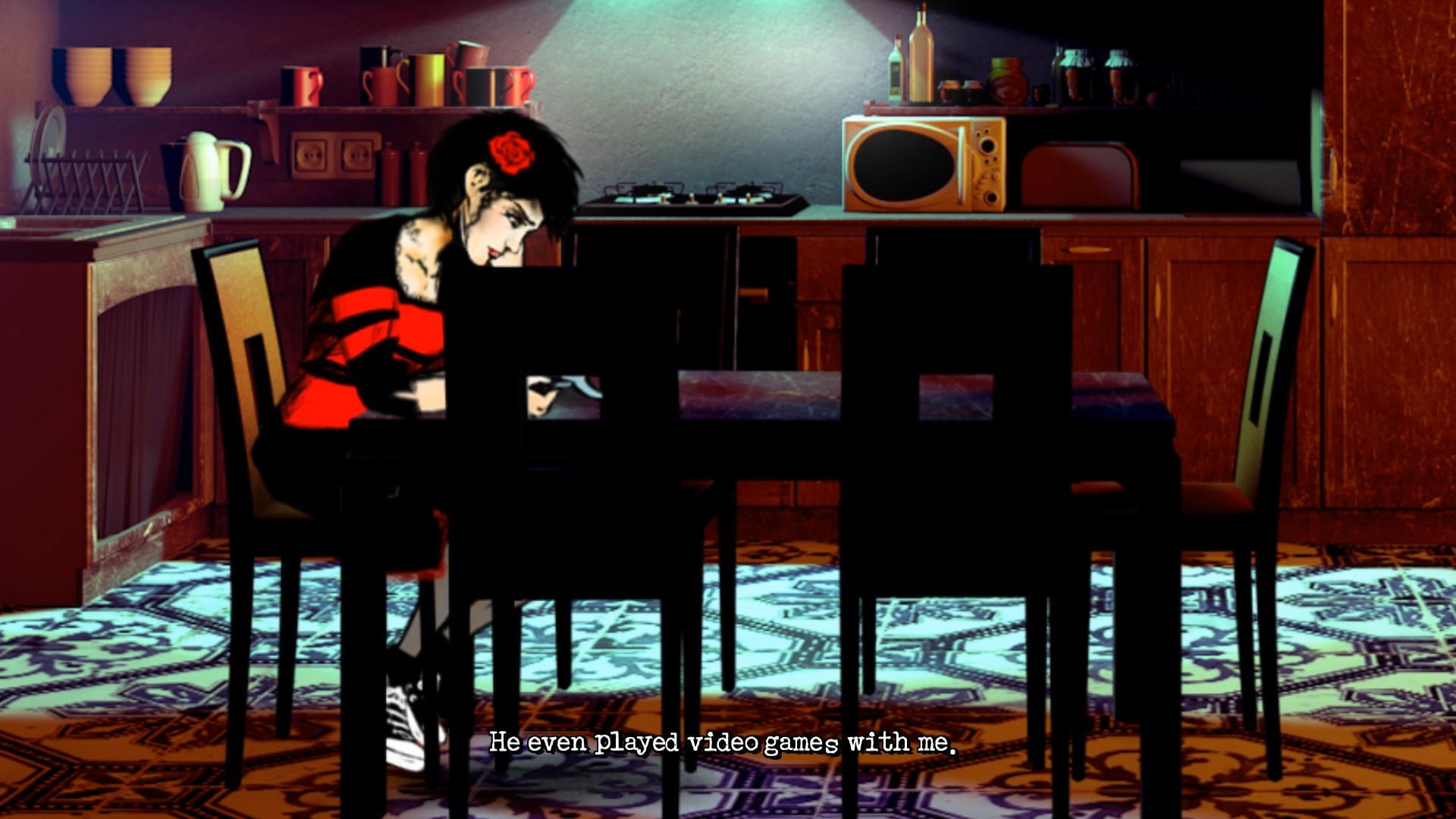
It started with a “Cat Lady” which I picked up with curiosity after seeing a trailer. The game in which the protagonist, Susan Ashworth, commits suicide in the very first scene, while her cat watches her slowly passing away. The scene had a very powerful impact on me, as I am a person deeply interested in the human psychology. What I did not know then is that the game features a lot of horror game mechanics, with occasional jumpscares, which I quite hate. Susan wakes up in a grassland afterlife, and is greeted by the Queen of Maggots, an old lady, with disturbingly skeletal-thin arms, and is sent by her back to life to get rid of five parasites – humans that should no longer exist. I couldn’t help it, but I immediately started comparing this game to the DreamWeb, and there’s a lot of similarities there. Susan cannot die on her mission, and dying and getting back to life to approach the situation from a different perspective is sometimes the last resort that pushes the action forward.
Susan’s reality is grim and depressing…
What is different though, is the dialogue the game has – the dialogue about emotional anguish, the feeling of loosing someone, depression and terminal illness. Of all disturbing moments from the game, the one that probably had the biggest impact on me was learning that one of the characters is terminally ill.
The majority of the game takes place in a tenement block 12th Helen Road, with its sinister sign letters forming a word “hell”. The building is a home to various people, and curious personae, that show the level of awkwardness not unlike the one from “Twin Peaks”. The more Susan explorer the place, the more it seems weird, hellish, onirical, with its denizens creepy and horrifying.
One of the disturbed denizens of the block is Joe, the horrid man, making a very, very bad impression of people who play the “Cat Lady”. We explore his story in the second game, “The Downfall :Redux”. The “Redux” is a remake of the earlier game by Michalski, and it’s a soft of a prequel to the “Cat Lady”, but the prequel that can be appreciated most whole played as a second game in the series. Joe is struggling with his love for his mentally disturbed wife. Yet again ,the game explores very difficult subjects – of anorexia, self acceptance, placing all feelings around a one person, and all destructiveness of those. And yet again, the game is very, very dark, with some unsuspected plot twists.
Meet Joe and his wife…
Right after playing the second game, I sent a short message to the author, thanking him for the game, and he shared the early alpha screenshot of his third game, “Lorelai” with me. I just couldn’t wait for it , but I had to. And finally, several months ago it was released. Serving as a finale to the story, we follow Laura, called Lorelai, a young girl from a deviated, dysfunctional family and its problems – a drinking mother, a dead father, a pervert, violent stepfather, poverty. During the series of events, full of violence and death, Lorelai meets the Queen of Maggots, who, in turn, wants to play the same game she played with Susan. Lorelai is sent back to life, and she is given yet another chance… As in the other two, Remigiusz Michalski is not afraid to ask difficult questions or convey difficult emotions. But I cannot help to think that the author is a little tired of these depressive games and would like to create something bigger. Well, some people struggle to get to his level, while he looks towards higher goals it seems 🙂
Lorelai wants just a normal life…
I wanted to write this article to say the trilogy is a MUST PLAY. You seldom find games so captivating, so grim and yet so beautiful with their discourse with humanity and its perils. The questions asked , questions about what it means to exist and what is the nature of evil, are heavy , the scenes are gory, and yet the whole thing feels like a serene contemplation about life, while sitting on the cemetery bench, rather than a horror.
And for me, for me it’s the gamedev goal I aspired towards and I hope my own game with be able provide, even if a part, of the same pleasure these games gave me. Rem Michalski is for sure one of my idol gamedevs.
Don’t wait, these are worth of your time.
A fun fact: the last game features voices of some well known Youtubers like YongYea and Jim Sterling.
The first game made by Wadjet Eye I ever played was “Resonance”. I was drawn to it after seeing several screenshots published on some gaming portal and, as a person very much into pixel art and 90’s style of graphics, I purchased it immediately. What was just a “but a playtest” approach towards one game, quickly became a years long adoration of the Wadjey Eye company and their products.
The game, set up in the near future, features 4 protagonists. First, there’s Ed, an assistant to the prof. Javier Morales, a scientist working on the resonance effects of particles. Anna – prof Morales’ niece, is a hospital nurse having some psychological issues (and in fact she probably should be in one of the “psychological problems in videogames” articles of this blog) and an unbeaten childhood trauma. Detective Bennet is conducting a police investigation on the track of mysterious Antevorta organization. And there’s Ray, a political blogger and a hacker. All four are brought together by a mysterious explosion in the prof Morales’ lab and start acting together to uncover the secrets of the mysterious experiment.
An accident in the lab. An accident? What if…
I normally tend to talk a lot about the plotline of the particular game, but I will leave you deliberately in the dark with this one. It is a detective story, that is most pleasant while uncovering things and matching the pieces of the puzzle together, piece by piece. The game has several shocking plot turns and several dangerous timed sequences – enough to keep the player on edge sometimes ( and far less, than in, say, Telltale games – to my delight). But what makes the game and the plotline really interesting is how actually these 4 people interact with each other and how their personal storylines intertwine. Giving control over all four to the player is a bold move (although not a new one…), and forces player to experiment with different setups and combinations of characters to achieve some goals. Anna’s feminine charms and medical knowledge combined with a press/hacker attitude of Ray give different results than grumpy Bennet combined with awkward Ed, while facing the same problem and situation. The game tells its story mainly through that trial and error, and soon a player starts to feel those characters, starts to be invested in their lives and problems.
Protagonists meet on the stadium to discuss their next steps.
Well, I don’t need to tell you how important it is , especially for those, who like character-centric stories. E.g. “Game of Thrones” TV series was finished recently, and with the books and the show being really Westeros-oriented than character-oriented (as every fantasy with a pretense to be a mythology or a history book of its setting), yet everybody is talking about characters only…
But getting back to the matter – I often tell, times after times, how important it is to leave some things “blank”, so the reader or a gamer could feel it in by himself. The more product relies on imagination the more “blanks” it really needs. And I will be telling more about the subject when I am ready to talk about Tolkien’s “Silmarillion” (not ready yet, for various reasons…even though I read the book dozens of times for 30 years now…). In “Resonance”, player has got plenty opportunities to experiment and walk a mile in protagonists shoes. The player is forced to play a role, yet, the amount of freedom of experimentation, trying to combine various items together or operate various implements and discussing things with people, is huge and so is the amount of player generated story.
A futuristic touch&feel.
To those of you who played adventure games before, you know exactly what I mean, but for all the rest: imagine the “Sherlock Holmes” story, in which the chronology of Sherlock’s actions is not determined by a shortest possible way to get to the conclusion, while still building the mystery and the climate through narrration, but, rather, by an unknowing narrator, who experiments with the story, not knowing how it will end. This is what happens in games like this one, and this one is particularly good when it comes to its combinatorics.
I am not a big fan of conspiracy theories or conspiracy games for that matter, so the subject of this game did not captivate me as the other games did. I also prefer rather traditional detective stories instead of dystopian future theme (there’s just too many dystopian themes in popculture these days…). But, like I said before, this is the game that got me onto the Wadjet train and the game one could learn from a thing or two.
One of the oldies I would like to talk about today is “Albion” by the German developer Blue Byte. The game was released in the era I still had a low tier PC (Pentium 60) and majority of my software was taken from the free cover CD-ROMs that came with magazines. In one of those, a really weird one, was a demo of this game. I was a seasoned c-rpg gamer back then already, with years of experience in the genre, so I had a lot of expectations. “Albion” provided, and to this day, remains one of my top favourite rpgs.
My expectations were quite simple: I wanted a great, rememberable storyline, unique protagonists I could understand and I could identify with, a compelling and consistent world, and of course, captivating game mechanics. Simple, right?
Iskai.
The story takes us into the year 2230, onboard the scientific-colonization spaceship “Toronto”, belonging to DDT Corp, into the mind and body of Tom Driscoll, a shuttle pilot, who is about to embark on a scout mission to the planet Toronto is currently orbiting. First few hours of game can be spent onboard that spaceship, with its futuristic, metallic surroundings, a hyper-smart ship A.I., cyborgs and security guards, and of course crew, amongs which Tom has some friends, a girlfriend, and a soon to be companion Rainer Hofstedt, a physicist and xenobiologist. The thing is, one of Tom’s acquaintances was killed in a strange accident in a hardware terminal area of the ship, and everything is so vague, while, additionally, ship A.I. urges Tom and Rainer to hurry up and start the shuttle mission to make the low orbit survey of the barren planet – according to all “Toronto”‘s computers and sensors – I immediately sensed something fishy here. So, instead of directly going to the launch bay, I started investigating.
Onboard the “Toronto”
During my investigation I was able to find a hidden entrance to the tech ducts, acquire a plasma pistol (a forbidden item for a simple crewman), smuggle it up from the tunnels with me, find the accident place and learn it shows signs of murder (why would the captain and the security want to cover it up?). At the time, I had a backpack filled with a lot of items, toothbrush, two mugs, first-aid kits, rags and even a pillow. And all that before the real adventure actually started – these were the deciding factors of why the game won me already, even before it even started. I was an immediate fanboy. Oh how many storytelling attempts nowadays forget that a convincing, interactive storytelling has to let you do seemingly poitless things, like gathering toohbrushes, because it builds up the world and the character you are playing. This is the storyline filler, the ultimate metaplot mechanic generator – the story you tell yourself while exploring the story relayed to you by others.
When I was ready I finally headed towards the shuttle bay (with all the stuff I had) and started the mission. Everything went smoothly with Hofstedt, until there was a circuit problem on the shuttle and all communications with “Toronto” were severed. The shuttle dove towards the barren, airless and lifeless planet surface. Only Tom’s skill saved heroes from crashing to their deaths, but to what end, I asked myself – they surely will die from exposure?
I just love the scenery…
When the shuttle hit the planet and Tom and Rainer escaped its hull, ready to risk their lives outside rather than to remain in a soon-to-be fireball, they discovered the planet is a wonderful paradise, and not barren at all. The fantastical pillars of rainclouds rose over the beautiful jungle, full of commotion. Years after, during watching of the “Avatar” movie, I was bitter because I could see how much the “Avatar” has taken from Roger Dean (an artist who we’ll return to while talking about another game soon) and the “Albion”. And I’d rather have “Albion” instead of “Avatar”…
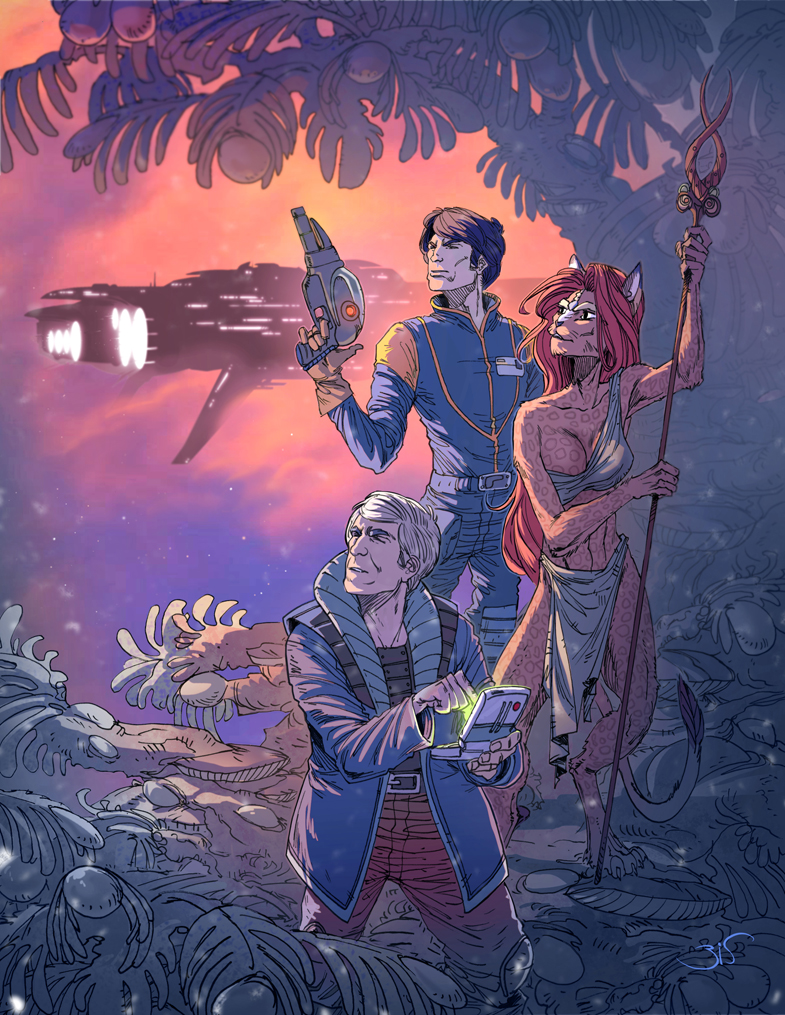
The shuttle explodes and our heroes loose counciousness, to wake up later… among the catlike, intelligent race, the Iskai. What is happening? Why does DDT and “Toronto” try to hide that the planet is actually populated by intelligent , civilized race and full of life. Above intelligent, because, apparently, Iskai know…magic. I wondered a lot why Iskai are not as amazed of Tom and Rainer as these two are of Iskai, even spending there months and learning the local language (ofc without any rescue attempts from “Toronto”), until another plot development – there are humans on the planet too! Celtic tribes with culture exactly the same as on Earth in antiquity.
Sira knows Iskai and Celtic languages, and she’s a Dji-Kas wizard. I couldn’t have won the game without her…
So this is the legendary land of Albion, king Arthur travelled to…. But how?
Sci-fi becomes a fantasy medieval with magic (all neatly explained!) in an epic saga of the clash between the primal nature and the industrial change. A struggle between the new A.I. god versus an ancient magical goddess. There’s so many layers of the story there I can’t even express it. The murderous power schemes, the weird and forbidden love of human towards an Iskai, the story of beings that became ones with the nature, and a ton, and I mean A TON, of lore, regarding, Iskai, Celts and cyberpunkish reality of DDT. Nowadays there are several games that want to achieve the same level of detail with new techology, and these games are an instant win if they pull this trough (Witcher 3, and the upcoming Cyberpunk 2077 e.g.) but they seldom reach the level of “Albion”
Tom, Rainer and Sira – a fanart found on the Internet
But, apart from the great story and iteractivity, and gimmicky two ways of displaying the world (topdown and first person), the most important thing is how beautiful are the graphics. The exotic visages of Albion’s deserts and jungles still work on me (I played it last October, while on vacation in Greece, in these periods between returning from the beach of Korintian Bay and going to sleep 🙂 ) It really enhances my imagination to the point I can say I just fell in love with the setting.
I wish I could see more of Albion, and from that hunger I have it always installed and tend to replay every few years.
There’s nothing really in the game market these days like the “Albion”.
Exploring the world in both, topdown and fps views paints a full picture.
I mentioned before I am a huge H.P Lovecraft’s and E.A Poe’s fan. My own adventure game, being developed at the moment, is, in fact, heavily influenced by those authors, with several references to the mythos and the overal mood. The “mood factor” is very important here, as capturing it is probably the most important thing of the storytelling by these two giants. Lovecraft, for example, managed to build tension with the exquisite vocalbulary he was using – words like “eldritch” or “gibbous” added to the overall reception of the ghastly scenes. The same was with E.A. Poe and his intense depictions of the environments, as seen in the mansions shown in the “Fall of House of Usher” and “Mask of the Red Death” .
I have no idea how I found “The Last Door”. I have several colleagues, also interested in the eldritch and storytelling, so I definitely was informed by them about the product, but I managed to dig to it several months before that. The game was first available as a browser game, with new episodes unlocked for backers (I was 567 backer I think, to show you how small the interest was…), and available for free later on. It was very easy to overlook this game. I mean – a browser game, with pixel art. I am very fond of the pixel art, but I hate browser and mobile gaming, because it tends to eliminate the storytelling element from games, and, well, I don’t need to tell you how important it is for me to have it in my games.
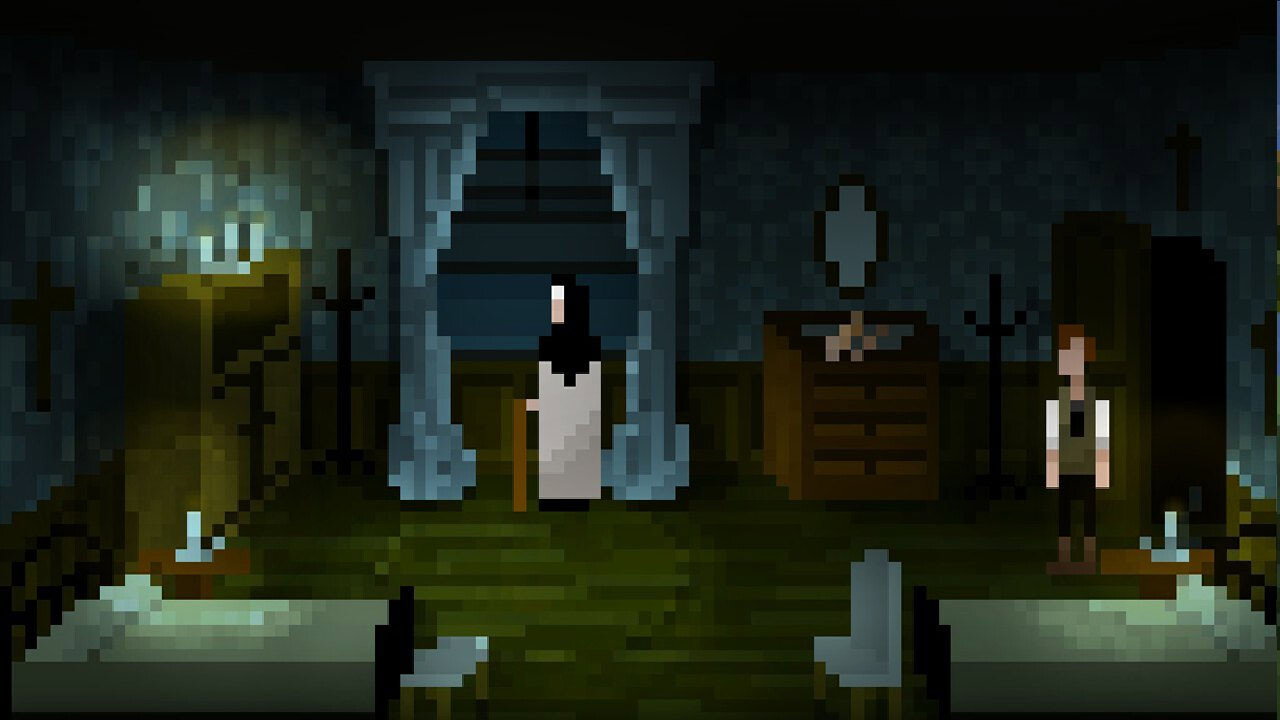
Devitt exploring the convent.
After the amazing intro, depicting some ravens and crows, being an obvious reference to the Poe’s “Raven” and the fantastic music I was immediately into it. Well, the “crow factor” is also something important for me. Wait till you see my game…
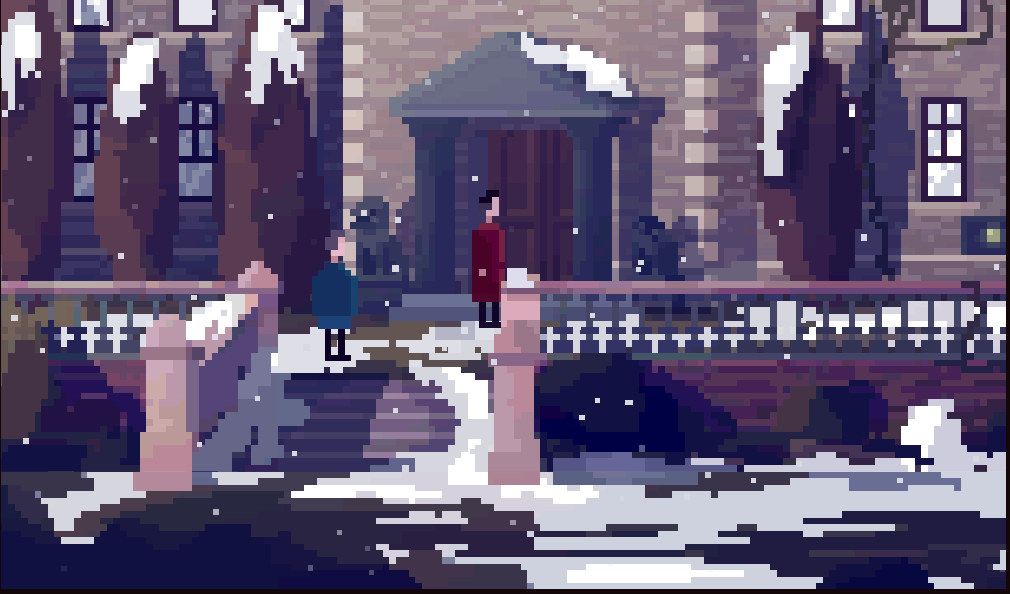
The story, made of two seasons, follows two protagonists. Jeremiah Devitt in Season 1 and Dr John Wakefield, Devitt’s physician in Season 2. Devitt’s task is a search for his colleague, Anthony Beechworth and for that, he travels first to the Beechworth mansion, which leads him to some other places in Scotland, featuring the hospital, the school. Mysterious and frightening events lead to Devitt’s dissapearance, and make Dr Wakefield deeply concerned. He starts following Devitt’s footsteps in Season 2 to uncover even more of the horrible, otherworldly truth behind the curtain.
Wright entering the Wright Manor.
I will not spoil it for you, because if you name yourself a Lovecraft and Poe fan, either you already know it (so I don’t need to) , or you just HAVE to play it. I mean it. The wooden, squeeking floors. The dim lantern light in the darkness, the horrible visages and frightening events. It’s masterfully embroidered into the storyline canvas in “Teh Last Door”.
One could ask – frightening visages? In the pixart game? Yes, I say! The obscurity of the pixelart make the scenes even more onirical, even more eldritch and gibbous. The shapes are unsharp and twisted. The faces are expressionless, leaving all the work to our imagination. And it achieves the state of the brilliant synergy with its storytelling, to the point in which the storyline of “The Last Door” consists both of the Spanish developers ideas and player’s imagination, filling all the gaps. The effect is just brilliant.
It’s difficult for me to express how Carlos’ Viola music contributed to the game. I am completely certain the game would be half of what it is today when it comes to its mood, if not for the music he composed. Below I post two YT pieces, first an intro, and the second is the whole OST. Just listen to it. Brilliant. You’ll never forget the insane concerto music from the first chapter after you hear it.
One more shout of respect for the developers. At one point they were creating this game without having any money to continue the project, to the point when several devs left it with broken hearts to earn some money, elsewhere, because otherwise they’d become peniless. Yet they managed to pull it through, this marvelous piece of art this game is. Chapeau bas, gentlemen! Chapeau bas!
As one of the reviews say: it’s a “love letter to Lovecraft”. It’s far more than that.
Another 90s Amiga adventure game hit was “Dreamweb”, for multitude of reasons, really. First of all, it strayed from the regular point and click schema and introduced a topdown view, as in RPG games of the era. Secondly, it produced a very, very dark mood. Thirdly, its setting was cyberpunk-ish, yet very mature. The mixture of these these three elements brought the game to attention of the press and audience, but what made it rememberable, was, again, its storyline.
The protagonist of the game, Ryan, is a bartender in a futuristic, dystopian state (implied to be England). He has a girlfriend and lives a mediocre life, being a medicre man. He clearly shows the sickly, maniacal indifference and other symptoms of depression. But it’s not implied anywhere that Ryan struggles with any mental problem: the game allows a player to feel and evaluate Ryan’s mental state only by showing his attitude to his surroundings, which makes it sometimes quite uncomfortable to be in “Ryan’s skin”, from the start. Aditionally, Ryan is having dreams, or nightmares rather. Ryan dreams of the entity called DreamWeb, and its Keepers, the hooded personae who communicate through dreams.
Ryan learns in his oniric state that DreamWeb is a world with a real power. It resembles the Changeling:the Dreaming (a part of my beloved World of Darkness) world constructs like the Dreaming and Arcadia, very much. Ryan also learns that DreamWeb maintains the stability of the real world and that stability is in peril.
DreamWeb featured a topdown view.
The Keepers bestow the world saving mission upon Ryan. He has to find and kill 7 “parasites” that endanger DreamWeb and the world…
This moment got me hooked into the game immediately, as I remember. An average person with a mission to kill people bestowed by a dream… That’s just… nuts! Immediate questions were: is the DreamWeb real, is it just Ryan being sick and depression started taking its toll. It doesn’t get any better when Ryan gets fired by his boss in the bar, and starts to be commited to the horrendous task.
He spots the first “parasite” on TV in the bar…
From that moment onward I was ensnared by the need to learn what is the truth behind all this. Is Ryan a maniacal murderer going on a killing spree, or is the DreamWeb real? I needed answers so I followed the tasks bestowed upon Ryan by the Keepers. And so Ryan started killing using me as a tool – to see the ending I had to pay the price of following the ordered tasks…
One of the most disturbing scenes of the game was slaying a rockstar (a parasite…) while he was having sex on the bed in his suite. Pixel blood and gore splattered and panicking woman had a shocking impact on the gamer of the era and was seen as very controversial, causing some difficulties to authors of the game.
The more player delves into the game the more the climate becomes darker. The last parasite is no longer human but becomes a disgusting huge monstrosity, crawling through the Underground tunnels, which also seem to belong to some monstrous world. It’s not unlike any other lovecraftian horror, and again forces a player to question Ryan’s mental state.
Everyday life is about to be changed forever…
The very last scene provides more questions than answer but is strangely fullfilling. I will spoil the ending now, so stop reading now if you want to play this retro marvel. Spoiler goes below:
3
2
1
Spoiler: Ryan is teleported to DreamWeb and thanked heartily by the Keepers but now the price needs to be paid: when Ryan gets back to the real world he is shot by the police after emerging from the subway. Yes, the quest ends as it should, really, in a quite consistent way. No matter the reasons, he was killing people and had to be put down or arrested, no doubt about that. But was DreamWeb a true entity or was it a delusion? Both answers are really plausible here, but at this point the most important thing from the player’s perspective is no longer the answer, but the sadness for the lives lost.
Clunky as it is by today’s standards, it is still a game worth playing today.
I have written about the most known Davey Wreden’s game before. “Stanley Parable” made Wreden one of those game devs I look up to in my gamedev career. People like him have great stories to tell, create a lot of artistic content in form of both plotline constructs and technical assets and they often do it alone or only with a small team of developers. That solitude makes the creation process less of a software development undertaking and more of an artistic project, not very unlike to the solitude of a painter.
In fact that’s the way games were developed 40 years ago. A publisher, having rights to a certain IP, would hire a developer to code the game for him. In the 8 bit era games weren’t very complicated visually, but it still was a difficult process requiring a lot of ingenuity. The very similar process is within the indie gamedev world today, except it’s devs themselves who create and publish games.
They just want to tell stories and their “amazing worlds”. Right?
The game development proces… In popular imagination gamedev is kinda like a weird mix between a rockstar and a hipster. There’s a lot of truth in that statement, because the medium is very popular and the demand is huge. The hipster part comes from the notion that a dev must be a weird type of nerd. What that depiction completely misses is what is the price of becoming a gamedev. We all know the trope of a whisky-drinking writer, bathing in cigarette fumes trying to forge a story or overcome a writer’s block. It looks difficult, it looks frustrating and painful, right?
A writer’s anguish.
“You know nothing of creative pain, kid.” our rockstar-hipster would say if he was to be like the ones from the popculture. Well I certainly won’t because I learned myself all those processes have their pains.
The truth is the gamedev process is painful, difficult, and has a powerful negative feedback. During the creative process, author’s self-validation is immediate and not all skills required to create a game can be acquired by a single person. As a storyteller one might lack the knowledge of tools needed to make a game, or a programming language. Gamedev, similarily to architecture, requires a marriage between the world of artistry and science, the world of mathemathics and creativity. This alone raises the bar, exponentially.
Lets assume one was able to acquire a tool knowledge and has a story to tell. One starts telling a story by creating a game. Very soon the author will learn about his own limitations. He’ll start fighting those limitations by trying to study harder or simply getting around them. This alone forces him to make compromises, sometimes forces him to abandon whole sections of the story he wanted to tell, because he’s unable to convey it in the form of the game. Then he finishes his product, sometimes the understanding follows that he’s only able to do games like the one he just did. There will never be anything new, the process of replicating the same non-creative formula is all that is left, not unlike that of a painter’s being able to paint only the lakeside sceneries on sunset with the same colourset to sell those on the local market.
Behold – it’s the gamedev impotence! The soul-eating demon that preys upon my kind.
“The Beginner’s Guide” is a story narrated by Davey Wreden himself. A player follows Wreden’s story about an acquaintance of his, nicknamed “Coda”, a gamedev, who, since 2008, created a lot of small, interesting games. Narrator wants us to play those games and to try to unravel the psyche of Coda. What makes him happy? What makes him sad? Why does he make those games? Does he even like making games at all? Step by step, the great mystery unravels producing more and more questions, right until the meaningful end. By playing Coda’s games we start seeing patterns, we start recognizing reused elements. Did he reuse those assets on purpose, as an artistic tool, or was he just unable to create anything new? There’s a lot of questions there…
I will not give any further clues to the story. I just need to tell you this – being a gamedev myself, I understand. “The Beginner’s Guide” for me, just a 2 hrs long experience, was brilliant and difficult to bear at times, it was like a look in the mirror. I think this product is a must play for everyone that ever wanted to be a modder or a gamedev, and it seems Davey Wreden thinks the same, since he named his game “The Beginner’s Guide”…
Beginner, beware! I know you love telling stories and love videogames. I know you are creative. But this discipline is a soul-twisting, blood-drenching experience. It will squeeze you like a sponge, it will make you frustrated beyond belief. It will consume all your free thoughts, to the point you will not be able to go asleep because of the stress. It will unbalance you. It will shatter your self-confidence and turn your hype into dust.
But, if you are lucky, persistent and if you work and learn hard, it will allow you to make something worthwhile and rebuild your self-perception as a better human – the person that overcame self-limitations.
Wreden’s “The Beginner’s Guide” is about that, and more. It’s a must-play for everyone that want’s to be a gamedev. I mean it.
Take a look at the trailer, also narrated by Wreden:
Lets talk about another not-so-forgotten masterpiece.
The second half of 80’s was a special time in Poland. Iron Curtain did not fall yet, but, thanks to several Polish IT specialists that lived in U.S.A, market started to be ripe for 8 bit computers like Atari and Commodore. I’ve been exposed to the 1st computer in my life when I was 6 years old in 1986. It was a ZX 81. My father would participate in a radio-amateur club SP2KFW in Radziejów, and these guys, mostly related to business areas like automation, electronics, electrics and soon to be computer-science, were the first people that actually had personal computers and seen the necessity to add computers as tools helping with their hobby. I had my Atari 65 XE presented to me in 1988. When we delved into 8bits and discovered programming (which remais to be my main source of income to this day), the West already learned the ways of the new, 16 bit, generation of machines.
One of the fruits of that generation was the “Loom”, made in 1990 . The wonder child of the 16 bit era was a computer called Amiga (“a (female) friend” in Spanish), with its superior graphical AGA board and sound card, when it came to present audiovisual content that computer was second to none. Before the Amiga, computer graphics reached the 256 colour palette at times, with some quite elaborate graphics too, but the age of computer-based storytelling was just about to start.
Amiga 500 allowed 4096 colours and the sound chip was 4 channels with sampling frequency up to 28 kHz. This was really something. It would be hard to believe for a new reader what difference it made to see the new pictures and music from that machine in comparison to the previous generation.
The Great Loom in the new age of graphics. The above is the newer version of the game, but the original was no less impressive.
So, with this marvelous piece of equipment everyone hopped on that new creativity train. Previously only movies could use the three media in semi-realistic or realistic manner, but now, computers no longer would “beep-bop” but instead they would play Tchaikowsky.
Yes, the first thing that immediately made us focus in the “Loom” were Tchaikovsky’s “Swan Lake” fragments. Never before would any author attempt to use classical music to the same scale in a videogame. Of course, chiptune short fragments of classical works were used in 8bit games before, but never to cover the whole longplay soundtrack of a game, with all its diversity of moods and scenes.
Swan motifs are in a lot of places in the game.
The second thing that would pick my interest as an 11 years old boy (I got my Amiga in 1991) was the protagonist: the hooded Nazgul-type, secretive weaver, Bobbin Threadbare. Nazgul-type, with his eyes only visible under the dark hood, because the same year I started reading “The Lord of The Rings” for the first time, which had a huge impact how I treated the whole scene and what my expectations were. And I expected an epic adventure in an original world with it’s own background and story. And “Loom” has provided. Weavers were a caste of magicians with an ability to weave reality from music (the same motif is in Tolkien’s “Silmarillion” when Ainur are creating the Arda from music), and they are a secretive bunch – whoever looks under the weaver’s hood is destined to die horribly. Bobbin himself is an orphan and a mesianic type, living somewhat on a verge of the weaver society, because of its Elders who perceive Bobbin as a threat to their culture and to the reality itself.
The original Amiga loom.
The reality of the “Loom” is special. It’s not visible at first, but apparently it’s the future of humankind, far after we killed ourselves in major conflicts and shattered the world to its current state – an archipelago of guild islands: weavers, glassworkers, sheperds, smiths. The world ingame feels very desolate and sad. Bobbin meats some people on his journey but, even though, there is still the feeling of solitude encompassed into the story, wherever Bobbin goes. The world is so strange, it’s cultures are so bizarre yet the game isn’t trying to explain it all. That creates the feeling this world has its own rich story, and makes the player to receive it in a completely different manner that a player would otherwise. It’s a secret of every major saga out there – make them believe that the world has a rich background without explaining everything.
One of the things impressing me greatly in game was the sky. Beautiful.
You knew Harry Potter’s Hogwarts was ancient before actually you learned its history, haven’t you? That’s what I am talking about here.
The analogy is not a random one, because the cultures of “Loom” use magic to do the work. Weaver weave sound, smiths chant the smithing, sheperds heal the kine with their staves. But along the adventure one starts to suspect there’s more to that magic than meets the eye- that, in fact, it might be a sophisticated technology no longer understood fully by its users. As Arthur C. Clarke said: the advanced technology may be perceived as magic in the unknowing mind.
Technology or not, there’s amout of pure magic to this world. There’s an evil power-hungry villain that tears the reality with his ignorance, causing the embodiment of destruction: Chaos, to appear and haunt the world. There’s a malicious dragon there too. But the most important part of this game’s storytelling is, and always will be, its mood. Sad, full of solitude, desolate. With the feeling of something gone, lost forever. The game starts with Bobbin seeing the last leaf on the tree, and the falling of the leaf spells the end of things. The game elevates that sadness and makes it follow the player at all times, until the very end wich is the peak of that feeling and brings a devastating hit of absolute loss, even though the world was saved.
The last leaf…
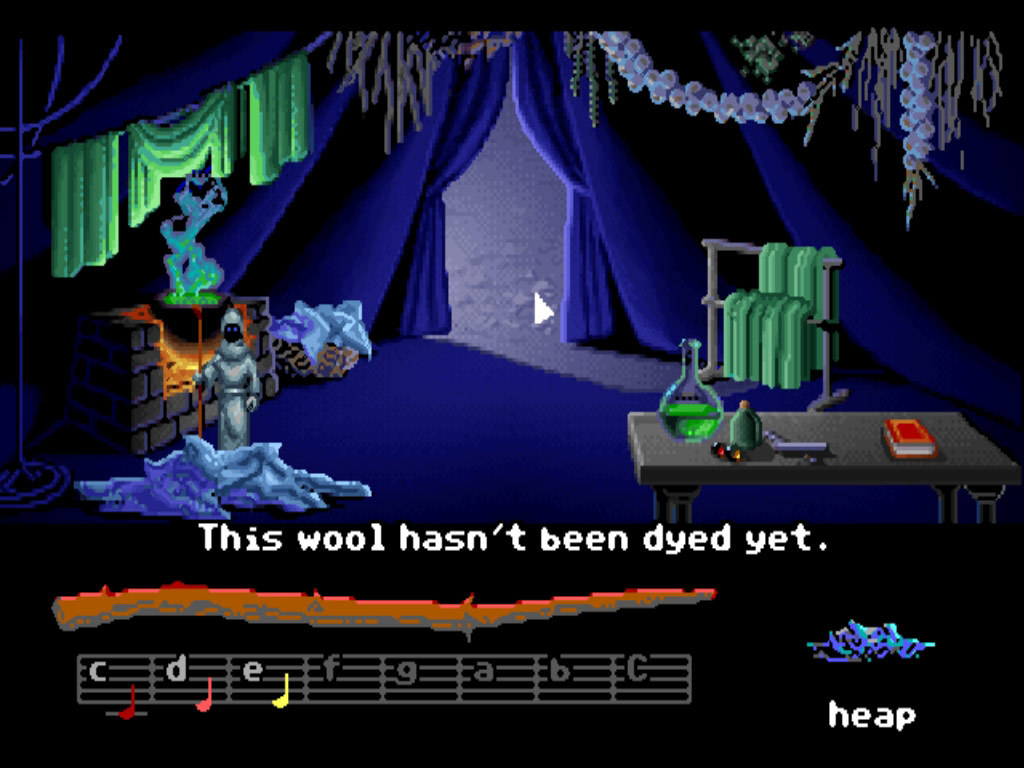
The game doesn’t have point&click item mechanics. Instead, it uses the distaff and the system of notes a player must play to cause an effect. So, if 3 notes dye the cloth, the same notes played backwards make it undyed again. Simple yet effective and majority of games puzzles is being solved that way.
Bobbin and the distaff notes
As for the graphics, the game had animations never seen before in any game. Adventure videogames slowly stopped to be “children’s toys” and raised their hand for their rightful place in the storytelling world of the mature humans.
They say movies were the 10 Muse, TV the 11th. With games like “Loom” videogames became the 12th.
I wasn’t able to convince any people to play this game. There’s something pushing people away in it. Perhaps they feel that the journey, although very rewarding, will leave them sad and thoughtful? True, but still, very, very rewarding. An absolute cult classic.
You need to see Brian Moriarty’s (the game’s creator) GDC lecture, you’ll learn of the creative process he went through on Skywalker Ranch:
The range of game types I play is very wide. I generally avoid mindless shooters. I know mammals love combat in general (look at your cats and dogs how they spend their time together…) but human combat-related leisure time (as disgusting as it sounds) sometimes can be filled with absolutely mindless slaughter. For that reason I hated “Quake III” back then, and I still hate it now – if it’s just sport then why add blood to it? Why one needs such a level of realism if not for the sake of blood itself? I have been playing games for decades now and I KNOW it’s the case: the thrill of digital blood without consequences of killing makes us digital butchers. From the era of “Moonstone”, through “Mortal Kombat” and “Doom” it was always about the same thing. Blood.
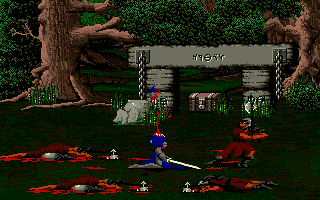
It’s just “Moonstone”. I started playing it in 1992 when I was 12 years old…
Recently I checked statistics from Assasin’s Creed: Odyssey. My character hero, during the time of the story, killed 4500 digital enemies. Digital people. Stop here and think a little. Did I say my character? I was the one controlling Alexios…
I don’t do platformers, mostly because I am absolutely lousy when it comes to the skill needed to play those. However there were some platformer games in my life that actually made me attached to the screen for long hours, especially those story-based. “Flashback”, “Another World”, “The Lost Vikings” or “The Inner Worlds”. I played these for the story.
“Inner Worlds”
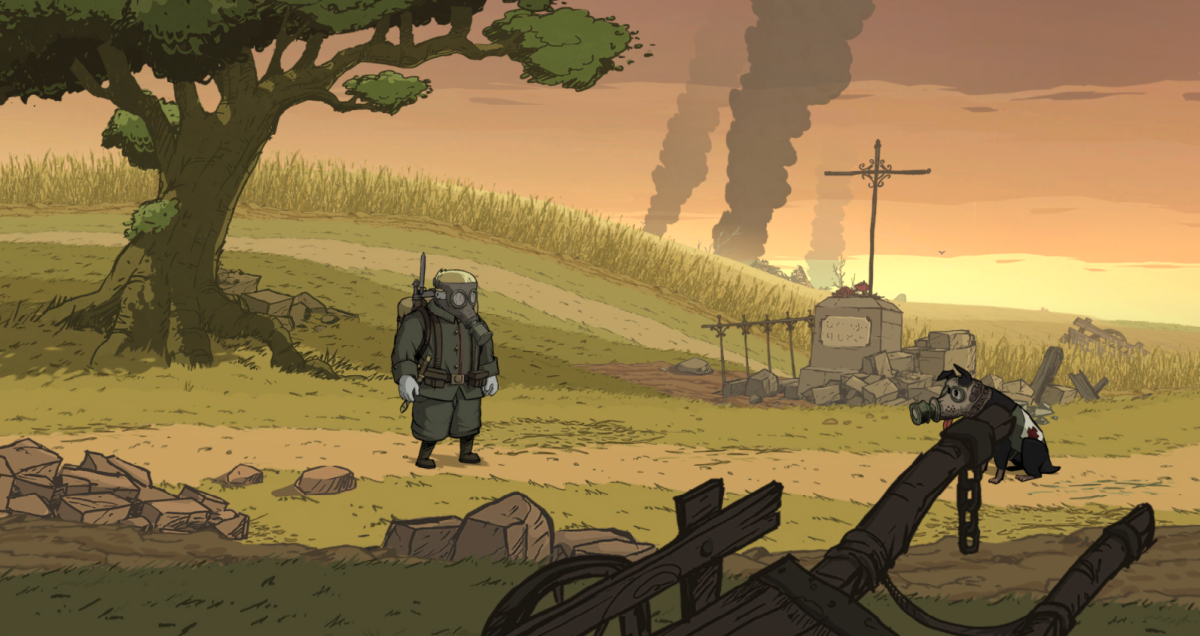
There’s a number of other game types I generally don’t touch. But I mentioned these two genres above for a reason. One being a combat, or war, oriented, the second being a platformer. The reason is “Valiant Hearts”, of course, that blendes these two areas together.
The game tells a story of several people and their lives forever changed by the Great War 1914-1918. These people don’t know each other and the story is being told from a perspective of a dog, a brave animal interacting with our protagonists. The game is also a puzzle sidescroller-platformer, with jumping , using items and shooting.
Anna. Look at the backrounds and the foregrounds. They also tell a story…
To tell the truth, I did not expect the magnitude of impact this game had on me. I did not think that I would be so moved after following Emil’s, Freddie’s, Anna’s and Karl’s stories. It’s partly thanks to this game brilliant depiction of war – it uses the cartoony style to show exactly what a player needs to see. And not only in a foreground, the background is also filled with pictures, each standing for 1000 words. The ruins, the refugees, the wounded and the dead. We see it all in this game. We see ordinary people with their lives broken and their possesions and relatives lost in an insane war machine, we see the randomness and pointlessness of death in the artillery barrage. We see how hate and vengeance takes over the minds and hearts of the otherwise ordinary people.
Eddie. The rage fuels vengeance. Vengeance solves nothing.
Our protagonists share one thing – they did not want to participate in this madness. Sure, Emil enlisted all by himself, but he did not do so because of politics. He did that for his daughter. Karl doesn’t want to fight at all – as a German on a French ground he was first expelled from France, then drafted into Prussian military. Anna is a medic, she’s saving lives. And Freddie… Freddie, a black-skinned, always smiling American, he lost everything in the war… He no longer smiles.
I told you before that we play warlike, mindless games for the sake of blood itself and a joy of a battlefield domination. It’s not by accident that these games are so devout of higher thinking processes. It’s a biological impulse – to disable those functions during combat, making all possible brainpower being taken over by a simple task – to kill and survive. For example, my wife is a seasoned Player versus Player gamer in Guild Wars 2, and it just takes a few minutes to observe what happens with her during the tournament against other players. From the nice, likeable person she changes into someone completely different. The digital killer. A very frightening digital killer.
Emil. An act of sacrifice for the family.
“Valiant Hearts” does an opposite thing. It surrounds player with death, destruction and war, but manages to give a player that feeling of “I want to leave this place”, “I want to be in a safer world”. According to many batllefield historians this is one of the first things to come to a soldiers mind after being exposed to the horrors of the war for the first time. The game manages to show us the same blood other games do in a completely different manner. In the manner, that we, biological machines, don’t want to look at it anymore.
It’s all in our heads, isn’t it?
The tension of this game is unbearable at times. A player very soon begins to understand that war is hell and death can happen anytime. It forces a player to play the game very carefully, as his own life depended on it, with a feeling of every step being fatal, and yet, a player is compelled to push on. Because there are things worth fighting for. Not a nation, not religion and definitely not political ideals.
In the wartime it becomes obvious for a common man what is really important: family.
Karl. Not a prison camp nor fields of killer gas can make him stop trying to reach his family.
Coming from a country that was war-torn for decades in the past, my point of view is biased. Though I did not live through war myself, my elders did. I know the stories. I know the cost – they told me about it. And “Valiant Hearts” strangely looks very similar to those depictions . “War is hell” – you see these words everywhere these days, but people actually forgot what that means. One day a person says that we should avoid war, and the second day the same person says that war can be justified sometimes.
Propaganda and political agendas of our rulers never take dramas of a single person into account. Anjd whoever says starting a war can be justified is either a politician with little care for individual lives (even if it’s according to Sun Tzu’s “Army is the only way to oppose evil” rule), or an ignorant idiot. The latter should play “Valiant Hearts” immediately. I mean it, like, now!
What this game does actually is to show us lives and tragedies of an individual. It tries to show us the price, and with that, I don’t know anybody who would like to pay that price after finishing this game.
This is one of those that will make your eyes wet. One that will make you ponder about humanity for hours.
Now, this one is a bit of a challenge. I am about to talk about the game that has so many interpretations and such psychological depth that it’s really challenging to even start writing about it. I have an equivalent of those hiperventilation moments when one tries to tell someone everything about his favourite book or game. Except this is maybe not one of my top 5 favourites, but has a visible place in my gallery of stories with an impact – at least in top 20.
I did not play any other Silent Hill game, before and after completion (multiple times) of SH2. My experience of the foggy and grim town of Silent Hill is based solely on this one game and I don’t see any other references to other titles of the saga. That’s beacause I did not know of the franchise before I played Silent Hill 2, and after I knew there’s just no possiblility that any game from the series could beat this one up in anything. This one is a shining gem and the best of all in the series. Probably also the best storytelling survival horror there is as well…
It got me hooked up from the very start – a man, John Sunderland, is washing his face and looking in the mirror in an obscure public toilet in Silent Hill. It’s not his first visit to the town, his wife was in a hospital and a hospice there. But this time, John arrived in Silent Hill, because he received a letter from his wife Mary to meet him there.
The problem is Mary died.
And so we start by looking at the face of a man, who knows he’s doing something insane – he follows the letter from a dead woman. We can feel his pain of the lost love, the many layered feeling of guilt (one layers of which is a guilt of being alive), and the insane and hopeless hope he has for meeting his deceased wife.
And that town…That town is covered with the thick fog, reducing visibility but to several meters. There are monsters in the fog, hideous creations that are twisted oversexualized, multilegged heaps of flesh… And so John explores the city in a hopeless journey of the mind.
He ocassionally stumbles upon others. People deeply disturbed and with serious psychological problems. There’s Eddie, a bullied, ridiculed for his entire life, young man with a complex of how he looks, absolutely self-councious of how he looks. There’s Angela, a girl with severe case of depression and suicidal tendences. There’s Laura, a little girl, all alone in the city. Mental problems these characters have are depicted in a very, very detailed manner, one can immediately see that devs did their homework. Nothing here feels fishy or is a laughing matter. They disturb player greatly, they scare from time to time, as a player wants to get inside their heads, to understand them or perhaps, to help them.
And there’s Mariah…
The moment I met Mariah in game I was startled and intrigued at the same time. She looks exactly the same like the late Mary. She has her voice. She has a different personality and different haircut though. Imediatelly after meeting her ingame I slowly fallen in some weird player moe love for that character and yet, I was scared of her to the bone. I started to follow her lead.
This game is so briliant on so many levels I just cannot fathom. Because that moe effect was intended from the start. Devs wanted the player to feel torn apart, to have doubts and yet, to follow the same fantasy John has – to reunite with his dead wife in life rather than death. The player is forced to delve deeper and deeper into that strange attachment, and learning that town actually might be creating all this characters and they might not be real does really nothing apart from strenghtening doubts – player still wants to protect Mariah, wants John to be with her.
The deeper into the rabbit hole the more knowledge about Silent Hill is aquired by the player. And that knowledge comes from various sources – from paper clippings, graffitis, books, conversations, from one of the scariest moments in videogame history – the elevator quiz… you name it. But the greatest knowledge comes from the little details, masterfully designed thingies that connect dots together. After some time player starts to realize that other characters don’t see each other even in the same room. While for John city is full of monsters he actually has to fight with, for Laura Silent Hill is a safe place, without anything scary or to worry about. The realization is so powerfull it adds to the horror. Is this happening in Johns head only? Is he mentally ill? What is this place that plays a different show for every person that visits it. Is what’s happening even real? The game balances on the edge and gives time to ponder on those things – and yet, player is unable to decide if Silent Hill is real or not.
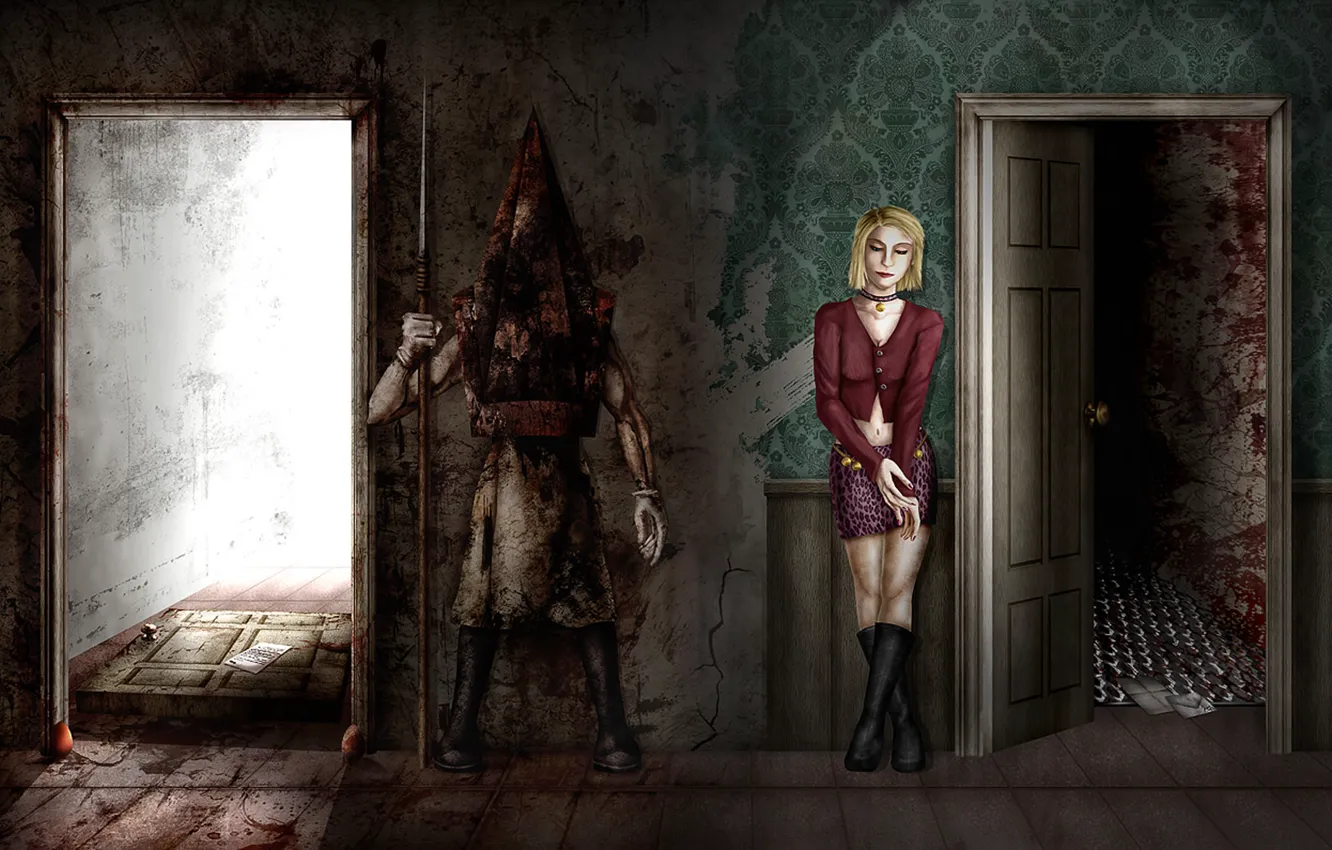
And then there’s an infamous Pyramid Head. One of the most iconic monsters in videogames. Its notorious presence in the game frightens the player and John so much, it almost immediately causes sweaty palms and the raction often is to fight or run. Primal instincts. Recently I watched a material about Pyramid Head by RagnarRox, who I am a big fan of, and I completely agree with his keen observation. Pyramid Head looks scary, we see him how he brutally, sexually exploits other monsters and it’s frightening and disgusting.
But it wants to help John.
You see, the more one thinks on what’s happening in game, the bigger the feeling of “this isn’t right” is. Following Mariah and the fantasy of regaining happiness is like an addiction. We know it’s stupid, we know John needs help and yet, we follow, unable to say “no”. John loses his senses, and the player loses his reason. Visiting Silent Hill is not helping John to overcome his grief, it makes him detach further from the reality. The need to protect Mariah is toxic, because there are multiple times where it cannot be accomplished.
Pyramid Head appears always before a turning point, and if player overcomed his insticts he’d see that Pyramid Head attacks only when attacked, or if player is in its path. Pyramid Head wants to block John from progressing on the futile path Mariah sets before him. He fights and abuses the very monsters that attack John. He’s the only friend John has in this town.
This graphic says it all. (by Max888)
I couldn’t understand at first why actually following the Mariah’s path is the worst ending for that game. But then I replayed it again and again to see them all. The understanding left a lasting impression on me. And I promise it will on everyone else who plays it…
Art. This is an early 3D game so everything looks retro for todays standards, but still, cutscenes are beautiful and directed excellently. But the biggest strength of game’s art is actually that it uses its full potential to tell te story. It’s depicting exactly what we need to see and know. For example – monters. If we look close enough we’ll see how they depict the obsession John has, how they reflect what he’s trying to accomplish. Arts shows exactly how John’s mind is creating the world around him. And yet, it seem so real (just horror-infested…), player starts questioning it’s realism only after going deeper into the story.
This brilliant game really is about a dark side of being a man. The popculture depicts males as hunters-gatherers and brutes but it forgets about the real darkness of being a male. Romanticism, sentimentalism and the feeling of accomplishment are good, but only if everything goes well. Yes. Men are sentimental and romantic, and very goal-oriented, and when things go wrong these feelings become frustration and pain instead. A true, overwhelming pain. Then add to the picture the knowledge that with great love often comes great pain, the pain of losing. A simpleminded brute is a just this: a brute, predictable, but frustrated, hurting masculinity is far worse: it’s toxic and dark. It hurts other people. It fights back, like a trapped animal. It snaps out of control. It causes the domestic violence and wars. It’s the very Hell.
See how brilliant this thing is?
This marvelous piece of work is probably one of the best games ever made. I can’t recommend it enough.



















 Amazing Worlds