Category Archives: Books

Bolesław Prus’ “Lalka” (“The Doll”) – a romance novel for cynical men.

While in school one is forced to read many lectures. Some of those are interesting, some not. It’s a problem that happens with everything – if someone forces you to like what he likes, or what he thinks is good for you – you’ll always rebel, if but a little. “Lalka” (“The Doll”) by Bolesław Prus is a school lecture, and because of that, many pupils hate it. It’s presented to those pupils, while they are at their peak interest of celebrity pop stars, engaging TV shows with special effects and action, and when their biggest concert is if they will have enough money to party all the time.

And there’s another kind of readers – those who treat this book as one of their all time favourites. I count among those. It’s not just that. I also thing this is the best Polish novel ever written.

Just some explanations regarding pronounciation – there will be a lot of Polish names in the text below. Ł (dashed L) in “Stanisław” whould be read like English W (and “W” is V) so “Stanisław” is “Staniswav” and “Wokulski” is “Vokulski”. RZ and Ż (dotted Z) are like French “J” (Jean-Baptiste e.g.), so “Rzecki” is “Jaecki”.  “Ą and Ę are nasal vowels, very hard for English speakers, but natural for French and Japanese. “Ą” is like on in the French pronounciation of  “mon”,  and “Ę” like the pronounciation of French department of Ain.  “C” is like “TS” so “Łęcka”  is “Waintskah” (“A” is alsways “AH”). “SZ” is like English “SH”: “Szuman” is “Shuman”. Masculine and feminine forms of names is something completely exotic for an English-speaker, but know that if Rzecki had a wife she would be named Rzecka, and  analogically Starski would be married to Starska and Mincel to Minclowa,and Łęcka’s father is Łęcki 🙂 If you want to dig deeper , be prepared for a hard time :). One last thing – ski and -cki suffixes are the same location based naming patterns as “von” in German, “van” in Dutch, “de” in French and of in English, but made distinct adjectives. Wokulski = “of Wokulsk”. 

There are some spoilers in the text below, but these should not affect the joy of reading, if you haven’t done so already.

The story takes place around year 1872 and follows the lives of two main protagonists – Stanisław Wokulski, a nobleman from an impoverished family, with interests in science,  and Ignacy Rzecki, an old-timer, remembering the People’s Spring in which he fought. Wokulski was also a freedom-fighter. You must know, that in 19th century Poland was partitioned between 3 occupants – Russia, Prussia and Austria, and effectively, it dissapeared from the maps. But Poles never accepted it, and from time to time, an uprising started to fight agains the occupants. Stanisław fought in 1863 January Uprising , then he was captured and sent to a labor camps of Siberia. Strong and intelligent, he returned, but with frostbitten, reddish hands, betraying his fate and frowned upon in salons of greater aristocracy. Wokulski is a product of two epochs, romanticism ending and slowly starting modernism, which in Poland was called positivism . This is the first (of many…) tragical conflic our main protagonist has.

We learn of Ignacy Rzecki, the subject shopkeeper, from his diaries mostly. The awkward old man, with an unfashionable green jacket and old trousers, the perfectionist shop manager is a true romantic, deeply in his heart. He has a dog and play the guitar while being alone, he imbibes from time to time with several friends, remembering old times. He uses to play with the toys in the shop he governs And he’s deeply sentimental about the Mincel (polonized, from German  “Minzel”) family, the original owners of the shop, who raised him, taught him all he knows about his trade, and changed his life forever. Ignacy believes strongly that all pains will be resolved by one of the Napoleon’s dynasty, a theory much ridiculed by cynical and realistic people.

Znalezione obrazy dla zapytania lalka serial
Rzecki and Wokulski.

After Wokulski returns from his imprisonment he is employed in the Mincel shop and its owner –  an old lady, Małgorzata Minclowa (a form of “Mincel” name, Polish is a hard language.. :)) fells deeply in love with Stanisław. He’s so powerless and has a chronical depression at the time, he agrees to marry her. Not from greed, but because he feels he owes her for taking care of him. This marriage, forced upon himself, is a hellish prison for him, especially while Małgorzata starts to be psychotically jelous of him. But he never does anything improper nor antyhing to hurt her. When Małgorzata dies, she leaves him all her wealth and the shop. Stanisław is indifferent to that fact, but soon something lifechanging for him happens.

Stanisław meets Izabela Łęcka, of an aristocrat Łęcki family, a beauty of the high circles, and he insanely, madly falls in love with her. Suddenly, he finds an unbelievable power reserves in himself and, to win her over, he starts amassing wealth. He builds a network of trade contacts, even participates in weapon trade, and soon he’s the owner of the most known shopping mall in Warsaw,  with a lot of money for other investments. He is also considered as a main president of the joint venture aristocracy wants to invest in. Friends warn him that aristocracy is capricious and will never treat him as one of his own, but he’s blind the warnings. For him its one step closer towards Izabela.

But, on his mad chase for Izabela, the femme fatale (who secretly despises him but, knowing her father has business with Wokulski, never does anything to stop Stanisław’s worship) he never forgets who he is – a deeply moral and commpassionate romantic. Wokulski embodies the Polish idea of “praca u podstaw” (“the work at the basis”) which is philantropy, educating the uneducated, creating the jobs to revitalize the society and spend energy for the needing, so they could take care after themselves. He helps a lot of people in the book, he helps Ignacy Ochocki, the aristocrat- inventor, to pursue his dream of the flying machines, he helps an ex-prostitute to become a profiting seamstress, he helps the driver Wysocki when his horse dies, and then his brother the train conductor, when he loses his job, he helps the sculptor and a jack-of-all-trades Węgiełek to build his own workshop. Overwhelmed by his feelings towards toxic Izabela Łęcka, he’s ignorant to the fact of how many people genuinely love him and worship him as their benefactor. He builts up an army of devoted common people around him.

Then another woman appears in his life, Helena Stawska, a struggling woman, a mother of a child taking care of her own mother as well. I think Prus unknowingly and accidentaly was one of the first writers to actually invent moe and its effects. Because Stawska is like a perfect moe girl, in all those chauvinistic aspects. She perceives Wokulski as a demigod, a man above all men, especially after Wokulski helps her to resolve the matter of her missing husband and after helping her while she was wrongly accused of stealing by baroness Krzeszowska. She’s beautiful, willing and insanely in love with Wokulski, which is empowered by the fact Wokulski genuinely likes her daughter and likes to spend time with Stawska’s family – he, the rich genleman, in her eyes far above her in social standing.

Znalezione obrazy dla zapytania lalka stawska
Stawska with her daughter.

But Wokulski is drawn towards Łęcka, like a moth towards the candle flame. He doesn’t want to listen to Rzecki’s words, he doesn’t want to listen to Dr Szuman, a Jewish physician and his friend, btw, a brilliant guy and my favourite character, the cynical man who learned all there is to learn about humanity, or even Ochocki – real friends who want to warn him and save him from the devious lady. Nothing helps him elevate his social standing really, even the help of the high aristocrat, an ex lover of his late uncle, countess Zasławska.

Znalezione obrazy dla zapytania lalka wąśowska
Małgorzata Braunek masterfully portrayed Iza Łęcka…

The aristocracy mocks him when he’s not listening. He’s even challenged to a duel which he wins, much to amazement of aristocracy that a “mere shopkeeper can shoot like that”.

Then another woman appears – a young widow Kazimiera Wąsowska, an aristocrat. Oh how I love that character. In fact, Kazimiera shaped a view of the perfect woman in my eyes. She’s rebellious, strong, a beautiful  feminist using and mocking men. Intelligent, cultural, declassing all aristocrats, shining very brightly. The ultimate moe for me. She’s flirtatious, knows her feminine strengths, but finding Wokulski  intelligent and resistant, deeply moral and hopelessly in love, she falls in love with him. In true love, she tries to help him to win over Izabela, while hurting at the same time. One of the last dialogues between Wokulski and Wąskowska is my favourite part of the book 🙂

While wrting this text I did a quick sanity check on myself and I can see that majority of women of my life were femme fatales (because they either were real femme fatales or I was immature or egoistic at times – depends) – my failures while trying to find another Wąsowska 🙂

Znalezione obrazy dla zapytania lalka wąśowska
Wokulski and Wąsowska

Then the fateful moment comes, when Łęcka, wrongly assuming Wokulski knows French and Russian but doesn’t know English, flirts with Starski and denigrates Wokulski on the train while all three are sitting in the same compartment. Wokulski learned English as yet another skill required to concquer the heart of the sarcastic and arrogant Łęcka, he leaves the train, telling Izabela “Farewell, Miss Iza” in English and then he attempts to commit suicide by laying down on the railway. Just in time to be saved by the conductor Wysocki, the brother of the driver Wysocki, and one of those people Wokulski helped before.

Znalezione obrazy dla zapytania lalka serial
Stanisław Wokulski, deeply in love with Łęcka. How he demeans himself while talking to her is just painful to read and watch…

The last pages of the book are a material to ponder on a lot. No more spoilers, but know there’s a discussion around it for tens of years now, generally divided on interpretation of Wokulski’s fate (it’s curious…). But it’s not the only thing that makes one ponder. The author outrun his own epoch, for sure. Well, Bolesław Prus was known as a weird man that tested the first velocipeds (an early form of bicycle) in Łazienki Royal Palace Garden in Warsaw,  when these were just an oddity. Just imagine lords and ladies having a walk and a gentleman pedalling between them and shouting at them to move aside 🙂 Completely outrageous. There’s a science-fiction element to the book as well – two subjects intertwine in “Lalka” – the search for metal lighter than the air, and the flying machines. Wokulski, as a chemist himself, funds the research on the subject and is a big fan of baloon rides. He often meets wich Ochocki to discuss science and inventions.

So, apart from a perfect painting of the social strata of 19th century Europe, in which an average, but famous celebrity musician (like Molinari in the book) can access the aristocracy’s higher salons, but an impoverished nobleman has their door shut and barred for him, Prus painted also another views: middle class and the poorest: their daily lives, their problems and lifestyle in the epoch of mercantilism and imperialism.  The insecurity of the working class, the struggle for employment and the power of money – it’s all in the book.

Znalezione obrazy dla zapytania szlangbaum
Prus saw the division between Poles and Jews. And it pained him. Wokulski and Szlangbaum family were always good friends. Prus wanted it to remain so.

And then there’s a socio-political element  in the book also.  The book features characters of many nationalities (Poles, Germans, Russians, French, English, Italian..), focusing several beautifully created Jewish charactes as well. Prus, through dr Szuman, a mentor-thinker type, analyses the rising anti-semitism with a horrendous accuracy. In fact, the author wanted to warn people of the possible holocaust, 70 years before it actually happened, and step by step – shows a pattern how humanity can reach that lowest of the stages.  Then there’s a family of Szlangbaum, a merchant. The young Szlangbaum is Wokulski’s friend, while the old one is a seasoned trader and businessman. These examples show the unity and intelligence of Jews, who are able to survive among not so friendly environment, but, as Szuman warns: the artificial antisemitism, fueled by Russian occupants by giving Jews better business and living condition than the Poles, will have a backlash (pogroms will follow…) will take its toll on Jews as well, promoting those who are ruthless, surviving businessmen.

Znalezione obrazy dla zapytania lalka serial
The legend says author was hated by students while he was teaching (he apparently was even beaten up by some..). But he portrays students only with positive vibes. One of the most hillarious moments and characters of the book.

The patriotic element is there, of course, as well. In fact, majority of the Polish literature has this element. This nation was in so many wars and struggled through so many occupations, way of Polish thinking is… Spartan. Combat, patriotism, sacrifice, defiance – these are Polish words, one might say. But Prus shows futility and destructivness of some patriotic actions, shows how stupid sometimes it is to fight, which leads only to destruction at times. Yet, as in the fairy tale about the tortoise and the scorpion, one cannot change one’s own nature. So, the echoes and the toll of Napoleon campaigns, Uprisings (1831 and 1863) and the Spring of Nations (1846-48) are visible in the book.

There were two TV series/movie adaptations (here and here) of “Lalka”. Both are critically acclaimed, but my favourite is the TV series with Jerzy Kamas as Wokulski and Małgorzata Braunek as Izabela Łecka. A brilliant show.

Like I said, this is the best Polish novel ever written. And that’s said by a guy who thinks Marcel Proust’s work as one of the best novels ever written on the globe. That tells a lot. If you are in the market for the slice of life, 19th century style, food-for-thoughts – search no longer.


Znalezione obrazy dla zapytania lalka serial


“The Hitchhiker’s Guide To the Galaxy” – Douglas Adams’s hillarious look at the mankind.

Humanity is a very sad and pathethic kind of animals. The vertebrae with the biggest capability of destruction of all vertebraes. Additionally, evolutionary mechanics evolved certain things beyond a vertebrae average, and left others completely underdone. It also applies to brain functions – while some behavioral patterns are top notch, other’s are, simply put, “in the dark”.

That limitation leads to a varying spectrum of human misbehavior, starting from domestic violence, through depression and frustration, to genocide. An average man likes to think that all the evil is performed by “the others”, perhaps sick or deviants. In some cases it is true, yet the majority of the bad things is actually done by socially and biologically programmed patterns. There’s a saying in Poland : “an occasion makes the thief”, meaning that even though people might be taught not to steal, there are situations, “occasions”, in which one would.

How to live with conditions like these? How can one retain morality or a stable belief system? Its impossible. In most cases it leads to atheism and misanthropy.

Douglas Adams fights this feeling, not unlike how Terry Pratchett did. Because sometimes it’s better to reforge the sorrow into irony and laughter. And Mr. Adams was merciless when it comes to irony and laughter, enveloping an intricate philosophy of life.

Life, universe and all the rest, in fact. The titular “The Hitchhiker’s Guide to The Galaxy” is a hitchhiker guide to space travel in our universe. It contains a lot of useful information (Wikipedia like) but its popularity is based on one simple fact. It has “Don’t Panic” written on its cover. Now this alone should convince you how brilliant this thing is. Can you imagine a shorter and yet bullseye pun on human ignorance? It really doesn’t matter what our Wikipedia or Internet contain. Its combined knowledge ALREADY is enough to change the world completely, for the better. But it will not happen. Because an average person prefers funny cat memes instead. Or soothing funny dog videos. Don’t panic, humankind.

The story starts with Arthur Dent, an average, not-so-smart Englishman, learning that his longtime friend Ford Perfect is an alien, and that Earth is to be destroyed because it’s an undeveloped patch of universe that needs to be erased because the interstellar highway will be built in its place. Not that it’s sudden – the notice about that was in Alpha Centauri development office for some time now, and noone should care if humans are so lazy and irresponsible that they don’t know about it.  If they really cared they would read it, right? But before the destruction other messages were sent – as it is explained, dolphins tried to warn humans, but humans are so stupid that instead of understanding the complex language they thaught it to be a playful mood and a waterpool ball games and tricks. So dolphins  leave the planet, thanking for all the fish and saying “so long!”.


Znalezione obrazy dla zapytania arthur dent
Martin Freeman as Arthur Dent. Remember, always carry a towel. And don’t panic.

Lets stop here for a moment. I’ll show you what human ignorance is. It’s when one says “dolphins are animals inequal to humans, clearly, because they did not develop any civilizations, powerplants etc”. If industrial civilization is the mark of intelligent, advanced life, then it means that Amazonian Indians are animals, right? Because they don’t have factories built. What about Inuits? Traditionally they wear animal skins and dont use electricity. No, in fact you are undeveloped. Your technology usage hindered you greatly. And yes, its about all of us. It frightens me every day how people browse the Internet for answers every day, instead of trying to work it out with their brains. Because technologically inadvanced people do – that’s why an average ancient Atenian was smarter that an average you.

And yet I sometimes see the movies about a scientist deciphering a language of the aliens. What about dolphins? We know they have one. Hell , we know dolphins have names!  That’s what ignorance and arrogance is. Humans can decipher everything because they are so advanced… No. The Earth wasn’t made by any god for you to inherit it. You are but one of many animals in this planets megaecosystem, and not particularily nice species while we’re at it.

The book goes through almost every subject that matters. Sociology, economy, psychology, you name it. Marvin, the much loved paranoid-android, the smartest being in the universe and his hillarious permenent depression shows what strength is needed to see the universe for what it is, without hypocrisy or self-lying. A direct opposition to Marvin’s case are the sspaceship automated door, embedded with an A.I. conded to be happy whenever it opens. Orgasmic “ooh” and “aah” of the idiotic door, while Marvin passes through it with his heavy, depressed steps makes me chuckle while writing this text. Or a moment when Marvin, being alone and wanting to talk to someone, interfaces with a warframe computer, which in turn, commits suicide, allowing pur protagonists to escape.

Obraz może zawierać: tekst
Marvin as it is seen in the movie. The movie is fun, but sits nowhere close to what the book is. Read the book, don;t bother with the movie, unless you read the book.

Arthur Dent is a true human. Meaning his an idiot. A true idiot. His idiocy is a blessing, because a smarter person would go mad if exposed to the same experiences. He sees Earth being destroyed, he’s homeless, the only human alive in the universe he knows nothing about (until he meets with Trillian, whom he met on one of the parties back in England but was beaten in courting by some richman, then exposed to be actually Zaphod Beeblebrox, the president of the galaxy!) . But he’s a middleclass guy with no imagination, living his petty, conformist life. But he evolves as the story progresses, which also is a brilliant embodiment of the human condition. Near the end of the story (6 tomes) he’s a philosophical and religious guru (The Sandwich Maker).

Znalezione obrazy dla zapytania the fool tarot
The Fool. A Tarot card.

The idiot thopos is an important and recurring one. It is tabula rasa, the emptiness, the void to be filled with experiences, the start of the journey. We, humans, are born like that. Empty, unfilled vessels for things and thoughts to come. Tarot for example, has a Major Arcana card symbolizing this state : The Fool, and Arthur Dent is the fool in the same very sense.

Morality, media and politics are discussed with the Zaphod Beeblebrox and Ford Perfect characters. Zaphod, the president of the galaxy, is a showman, a celebrity, distracting people from the real politics. Yeah, humans are so stupid that they fall for every government trick if its exciting enough. Romans used the chariot races and gladiatoral games to achieve this in the antiquity and today governments use one scandal to focus attention and get supoort for the other. Ford is but a journalist, doing his job not because it show the truth or with some other said mission (only naive believe in the journalist mission to show the truth). It’s only about fame and money.

And then there’s a fact that this Universe wants to kill us. Paranoia? No, a reality. Falling rocks, self proud civilizations that dissapered in a blink of an eye, dinosaur extinction. It’s easy, simple and meaningless. And here comes Agrajag, the being killed by Arthur Dent in every incarnation and every lifetime. Agrajag believes it to be Arthur’s hatred for him and plans revenge, while in fact it is just. a meaningless, maliciousless, accident…

Morality versus food consuption is there too, with the restaurant At the End of Universe and a councious Dish Of The Day cow, bred with intelligence to be the tastiest, willing dish. The cow is willing to die, it is its purpose in life, yet Arthur is the only one disgusted by that practice, even though the cow reassures him that its suicide will be painless and by the numbers, and that it really wants it to happen. I know what you are going to say – GMO. No, its not that. GMO might be a way to save humanity from hunger when we reach 10 billion soon. Think about it as a threat of behavioral engineering coming with the same bioengineering tools GMO and microbiology gives us. The temtation of being a Gepetto to our lab Pinnochio might be to great to resist…

Or is it that we humans are so limited we don’t see the forest for its trees? Maybe the cow is right, after all?

When it comes to sociology, Deep Thought, a master computer that calculated the Answer To Universe Life and Everything for millions of Earth, returned a meaningless 42. A correct answer far beyond comprehension of mortals. So the second computer was ordered. The Earth…

Again, I don’t want to spoil this marvelous adventure the saga is. I don’t know any other work that is comparable to it except for Pratchett’s work. The world is cruel, nasty, we die and our lives are meaningless, but the only thing we can do is to be as moral as possible and accept the facts for what they are.

And, like Marvin looking at the message from the Creator to All His Creation, embedded in flaming letters on the mountainside, we can only say “I can live with that”.


“The kidnapping of Baltazar Gąbka” and “Karolcia” – children fantasy masterpieces.

The world knows J.R.R Tolkien’s “Hobbit” very well at this point. The story depicting how Bilbo Baggins travels with the dwarves and the wizard to defeat the malicious dragon and finds the One Ring in the process is deeply rooted in popculture. There were movies showing it to the wider audience, and a lot of people has read the book. In many schools reading “The Hobbit” was mandatory. From the tolkienist’s (myself being one) point of view the book is no longer a children fantasy book, but of course fits to the greater picture of the whole Arda saga (with “The Silmarillion”, “The Lord of the Rings” “The unfinished tales” and “The lost tales”). I have often heard an opinion it being the “ultimate fantasy book for children” wich always puts a grin on my face. As much as I love Tolkien’s works, I know better literature than “The Hobbit” .  For example Tove Jannson’s “The Moomintrolls”, but I wanted to show you something different today.

“The kidnapping of Baltazar Gąbka” by Stanisław Pagaczewski is the first book of the trilogy. And it is a masterpiece, far exceeding “The Hobbit” and the other similar works. Althought a different setting, there are similarities allowing the comparison of those books. While “The Hobbit” uses the germanic legends as the basis of its storytelling (with all the  post-Burgundian clumsiness of the Nibelungenlied and epic-like approach of the Norse sagas), “The Kidnapping of Balthazar Gąbka” (I will shorten both to “H” and “BG” in this text) focuses on the Lesser Poland’s legends surrounding the royal city of Kraków. Both books feature dragons  =- there’s Smaug in the “H” and Smok Wawelski (The Wawel Hill Dragon) in the “BG” but their role is completely different. There’s a journey “back and there again” in both books – it’s Bilbo Baggins who travels to Erebor in the “H” while Smok Wawelski goes to adventure of releasing professor Gąbka from the custody of the Raindwellers. Both Bilbo and Smok are acompanied by skilled companions, some recruited along the way. Both feature different “literary biomes” as I tend to call them – multiple areas or “zones” (a gaming term) with distinct literary characteristics (“H”‘s Mirkwood and Misty Mountains, “BG”‘s lands of the Sundwellers and Raindwellers)- a typical mythological approach. There’s far more similarities. But there are some distinctive differences too.

Znalezione obrazy dla zapytania kraina deszczowcow
Heroes. Smok, Bartłomiej and Don Pedro.

The reality of the “BG” is less fixed on the sagas and the legendary stuff and is not a literary experiment for adult professors of literature . It’s a children’s fantasy novel, so it uses the full spectrum of tools to give the engaging, intellectual, but fun, material for the younger reader. So there’s a mythical Duke Krak who’s sending Smok on a journey, but Smok is a gentleman here, not a monster, a crossover between the Sherlock Holmes, James Bond and Arsene Lupin but far more positive, encompassing the gentleman virtues of the man of 1950’s. Smok is given an car and a personal cook, Bartłomiej Bartollini, an Italian maestro of cooking, who uses his barbecue spit as a weapon. The book sets boundaries for its setting but does not set any boundaries for the imagination. The younger reader, after a dozen of pages, starts to have a feeling that anything can happen and anything is possible in this book, and craves for more. The book survives also adult’s eye surprisingly well, in fact, far better than the “H” does.

Znalezione obrazy dla zapytania mżawka z krainy deszczowców
Don Pedro spies on and sabotages the heroes at first, but then becomes one of the good guys.

Pagaczewski masterfully manipulated emotions of his readers. I rember how outraged I was as a kid, when I first learned of the attempted poisoning of the Smok that Raindweller spy, Don Pedro, attempted with the toadstool mushroom jam. Treacherous, shady character who in turn gets recruited into the company  (Gollum in “The Lord of the Rings” (not in the “H”) has the same impact, although Don Pedro is far more likeable). Polish experiences of the author with various dictatorships (Nazi and communist) also added to the picture. I remember I was genuinely unsettled and I had the feeling I was being watched for a week after the section in which prof. Baltazar buys the rainmuffins in Raindweller bakery from Mżawka (eng. “Drizzle”) and then learned that Mżawka is actually Agent Mżawka reporting every action of the professor to the secret police HQ. I was genuinely scared of the Great Raindweller (remember the Great Goblin from the “H”?).

Znalezione obrazy dla zapytania mżawka z krainy deszczowców
The Great Raindweller was really scary, and what scares children most is his unlimited power…

One of my favourite sections, remembered after 3 decades after reading of the book is the moment when Smok and company are in the jungle, inhabited by monkeys and okropiki (eng:”Hideousies”). You see, there was a traveler to that jungle before, who died unfortunately and both okropiki and monkeys rummaged through his rucksack. They found two books. Monkeys found the physics book while okropiki a tome of poetry.  That’s why it’s not weird when you learn the friendly monkey’s name is Interference. But’s okropiki who are greater here: I will never forget that one okropik, who, after piercing the gas tank of the Smok’s car, turns around and declares “I am as an arrow submerging in the gardens of peace!” and then “Time of the craddling comes!”. 🙂

The “BG” is in fact a trilogy. Professor Gąbka is released from custody of the Raindwellers and the Raindweller regime falls to be replaced by democratic Raindweller government of Salamandrus, Gąbka’s political co-prisoner. Mżawka and the Great Raindweller are prisoners in Kraków but they manage to escape. The hunt for them is the subject of the second book, as well as the scientific journey of Professor and Smok.

The third book is different. Our heroes, through hibernation, wake up in 1960’s Poland. The book is a very sad, deeply sentimental work, the longing for the old times. Our heroes try to fit into the new, grim and dull, reality but they somewhat fail, unable to find the charm of the lost epochs.Where Rowling ultimately failed with what she wanted to achieve with the feeling about “muggles”, Pagaczewski succeded. The book is a good-bye from the author,

There was a brilliant and very faithful animation series produced by Polish animation studios, that can still be found on YouTube (in Polish).

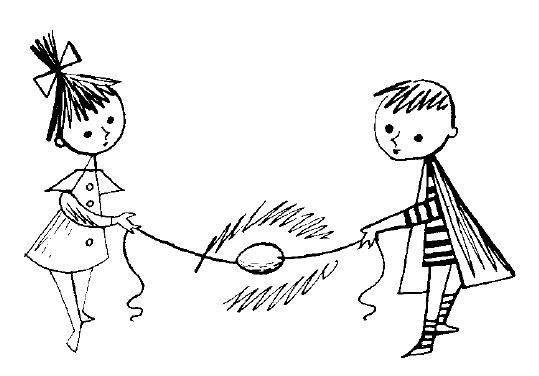
There’s one more book that imediately follows the “BG” as better than the “H. “Karolcia” (“The Little Caroline”) by Maria Kruger. The child fantasy following the crazy ride of a girl who finds a mysterious round, shiny bead, hunted by an evil sorceress. The bead, not unlike to the One Ring, has many powers, and Karolcia uses those powers to escape the Sorceress. The Frodo’s escape from the Ringwraiths had the same emotional power reserves as Karolcia.

So, if you are a fantasy fan, have kids, and say that “The Hobbit” is the best for you kids, think again. Read Tove Jannson, Stanisław Pagaczewski and Maria Kruger first.

Znalezione obrazy dla zapytania karolcia
Karolcia and the bead.


Benjamin Hoff’s “The Tao of Pooh”, “The Te of Piglet”

Almost everyone in the world knows Winnie the Pooh and the Piglet. A.A. Milne’s work became one of the most important pieces of western literature of 20th century. What started as a story based on Milne’s son – Christopher’s, childhood plays, literally helped to raise children in the whole Europe (and beyond). The rich storytelling, emotional depth and a plethora of interesting and memorable characters just had to produce a hit. The value of behavioral programming in the books was understood and appreciated by educational ministries of almost every government, and “Winnie the Pooh” plus the “Pooh’s House” became mandatory lectures in primary schools, such as mine.

I remember I knew it so well, that when the Winnie the Pooh animation was first played on Polish TVP1, I was able to recite almost all its contents along with the dubbing…

So, we, the children, who were programmed by that book, we acquired a lot of archetypes and moral stands by following the adventures of the Pooh. We’ve seen the not-so-wise Owl, grumpy and negative Eeyore, silly Tigger and all the rest of them. And we analyzed their behavior and the interactions between those characters. Which itself is probably the greatest achievement of the author – being able to show various problems and problem solving children might have while interacting with the world. It’s all there, fear, selfishness, trying to become an alpha-child, but also appearing compassion and empathy. And, in the end, the sadness of leaving childhood behind, never to return.

So, with those archetypes and stories in our heads we were better prepared for whatever was awaiting us in the future. We also always kept those pictures with us, sometimes without self-knowledge.

Benjamin Hoff exploits this state. As “Winnie the Pooh” is all about interaction as is Mr Hoff’s work. With the slight difference…

Benjamin Hoff tries to explain Taoism to the western reader by using the Pooh and the Piglet. Yes.

A very difficult task, because our western minds are so focused on individualism and materialism it’s really hard to grasp the very idea of that philosophy. There are thousands of years of history and layers upon layers of cultural metainformation enveloping the Far Eastern philosophical systems, adding to the difficulty.  In fact, without dozens of years of studying and trying to understand all there is about the Chinese culture, grasping Taoism would be probably impossible.

But we have Winnie the Pooh and its archetypes, ideas and emotions, remember?

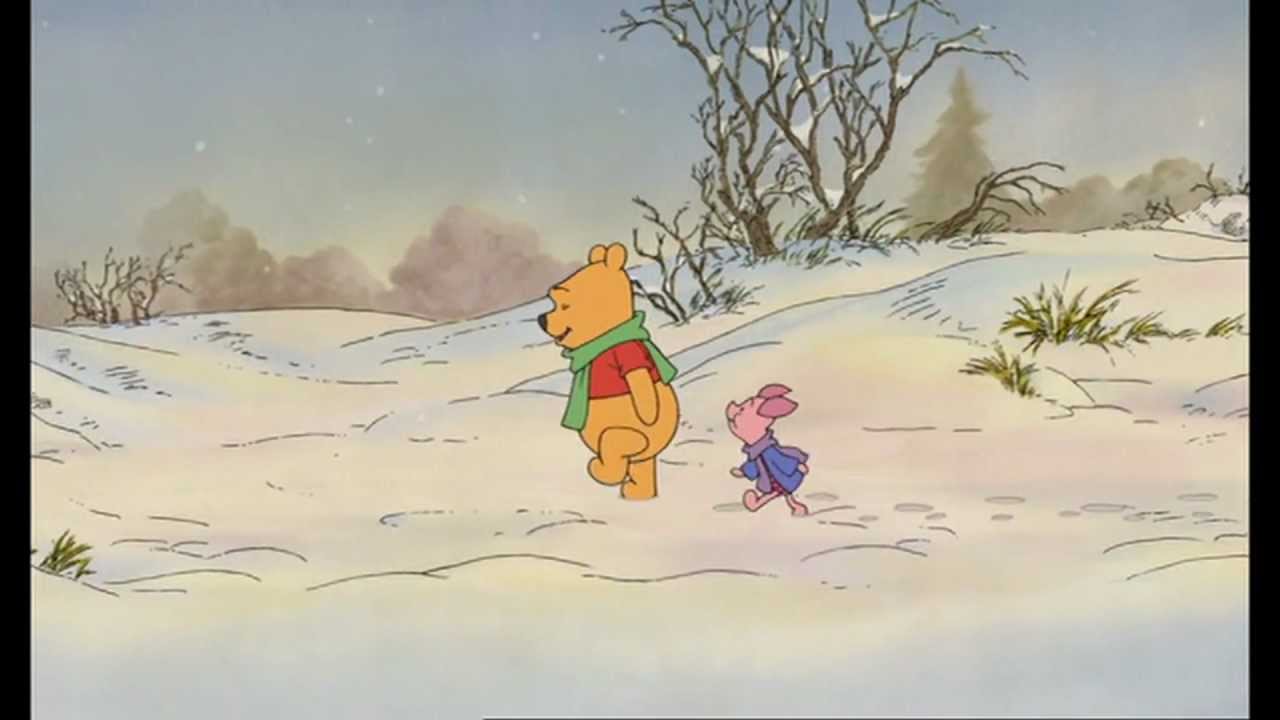
Image result for snows it snows pooh
Unwilling taoist philosophers.

What the author does here is just brilliant. He based his work on the tacit knowledge (oh how I love the subject, I wrote my thesis on the tacit knowledge in computer science and done some other scientific work in the area 🙂 ) of the human brain, the things we learned from the Pooh, and that’s how he made it possible for us to understand things, that, otherwise, would require a lot of studying.

First, let me explain you a little about that tacit knowledge thing, so you could easily understand what’s going on. Did you ever listened to hydraulic heaters being filled with water? Did you ever listen to the DVD or CD drive reading a particularly difficult medium? Remember the sounds? Remember how they were able to tell you if everything is going well or not (especially with the drive case)? Visual example: some individuals are able to tell that it’s going to be raining by observing the change of the colour of the air by looking at some background. That is the thing – it’s very hard to explain it to others, but you just know. Another word that is tightly connected to tacit knowledge is a meme. I am not talking about the Internet cat pictures here. A meme is the package of information that defines itself and can be digested and transmitted internally and through socialization in an unchanged manner, involuntarily, and for some, difficult to explain, reason it’s valued by brains enough, to store that information indefinitely. Beethoven’s 5th – “ta da da dam” – everybody knows that, rigth? A meme. Indiana Jones theme – its first notes – a meme.

“Winnie the Pooh” produced a lot of memes that are stored inside our brains.

And this is what is going on in Hoff’s works. Pooh seems to be the perfect character to explain the wu wei and the pu principles to the western reader.Winnie the Pooh embodies those principles. He is doing things the way a taoist master would do, and he perceives the world in the same way. Simply, accepting the world for what it is and not trying to change it. Just living along it. As opposed to the Pooh, Eeyore is a taoist anti-example, the western man, unhappy, changing the world, trying to get into the depth of things that cause him only sorrow (he’s basically me :)).


“The more it snows (Tiddely pom), the more it goes (Tiddely pom)” – says the Pooh. Uneducated, silly, empty, he lives the life the taoist way. And the “tiddely pom” says everything is there to say in taoist way.

The tree just is, grows, and that’s that. The rain just falls, and that’s that. People die, and that’s that. Don’t try to fight it, don’t try to understand it, it’s the tao.

I am not a taoist myself (obviously, I’m Eeyore), because I compulsively fight for understanding and truth, and that leaves me more and more frustrated in life. This is what tao wants us to avoid in lives. Well, I do my things because I chose so, as I chose to understand taoism, and I prefer my option but it’s a hard, hard road…

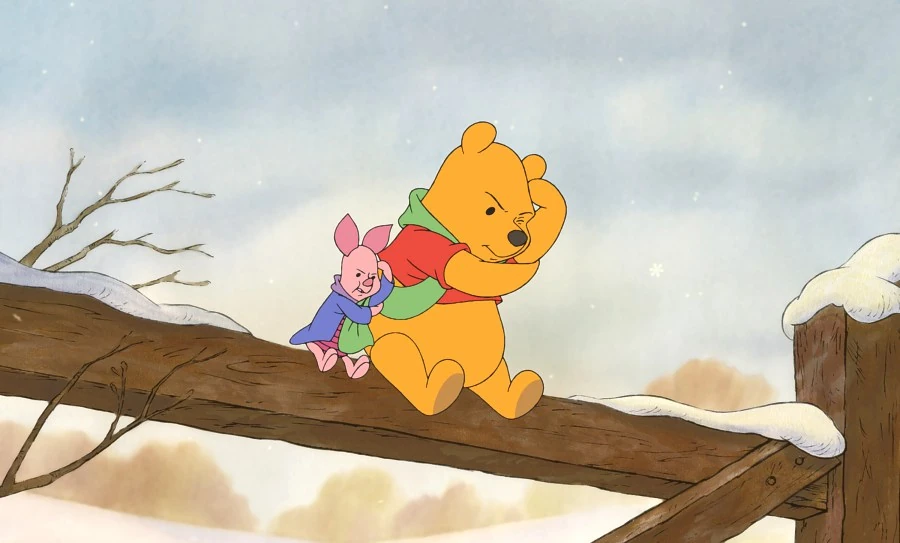
My face everyday kinda looks like that of the Piglet on this pic…

The Piglet is a completely different story in Hoff’s works, one much closer to my heart. The ideal of te introduces the concept of what is known in Poland as a proverb “when you have a soft heart, you need to have a tough butt”. But adds to it one important idea- that one cannot be a hero without being soft, without care for the people. In fact, Hoff proves, the Piglet is the only character in the books who is able to do anything. All others just talk or do nothing. It’s the Piglet who saves Eeyore who fell into the river. The small creaature, without self-confidence, always scared, in fact is the only character who conquers his own vices, steps out as a true hero of the day. And whenever I think of the real life heroes, they were always Piglets, people who cared, people with flaws but they were able to conquer themselves for the cause.

I don’t want to bring everything out to you, because it would be best if you consumed these two booklets together, absolutely worthy of doing so, especially if you’re interested in philosophy, as I am. And if you’re not, it’s one of the examples how deeply in us the Pooh resides, even today.


The grim and mysterious works of E.A. Poe.

Well, I mentioned Mr Poe before, but there’s definitely much more to be said of the author. It is difficult to write about known authors, especially those who are taught at school in many countries (not Poland, Poe is briefly mentioned only, but it’s understandable with the plethora of Polish masters of literature starting from early medieval times to this days, and then European masters…), because it’s really hard to tell anything new about works and the author. But if I learned anything at all from Tadeusz Boy-Żeleński, the famous Polish writer and critic, is that analysis of any masterpiece is an unending processes. One uncovers layer after layer of meaning and content, without end.

We all probably know Poe for the master and the progenitor of modern horror stories. Some, perhaps, know him for his grim depictions of passionate, ill, abusive and obsessive love. Popculture absolutely and completely aligns him with his parody of romanticism “The Raven” poem is.  I think what is worth showing is how Poe excelled at every subject he touched.

Image result for harry clarke
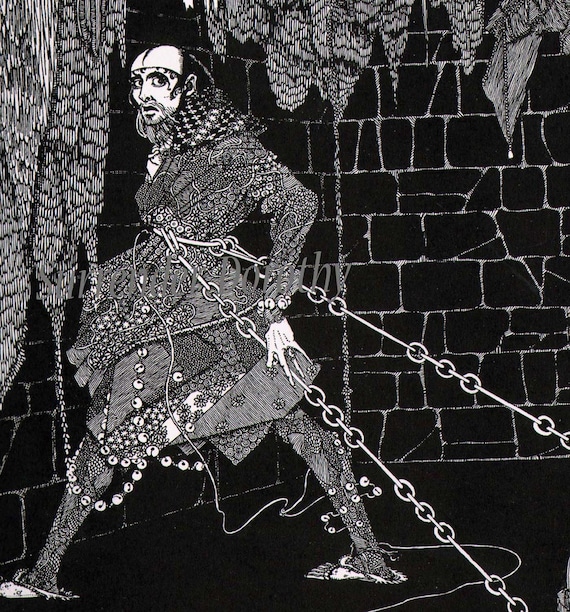
Make sure that Poe books you obtain have Harry Clarke’s illustratons…

First of all. The language. I am not a native English speaker (which you can probably already tell by my silly, overlooked writing mistakes or funny constructions I’ve been using in this blog) yet I am able to fully enjoy and evaluate the style and the quality of English Poe used in his works. Shortly: he used the writen language medium perfectly. Enveloping human emotions, psychological states and unspoken fears was always the function of poetry, yet Poe was able to encapsulate those in prose, convincingly. This alone is a tremendous achievement. Psychological study of Poe’s characters is flawless and the climate of the spoken phrases and depictions of the surroundings paints the picture in the way brains of readers are able to immediately grasp the concept and paint every scene acurately with reader’s own imagination.

Then there are psychology and empathy. Yes, these two factors determined the authors ability to tell those stories in such convincing and interesting manner. A reader, who heard about Poe but did not read his works yet, almost always starts reading it convinced what he is about to consume is a supernatural horror. A story after story one discovers that it is not the case, or not fully, perhaps. Majority of the thrills produced by Mr Edgar comes from psychological anguish alone.  Just think about “The Pit and the Pendulum”, one of the best known stories Poe created.  It tells about the torture inflicted on a prisoner enslaved by the Spanish Inquisition, locked in the pitch black cell, with a seemingly botomless pit in the middle. There’s nothing supernatural in this one, yet readers own empathy frightens and shocks from the very start to the very end. It’s easy to reconstruct the feelings  of a prisoner, when he uses an animal fat on his hand bonds to allow rats in the cell to bite through them. Rats of course bite his hands as well… The effect is similar to the effect of the Room 101 from Orwell’s “1984”… In Poe’s works a natural phobias sometimes s e e m supernatural, to the point both the reader and the narrator are unable to tell what is truth and what is not, what is real. It’s like a self generated schizophrenia, that comes from a natural brain function – the function allowing us to convince ourselves we see things (think Shakespeare’s “Hamlet” and the ghost case).

Another example of psychological artistry is “The Barrel of Amontillado”, which allows us to study the development of a mortal grudge, of the cunning vendetta, carefully preserved hate which ends up with a cruel, unbelievable murder. What matters is that when the murder happens a reader both is shocked and sympathizes with an executioner rather than the victim. Poe allows us to feel the murderers reasons, and that’s the main source of the horror for the reader here. Oh how I often hear things like “I wouldn’t do such horrible things” or “only deviants could do it” when speaking about war atrocities, for example. Poe understood perfectly that everyone could and can do it, it’s just a matter of cioincidence mixed with a specific context. Again, humans are machines and will act like machines very often. It’s in our genes and that really makes us afraid of ourselves.

Want to argue on this? Deal with the consequences of the Zimbardo experiment first.

Image result for harry clarke
Harry Clarke’s  “Morella”

One could say Poe’s characters are overpassionate, in the romanticism style of character building. They have far too many internal monologues, are being torn by too many contradicting emotions. It’s a valid point, however consider this: in the last 10000 years people don’t change, what changes is their surroundings – technology and context. I am saying this after studying historical eras and people throughout the history for 30+ years now. It’s so important let me put it again:

People don’t change. Only context and technology does.

That means you and me are not different from people living 1000 years ago. Our problems are different because a Norse warrior didn’t have to worry about a fuel pump, obviously, but he was equally concerned about the board pegs of his longboat.

Image result for harry clarke
Harry Clarke’s “Ligeia”

We often think such monologues are archaic and very awkward, but we do exactly the same thing when we face any difficult problem. And when one compares what e.g. one feels in difficult situations to the feelings of Poe’s characters it’s immediately visible how brilliant the author was.

Then there’s climate of the stories. I said Poe’s depictions are a food for thought and allow brains to immediately depict the scene. Grimdark mansions, brick walls, dunk, wet cellars,  an uneven cobblestone, sweaty clothes, musky earth and a decomposing corpse… He was able to put it all there to his works, and the reader, often disgusted, can feel it.

Poe wrote a great deal about love, but he treats this state also clinically. Love in Edgar’s works is obsessive, dark, bordering with unhealthy desires and insanity. Love clinically is very similar to illness and it can be seen in e.g. “Berenice” and the narrator’s fixation about Berenice’s teeth…

Other love related works like “Ligeia” and “Morella” that deal with a drama of a loss of a loved one. And yet again, the psychological trauma borders with supernatural, with Ligeia’s transformations, Morella’s dying twice.  Emotional exhaustion of the narrator and stages of grief he faces make the border between reality and delusion to dissapear.

I named Poe the “minstrel of the darkest love” once and I still continue to do so.

Image result for la rue morgue poe
C. Auguste Dupin, the predecessor of Sherclok Holmes.

Then there’s the “Poe, the science fiction” writer. Before Julius Verne it was Poe who fantasized about the balloon travels to unreachable places (“The Baloon Hoax”)  or exploring the poles of the Earth (“A Descent into the Maelström”). Some concepts he was writing about in those sci-fi works are awkward today (the same way robots from 50’s sci fi films are awkward to us, metallic cans walking strangely..) but the way his logic worked is flawless and should be applauded.

Poe, the cryptographer and a mathematician, is also worth mentioning. In “The Gold Bug” I adore very much, he actually describes how the Viegenere’s method works, in an “Indiana Jones-like” adventure.

Are you a programmer, like yours truly? Take a look at some code if you’re curious 🙂

I will briefly remind you again that detective stories would not be the same today if not for Poe.

Poe, the romanticist… Well that’s a hillarious one because “The Raven” is a response to the fellow writers who accused Edgar of being unable to write according to epoch’s decorum. He proved them wrong, used the trochaic octameter in 18 stanzas each 6 lines long, with a subject mocking the era a little.  Funny thing is trochaic octameter is characteristic to Polish literature mainly and to Polish romanticism. That’s makes “The Raven” sound very nice for a Polish reader 🙂 Duh!

Image result for poe nevermind
Edgar might have liked the joke 🙂


The doomsday feeling in “The Fall of House of Usher”  and “The Masque of Red Death” affects many other works, including my beloved World of Darkness franchise I wrote about before. When we’re at it, think about how colourful are Poe’s work. In “The Masque of the Red Death” he uses colours to depict the various chambers of the mansions, but also the stages of the illness, the epidemy that is about to kill everyone. The same goes for “Morella” and the narrator observation of the colours on the face of a dying woman. The realism of colours in Poe alone is worth consuming his works in full.

And there’s my game – the game I am currently implementing and I will write about some more in the future, heavily inspired by Poe’s works. Is there a bigger homage than a pupil wanting to be like the tutor?


Terry Pratchett’s “Discworld”

I have no idea what is the most often behavioral model  of choosing a book to read or a favourite genre in the era of electronic globalization. Whether one just goes to the GoodReads portal and checks the number of stars? Check the bestseller lists? I really don’t know, because my model is completely different. For example: I very rarely use any online rating system. Instead, I go for a hunch.

Back in high school I used to visit the public library in the city of Radziejów quite often. Normally I would hurry for the next bus going towards my home, but sometimes I deviated from my regular schedule and went to the library instead. There I would stare at the bookshelf for some time to pick something that “feels good”, either cover giving a good vibe or a short description.

That’s how I picked up “The Colour of Magic”. I assumed it to be an adventure fantasy, which I liked very much at the time, but it has proven to be something completely different.

In fact, the whole saga is one of the best philosophical works and most sober looks at humanity (after all Pratchett invented the “knurd” mental state (“drunk” backwards) – an opposite of being chilled out, the state of complete clarity, making some shout for hours in despair…) and our existence I have ever read, and Terry Pratchett, unwillingly,  remains one of the greatest philosophers of XXth century in my eyes.

Where do I start…Well, it begins with the setup of the world that evolves with time – and that setup is: the Discworld is a parody of our real world and other fantasy worlds (by other authors). It’s a disc, supported by 4 elephants standing on the great turtle A’Tuin. It’s flat. It’s Creator’s joke (and an extension of another concept of Pratchett from “The Layers of the Universe”). It’s ridiculous to the limits of absurd and would normally fall apart if not the greatest law of the Universe that trumps the laws of physics – narrativum. The power of storytelling. Or maybe I should say: The Power of Storytelling, having in mind what this blog is all about. You, see, Pratchett understood what it means for humans to tell stories. He perfectly understood that we, humans, program ourselves socially and psychologically by telling stories. Example? Consider yourself being born in exactly opposite side of the planet (or the nearest landmass, because my exactly opposite point is somewhere in the depths of Pacific…) and think about what your beliefs would be and how you gained your own beliefs. Yes. Somebody told you a story about how the world works. Someone told you not to cross the street while the red light is lit. Someone told you it’s not nice to hit other children.

Josh Kirby was an iconic illustrator of Pratchett’s works. “Mort” cover.

So, the turtle, the flat world and the narrativum. What else? Oh, the regular fantasy setting with dragons, witches, dwarves, elves, werewolves, gnomes, trolls, humans, gods, Nobby Nobbs (fans will appreciate listing him as a separate species 😉 ) and many more… But’s just a first layer, scratch the surface and it’s completely different. Because Sir Terry wanted to tell another kind of story. Not just an adventure of a warrior or a wizard on a perilous journey for the sake of sudden plot twist and heroic deeds. No.

Sir Terry wanted to ask: what’s the point of it all?

What is the point of heroism for example? Why do we revere Conan the Barbarian? Or maybe: why people tend to know and revere characters like gen Patton more than Euler? Or, if you prefer, Hector instead of Socrates. You disagree? Well, watch all Marvel comic books and movies and tell me what is the percentage ratio of characters falling into Patton and Hector archetype against the other archetype… Why does Icarus trump Daedalus?

The main protagonist Pratchett started with (oh, because there’s a gallery of unforgetable characters in his works..) is Rincewind, an antihero. A wizard with no power, a goofy coward, made special by a random event. Rincewind never wanted to be a hero, he just wanted a peaceful wizard’s life, but being chosen of the gods and the greatest spellbook of the Disc makes him a target for everything and everyone: demons, lovecraftian entities, political powers and Death himself. With Rincewind constantly on the run, and falling into more and more heroic situations we explore this marvelous, rich and hillarious world. The humour of Pratchett’s works can be compared only to Douglas Adams’ “Hitchhiker’s Guide to the Galaxy” and perhaps, “Monty Python” comic group. It’s abstract, it touches the core of the matter and requires a level of intelligence to understand.

“The Light Fantastic”

Some of the jokes are multifaceted and multilayered… Sometimes after you understand a joke, live some more and gain life experiences, re-read the book you find there was a joke inside of a joke…

I mentioned Death, the antopomorphic personification of the process of the Universe. Well, remember about the narrativum, it rules the universe, so there’s more anthropomorphic personifications of processes in the books, like the Tooth Fairy or a Hogsfather (Disc’s Santa Claus), but it’s Death that shines most. Terry Pratchett was able to make Death look friendly, sympathethic and needed. Discworld novels are probably the best literature to deal with the concept of death philosophically, how it affects our whole lives and if should we fear it at all. Death hilariously tries to understand humanity, sometimes be like a human, with funny results: he builds a mansion, has a servant Albert, likes cats, tries his strengths as a farmer and … has a daughter and then granddaughter, Susan, who inherits some of the skills that, er…, run in the family.

Then there’s a matter of politics, both domestic and international. These are embodied by various archetypes like a romantic Verence, a righteous king of a small kingdom, lords and ladies of Ankh-Morpork, religious fundamentalism of Omnia, democracy of Epheb and… lord Vetinari. Vetinari is another story, because he is a “Machiavelli’s wet dream” – a man of the state and for the state on the one hand, and a cruel tyrant on the other, balancing between the two so the “system could work like a watch”. A person everyone fears but also a person that actually solves all of the state problems brilliantly.

Vetinari sometimes needs help of the newly formed police – the most progressive formation on the whole Disc. A noir style detective – commendant Vimes and his posse of multiracial, multigender, multispecies policemen bring constant joy to the reader. The way police works in the Discworld is a very moral compas not only to all police formations, but to humans in general. Vimes, after all, is the first person in the history of the Disc, who arrested the whole army during invasion for “distrupting the peace”. It was made possible with assistance from captain Carrot, a descendant of the old Ankh-Morpork kings with the charisma allowing him to bring two fighting gangs to tears of shame and Nobby Nobbs – the only human that needs a certificate of belonging to  the human species. Vimes is the person that allowed peace talks between dwarves and trolls – and to calm the tensions between them – a long lasting hatred devoid of all reason. Finally, Vimes is the person that fiercely fought against racism by helping goblins – he countered unjust prejudices based on ignorance and used his authority to help the poor, abused goblin-people.

Everybody loves witches.

Who read the Discword novels without loving the witches? Probably no one: granny Weatherwax, the most powerful witch of the Disc and her sidekicks, nanny Ogg – a femme fatale that had many men and now is a head of the mightly family, Magrat Garlick – soon to be come a Lancre witch-queen, and Agnes/Perdita Nitt, a chubby opera singing witch with inclinations towards goth style. It requires a lot of brain power to fully understand how hilarious is what witches do to logic itself, how they bend it and break it sometimes. As mistresses of psychology they solve an average man’s problems, and, they show what is the foundation of the society and civilization – what is the true area all problem solving should start with – the said average man. Everything else comes to this – feed the bellies of men, calm the fears, teach and there will be no wars…

There’s a lot of Discworld characters there, as there is a multitude of topics Pratchett discusses, but I need to mention some more – Brutha the Prophet in the “Smaller Gods”, an excellent book about belief and religion and how they differ and, my personal favourite, Moist von Lipwig, an ex-thief turned into manager of post office at first and then into a head banker. His charisma never goes to waste for the better of Ankh-Morpork citizens. And Cohen the Barbarian laughs at Conan the Barbarian and his barbaric principles, saying that a soft toilet paper is far important than honour.

“Discworld” novels go through every possible subject of importance. Author’s deep care for humankind, his humanism and amazement of the world and the people is heart warming. Pratchett was able to show how insignificant we are and yet, how beautiful it is to be able to talk about our insignificance at all! Of course, with existence comes an inevitable pain – of sickness, of dying, of loss, but the author believed in the humankind, believed that some of that pain can be taken away. If only we all started to listen what he wanted to tell us, world would be a totally different place.

The Disc changes a lot in the books – starting as a fantasy world it becomes an industrialized and computerized environment. We see the Disc version of cinematography, the rise of new age music, and remote communication. And with it we see a lot of arising problems affecting the denizens of the world – like chauvinist opression and the rise of feminism. But our Discworld counterparts are always able to overcome it.  In a good way.

Escarina becomes the first female wizard. Not a witch. A wizard! The triumph of Discworld feminism.

Then there’s a “Science of Discworld” trilogy, co-written with Jack Cohen and Ian Stewart – a science book for people that would like to take a look at various scientific puzzles of the new era, intertwined with the neat plot of Rincewind and the wizards trying to save our Earth from various threats.

Pratchett saw what humankind is. He saw everything that is good and bad. What makes people become warmongering savage beasts? Biological conditioning and ignorance. What makes traditionalists fighting for their ideas to the death or suffering of others? Biological conditioning and ignorance. What makes progress so difficult? Again the same two things.

Evolutionary legacy and ignorance… If we only could take away the second part of that equation, how much better our world would be!

Yet, Pratchett learned to love humankind, for all its flaws. As Death states many times – one cannot weigh compassion, there’s not a single atom of love in the universe, yet humans created these abstracts and these are worth fighting for and worth saving. Is our species special? No, we are but members of a huge family of animals of the world of organisms, but we are special in some ways. Do we have a soul? Perhaps not, because everybody intelligent there knows we are but complex machines, yet our behaviour sometimes seems to exceed our programming. We create our soul.

Death becoming a Hogsfather? A Santa Claus? Yep..

Sir Terry convinces us every single person is worthy and valuable, every single life matters. We don’t need a masterplan in the chaotic universe because in the end everything dies, even universes. We don’t need to try to preserve old ways, because the arrival of the new is imminent. What we need is to try to be decent people to each other, to receive some warmth from another everyman like ourselves in this cold, unknown, empty space we live in.

We are but trapped butterflies flying towards the candlelight, hopeless and doomed to perish, but our flight is epic, our wings beautiful and we deserve some love, Pratchett convinces us.

Here’s the list of the books Sir Terry wrote before the illness, an Alzheimer’s disease, took him. It struck me hard when he passed away, because I knew who he was, I knew what he cared about. He was a close person to me, even though I did not know him personally.

And I bet every fan of the series says the same about the author and the books.


“Smaller Gods”


James Clavell’s “Shogun” – a positive cultural shock.

From the earliest days of my life, even before I learned how to read properly, I was conditioned by my parents towards the specific view of Japanese culture. You see, it was still before the event of the Round Table discussions, and the life in Poland was circulating around the Central European style, with scarce amount of western culture influences. As rich as the culture is (1000+ years of literary and art history of Poland makes it one of the culturally richest countries in Europe) the exposure to western or far eastern lifestyles was limited.

Being in the Warsaw Pact had one drawback – everything that was from the “imperialist” zone of influence was considered inferior. Literally: “why are you using this west-german junk, buy Soviet Junost TV set instead” was a common discussion between tech-savvy people for some time. Everything was political. The point of view also included Japan (although I’ve seen one or two Hitachi radios at the time..), with its culture alien to Poles for a long time. That was about to change…

About the Polish-Japanese relations. After II World War Poles knew Japanese were an Axis power, and therefore, an enemy. Before that, there were some diplomatic relations that did not fruit any cultural exchange. There was one Japanese person and a one Pole that made some difference.  Major Fukushima Yasumasa was probably the very first Japanese to ever visit Poland, and he composed the “Porando kaiko” (“The memory of Poland”) popular poem and later a song,  known to this day. The second, was a brother of marshall Józef Piłsudski – Bronisław Piłsudski, the man that saved the Ainu people of Hokkaido culture from extinction. Nothing more than that.

Akira Kurosawa was well known, shown in the old movie block of Polish TV (“The Pearls of Old”) which had only 1 channel at the time (2nd channel was added some time after the 1st), but the ideas presented by Kurosawa were sometimes too alien to understand for a viewer, even though Kurosawa used also Shakespearean storylines in his works (“Ran”, “The throne of blood”).

And then, in the 80s, someone decided it’s a good idea to show a TV show “Shogun” to the Polish receiver. No one could foresee what impact it had on an unknowing viewer. After the emission almost all magazines started publishing ladies in kimonos, which were carefully cut out with scissors and used do decorate one’s kitchens (I remember my grandma doing this). Everyone was talking about samurai.

And this caused to yours truly, 4 years old Northon, to be dressed by his parents for a kindergarten ball (during which everybody else was either a princess, a cowboy or an American Indian archer) like this:

samurai2
1984/85..There was a huge red sun painted on my back…


Yeah, I am saying I might be biased a little while talking about the “Shogun”. The TV series was (and stil is) a magnificent show, but it’s the book that matters for me. I started my first reading of the “Shogun” around 1995 and it was so immersive and so consuming, I remember just sitting there during school holidays and reading the thing, heavily supplied with delicious Kuyavian bread with butter and plum marmelade and a teapot with Indus tea, to eat something from time to time while reading.

I might be more than biased, because even now when I think of the book I can remember the taste of that delicious marmelade…

The book tells the story of an English sailor John Blackthorne (lossely based on the historical figure of Will Adams), one of the leaders of the expedition to find the western route to Japan. After landing he and the Dutch crew find out Japan is heavily influenced by Portugese Jesuit monks, which immediately leads to imprisonment of the protestant crew for piracy. John, being a brave and a very intelligent person, manages to convince the daymyos (lords) one by one that he can be a valuable asset,  a wildcard in the domestic war of Sengoku Jidai. Kasigi Yabu, the bloodthirsty daymyo, wants to gain superiority by naval power and he wants to use Blackthorne, an excellent pilot and shipbuilder, as an asset. But then, Toranaga Yoshi, based on Tokugawa Ieyasu, appears, claiming Blackthorne from Yabu. Toranaga is a patient sage, not only a lord an a warrior – he’s a person Sun Tzu would think of as of a perfect pupil of his works. The moment in which Blackthorne boldly expresses to Toranaga, that there’s one excuse for rebellion against a liege lord – a victory over him, is the moment Toranaga sees Blackthorne in a different light. Blackthorne becomes an Anjin-san, a Sir Pilot of Toranaga. More than that, the relation between Toranaga and Anjin-san becomes more and more…friendly. They dance together, swim together and speak together.

Then there are Ishido, the Toranaga’s nemesis, Portugese with their political and religious schemes, christian daymyos… The war is bloodthirsty and lasting for decades now, so expect many heads falling down from their necks.

Oh, there are ninjas there too. Did I mentioned the ninjas?

Image result for mariko blackthorne
Richard Chamberlain and Yoko Shiamda as Anjin-san and Mariko-san in the TV series.

Initially Anjin-san doesn’t know Japanese, so everything is translated by a Portugese monk (and Blackthorne’s nemesis) Tsukku-san, until Anjin-san protests against biased translation. Then Toranaga introduces Mariko-san, a beautiful lady of the court, a catholic, as his translator.

Mariko-san forever changed my view on women. The thing is she’s a Japanese woman as Japanese society expects her to be (calm, and bowing always..), but only as her tatemae (the facade). Truth is, she’s a last member of a rebellious family, that never forgiven for her family’s demise and the loathing she received after the rebellion. She’s strong and magnificent. She’s uncontrollable and brilliant. Toranaga sees that, and he makes her his most important asset.

That’s also why Blackthorne finds her mesmerizing. That’s why she, the only Japanese person in the book, is able to understand the western idea of love.

Their romance is one of the most beautiful and emotionally engaging romances in literature, and they are probably the best written couple ever in my eyes. Oh the sweet drama! She has a bloodthirsty elite samurai husband who beats her and looks for an occasion to slaughter Blackthorne, Japanese society doesn’t look kind to barbarians, and yet they are together, against all odds. The Japanese concept of sex and how important it is in social terms only spices up things. Then there’s a number of dramatic events during which a reader would just like to drop the book and somehow go and hug them/pat their backs.

Image result for mariko blackthorne
The couple in Anjiro village, where their love evolved…


The thing is Clavell’s experiences with Japan are complicated. He was an Allied soldier, captured by Japanese during II WW and imprisoned in Singapore in P.O.W. camp, which caused him to write his bestseller “King Rat” (tbh whatever Clavell wrote was a bestseller, really..). Yet he was able to write about Japanese like no other western author. With amazement and the need to explain their culture and motives. And he succeded.

The “Shogun” is a novel about Japan and the Japanese, and reading it made me enter the path of slowly understanding the people – the path I follow to this day. This was probably one of Clavell’s masterplans – force reader to follow Anjin-san on his mentality-changing experience and become less gaijin and more – samurai.

But most of all – it’s one of the most important books of my life.

Image result for toranaga
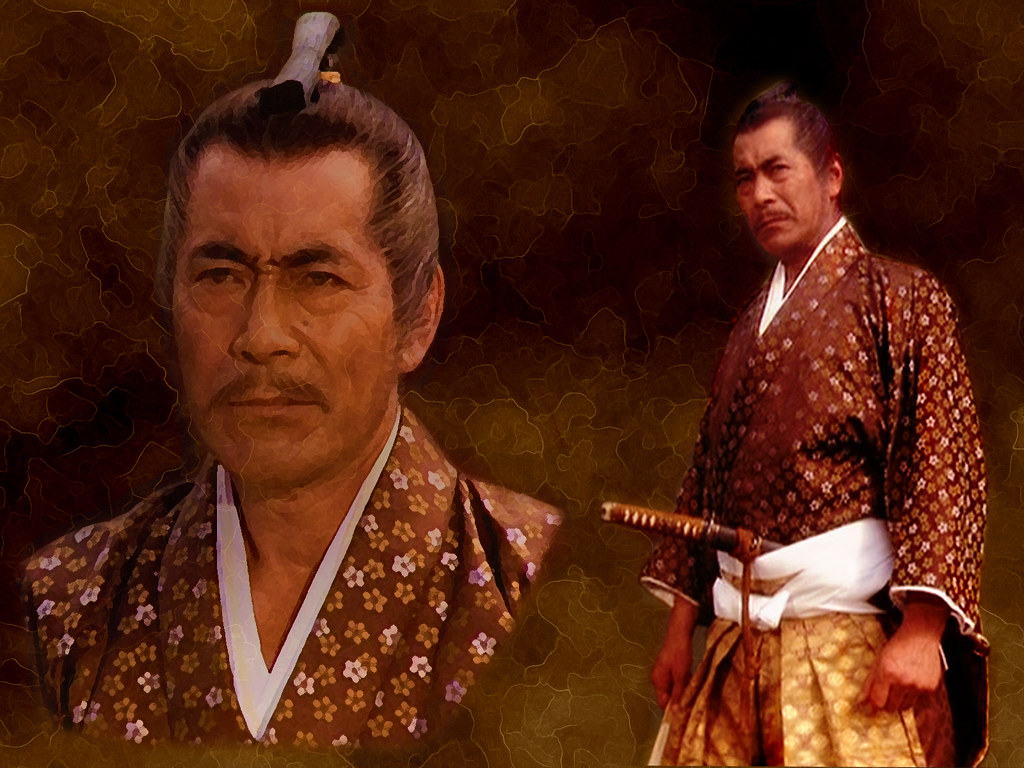
Toshiro Mifune is glourious as Toranaga in the TV series. Damn, he’s glorious in every movie he played in…


The “Amber” saga by R.Zelazny.

The problem of being overwhelmed by the information chaos these days affects literature (and the whole storytelling world) deeply. Never before in any age of humankind were humans so exposed to the neverending flow of information. The stream of data no human being is able to fully grasp and process. Being overwhelmed with the news coming in from various sources (often contradictory), publishers flooding the market with new movies, games, books, we engage our defense mechanisms to remain sane. We start to filter everything with the coinstrain of the smallest amount of energy needed for that filtering as an expense. In other words – we became lazy and picky.

The problem is even bigger when one notices the quality of the works today is worse than several decades ago. From the publisher’s point of view though, times never been better because for them quantity trumps the quality – it’s easier to manipulate the prices in the world of information chaos, and if you have big data tools like certain companies, then you already have won the race.

Far to often I pick the book praised by the sellers and readers alike these days, to find out it’s shallow, made entirely of well known and worn off tropes, using combinatorics as a way of developing a story and completely unworthy of my time. For example, in the current world overflood with zombie content, there are only 2 zombie related titles in all industries (game, movie, book, comicbook etc) that are worth something in my oppinion. And I am not talking about the “Walking Dead” here – this one is as bad as the others.

You know what? I think I’ll start describing the whole problem as a “zombie effect of storytelling” from now on.

In such perilous times I tend to look back at the books I read before and those I missed. I turn to classics for a solution for my hunger.  And in the most perilous times, when I need the immediate storytelling injection I tend to re-read the stories that proven valuable and worthy.

Roger Zelazny’s “Amber” saga is one of safe bets here.

Image result for amber zelazny
The true world of Amber

Zelazny was a very known author in my salad days. He was considered to be one of the masters of the fantasy/sci-fi genre. It’s kinda sad to see him today known by many only as “G.R.R. Martin’s friend from the Santa Fe writing circle”.  It’s probably also because Zelazny created many of those tropes freely used these days in “zombie effect” affected works, and it’s really hard to distinguish the originality of his works.

The “Amber” saga is epic. It’s a story of intertwining worlds, a multiverse of realities , but fake realities. There is only one true reality there, Amber. All others are but a reflection, combinatorics affected constructs, a “zombie effect” worlds if you will. Of course these are sometimes interesting, sometimes ridiculous, but the point is, they exist. And they seem to becreated and  governed by some cosmic order there.

Nothing further from the truth. It’s chaos that rules everything here. Or rather, Chaos I should say, because Chaos itself becomes entity in the saga. The mathematical idea of fractal functions affects also these story deeply, and one of the most important points in the story is the inability of the protagonist to understand the patterns the Chaos is generating. Or rather, a Pattern – an incomprehensible fractal knowing and understanding which promises godlike powers.

It’s not that our protagonists are without powers – in fact they are almost gods. They are immortal, and even unkillable at times. And they are filled with a hunger of power. In fact, the “Game of Thrones”, the overhyped (the book has a  great writing style, kudos to Martin, but the contents are just pointless, soap opera style pointless!) bestseller of the last decade, takes a lot from “Amber” (and remember Martin and Zelazny were buddies).  But when it comes to the story, “Amber” is much. much better in my eyes, to this very day.
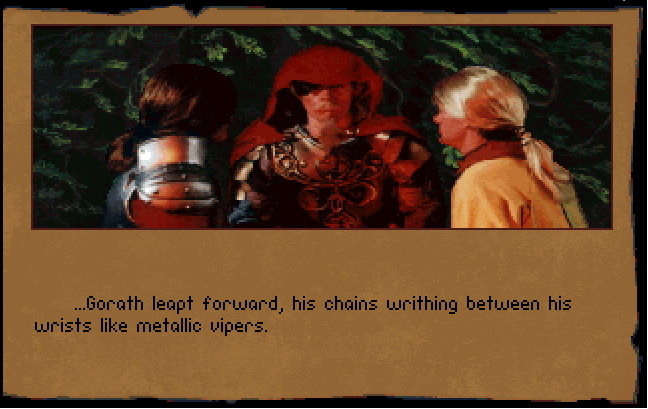
Image result for amber tarot
Tarot plays a big role in Amber. Cards are used for .. .communication, and more…

The power struggle between the ruling family of “Amber” (including our main proagonist Corwin and later, Merlin) spreads across said realities, making the resolution of the conflict complicated. Defeated can retreat to some safe reality, regroup and plan a counterattack with usage of newly acquired resources. But that’s only the facade of the real conflict in the background and the real question arise the deeper one delves into the story. What at start is yet another fantastical conflict of demigods becomes a philosophical dispute.

Did you notice that every mythology constructed around gods, if consistent and complex enough, has to become a philosophical dispute?

I must say, that uncovering the layers of depth of the “Amber” saga is very rewarding, especially today, in the Age of Mediocrity.

Today, when we stumble upon magic in literary works, it just serves as a tool. We got used so much to fireballs, lightning bolts and adava kedavras there’s no more amazement, no more magic in magic. Harry Potter’s magic is just another way of shooting from AK-47 or using a pitchfork…

Heh, the “zombie effect era”, the Age of Mediocrity is also the “age of trivial fireballs”.

The “Amber” revives and keeps the magic alive.


Stanisław Lem – “The Cyberiad”

Science fiction and fantasy genres have this problem of sorts. A problem of focusing to much on the world building instead of the story. There are countless stories about aliens and elves that tell about just aliens and elves. Painting new worlds is interesting and it also can be interesting to absorb such stories, but in a longer run these are boring, repetitive and often reuse the same character creation or plot creation patterns.

Unless the story is not about the world-building. Unless the world building serves to tell a story.

Stanisław Lem was a Polish writer with a lot of events in his life that would potentially break a less willed person. He came from the Lwów, which was Polish back then (today’s Lviv, Ukraine) from a family of scientists, matemathicians (Lwów math’s school was one of the strongest on the planet). He survived two occupations – German and Soviet during the II WW, with all their ruthlessness. He has seen a lot of dead people and gory scenes.

Image result for stanisław lem
Stanisław Lem. P.K.Dick was convinced Lem is not a real person but a KGB cell to destroy western literature. Bollocks, but Lem is really that good 🙂

It’s not puzzling that his faith in deities and humanity dwindled. Yet, he engaged his all mental powers in an epic attempt to understand it all – the human condition, the suffering, the motors of human behaviour. He managed to do this and left a lot of brilliant works with prognoses of the future.

“The Cyberiad” is one of those works. First published in 1965 it features two “constructors” – Trurl and Klapaucius in a distant future. Now, the said constructors are not human – they are a robotic entities, minds no longer made of flesh and no longer constrained by human limits. The only thing that constraints them is the reality itself, but as “constructors” they are constantly breaking or getting around the laws of universe, producing and creating the unthinkable – whims of galactic powers, legendary machines etc. Whatever challenge is there, they’re up to it, with the only limits being their own mind boundaries.

At least they think so…

The problem is they are deeply flawed. In all that futuristic, godlike advancement they embody, they still have limitations. They tend to be shortsighted with that particular kind of being shortsighted when one says “oh, lets kill all the pests in the farmland with the strongest pesticide ever!” just to find out later on that all birds died from hunger after bugs were eradicated. They are arrogant and tend to choose their own ego above all reason. And they have issues with morality.

Image result for trurl
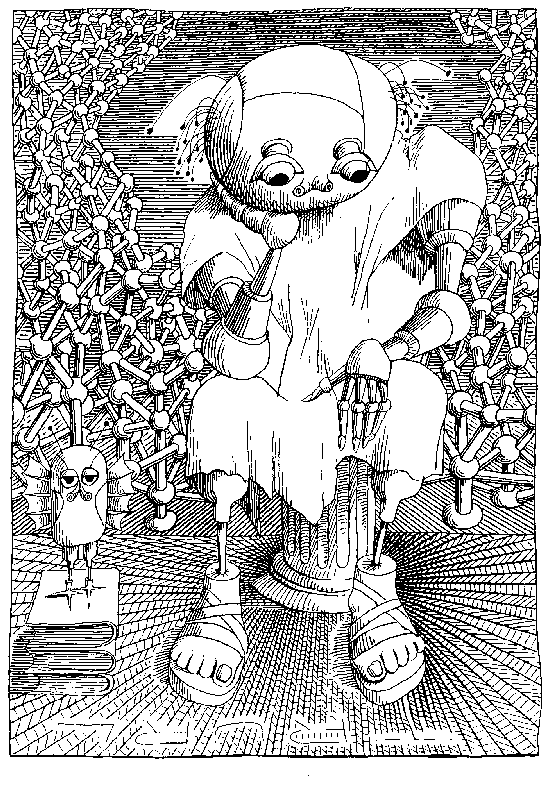
Trurl, with all his genius, faces real problems while teaching his offspring Ciphranio. Ah, the nature of free will….

Morality is one of the most frequent themes in Lem’s works. For example – is it moral to create artificial life (intelligence) with artificial pain implemented? It’s what they did more than once. Do you, my dear reader, think this is an artificial problem? Well, there’s a game called “The Sims” (I believe deeply inspired by Lem’s works, knowing that one of the cheatcodes in game is “klapaucius”….) where there are artificial humans with artificial pain implemented, they cry, they can be hurt, they can feel sorrow and they can die… Lem asks – is that moral? What is the difference between the human and the machine? Trurl and Klapaucius themselves prove there is none. The whole civilizations in The Cyberiad are robotic as well. Lem dissects humans in one of the stories (robotic entities call human “palefaces” and tell stories about them to their offspring  – the paleface is the monster to scare children with) – the paleface is a machine, according to robots, with a multitude of slippery tubes with fluids with oxidizing effect  and hence, highly toxic for metallic robots. Human machines are flawed and cinstrained much more than robots, but they are cunning enough to survive.

The civilizations surrounding the constructors are flawed too. They are archaic, have watcher-kings and electro-knights, metallic-princesses and null-dragons. This is one of the most brilliant ways in the whole literature to show to the reader this one truth: technical advancement does not make us smarter. Want to argue? Science proves than our memory capabilities decrease with memory storing technology advancements, for example. An average ancient Athenian philosopher had a lot better brain than a Ph.D. today. He didn’t just have the data.

So the robotic entities feel silly and very retro. They don’t need constructors to do make their world a better place, even if they are capable of it. They just want entertainment. Seeing what today world is, just think how much energy of an individual daily goes to ecology and how much into entertainment. If I used the time I have to write this article to gather and sort some trash instead… I have an excuse that I want to share some important things, but in the end it’s entertainment mostly – isn’t it?

Our future versions of ourselves are flawed just like us.

There’s no better future, there’s just a different future. Of course if we don’t kill ourselves before then. We tend to create and create, think that technological advancement advances us. Lem shows that illusion. Because ultimately we face the same problems our ancestors faced. Sure, we extended our lifespans and make travel easier, but that’s about it. We still kill, make arbitrary decisions without full knowledge, chase after achievements to feed our ever-hungry ego. And in the end we produce more sorrow.

What “The Cyberiad” is not is the gimmicky sci-fi with lasers and spaceships. It’s a search for human happiness and perfect society. And it seems there’s just no way to achieve any of these two…Humankind and robotkind are just far to flawed.

A note for a non-Polish reader. Polish is the second hardest language on Earth (after Chinese). I am not exagerrating, I am nearly 40 y.o. and there’s a lot of things to learn still. When it comes to way of describing the world and using the words that seem synonymous but in fact aren’t because they have a slightly different metainformation or emotional pressure in them, there’s probably not many other languages like this one. (e.g. I use English to write these posts normally to make it readable for  people over the world, but know this that this language feels … flat). It’s hard to show how it works, it’s like Eskimo or Inuite having dozens words to describe snow, with the difference Polish has similar for almost everything. See here and here to get the idea. Plus the hardest grammar ever (“like Greek, Russian and English combined” ) . With that preamble here comes a fact: the writing style of Lem is just stunning. Beautiful, intelligent, with phrases so perfect and beautifully constructed he got me gazing at those for a minute there and thinking “damn… that is something”. This style causes me blush when I think how imperfect my spoken and written Polish is (and again, I am a native Polish speaker with M.Sc.Eng degree….). I wish I could speak and write Polish as Stanisław Lem did. This means it probable looses a lot in translation. I dare to say the perfect way to read Lem is to learn Polish, the same way the perfect way to read Proust is to learn French and Nabokov to learn Russian. But the translation is very good too ,although it does loose some things; in the original poem (translation below), a mathematician dies with the broken heart in the last verse :). Rate the quality of the translation yourselves (the fragment is about the AI built by Trurl that could solve any problem, including poetry):

Klapaucius thought, and thought some more. Finally he nodded and said:
“Very well. Let’s have a love poem, lyrical, pastoral, and expressed in the language of pure mathematics. Tensor algebra mainly, with a little topology and higher calculus, if need be. But with feeling, you understand, and in the cybernetic spirit.”
“Love and tensor algebra? Have you taken leave of your senses?” Trurl began, but stopped, for his electronic bard was already declaiming:
Come, let us hasten to a higher plane,
Where dyads tread the fairy fields of Venn,
Their indices bedecked from one to n,
Commingled in an endless Markov chain!
Come, every frustum longs to be a cone,
And every vector dreams of matrices.
Hark to the gentle gradient of the breeze:
It whispers of a more ergodic zone.
In Riemann, Hilbert, or in Banach space
Let superscripts and subscripts go their ways.
Our asymptotes no longer out of phase,
We shall encounter, counting, face to face.
I’ll grant thee random access to my heart,
Thou’lt tell me all the constants of thy love;
And so we two shall all love’s lemmas prove,
And in our bound partition never part.
For what did Cauchy know, or Christoffel,
Or Fourier, or any Boole or Euler,
Wielding their compasses, their pens and rulers,
Of thy supernal sinusoidal spell?
Cancel me not — for what then shall remain?
Abscissas, some mantissas, modules, modes,
A root or two, a torus and a node:
The inverse of my verse, a null domain.
Ellipse of bliss, converge, O lips divine!
The product of our scalars is defined!
Cyberiad draws nigh, and the skew mind
Cuts capers like a happy haversine.
I see the eigenvalue in thine eye,
I hear the tender tensor in thy sigh.
Bernoulli would have been content to die,
Had he but known such a2 cos 2 phi

Just perfect. The content, the style, the philosophy. Perfect. Unwillingly, Lem’s is one of my favourite philosophers of 20th century.

Nota bene If you want to watch some material about the language itself, to see I am not exaggerating , here you go, it should give you the idea (turn the subtitles on, because there’s some Polish spoken in there) :


“The Riftwar Saga” by Raymond E. Feist

Fantasy genre… A very problematic subject these days. We are long past the freshness of the theme that was one of the most important literary milestones of the last century. With the revival of the mythological storytelling J.R.R. Tolkien and C.S.Lewis initiated, a huge amount of works followed. Some of them created new, compelling worlds, and some of them went into oblivion. With those on the market, a number of fantasy RPG systems followed, and evolved along new fantastical prose releases.

Soon, they begun to intertwine with the newly begoten feedback loop.

Well, it’s not that the loop’s cause-and-effect thing was new. From the beginning of humankind the stories made people to invent new stories, which in turn affected the source. Think about minnesängers for a moment. The court tradition of giving entertainment with courtly love songs shaped the courtly love of the western medieval times, which in turn shaped the expectations of the content created and performed by minnesängers. This effect is visible is every human activities there, because human brains are highly susceptible to become a meme transmiters (by the way, it’s really telling if the person understand a meme with it’s original meaning or thinks about cat pictures instead. It really is.).

In the memetic chaos of the transmitted fantasy stories it is really hard to pick those that are not just a waste of times. How many times did we, readers, start a novel to understand this is again about some new type of elves and dragons, in the postmodernistic, combinatoric new flavours we could invent on our own while commuting to school or work? How many times the cross-product of those fantasy flavours tried to hide the shallow plot, pathethic world building and force us to focus only on the facades of protagonists? I am not saying that knowing to what brood of Quendi Elwë Singollo (“Silmarillion” – we’ll get there, in time…)  belonged to is not important – it is,  but only because it serves the higher purpose of storytelling. There’s a deep reason why it’s there and why it is important for the readed to learn the lore.

Majority of fantasy however is estranged from the idea and therefore, a waste of reader’s time.

It seems however, some publications never aspired to the higher literature and followed the road of combinatorics, just to become something better in the process.

The “Riftwar Saga” is one of those. Imagine, that 40+ years ago, a group of students, fantasy genre fans from California, started playing a Dungeons&Dragons RPG game. Filled with RPG creativity, they started to shape the world of their adventures. That’s how Midkemia, the continent and one of the worlds of the saga,  was born. Gradually they filled it with characters, events and a backstory that at one point caused one of the players to write about it in a form of a novel – Raymond E. Feist.

I must say this: Riftwar is guilty of reusing the existing tropes, like elf kind combinatorics (to the point where names are actually taken from Tolkien’s works: e.g. “moredhel” is Sindarin for “dark/black elf”..), adding dragons and princesses, kings and squires, magicians and impending world dooms. There is not fancy language there, or brilliant rethoric forms. I know people that were cast off in the beginning by this saga beacause of the naivety of style and story at the beginning. One can see how author developed as a writer over decades since publishing the first book, and the change of style is really flashy.

But in the end, mr Feist did the job. And he did it magnificently.

I mentioned the stories being social programming before. We, as humankind, tend to repeat story patterns over and over again to be able to actually tell something new with the old elements. Again, I can see similarities to information technology – stories told anew are new revisions of the same program. Updates if you will. And it really does matter how the story is told and what new info it contains, rather than what elements it is using to produce that new meaning For example, one can say a story about Cinderella in a classic way, or making her a vampire that lives with humans  and masquerading as a poor girl to prey on their blood.

What Riftwar Saga does is telling a story of epic proportions. It extends in time for more than one lifetime (meaning some characters will be born, grow old and die before one finishes the books…), it contains multiple metaplots on a cosmic scale, played along the main storyline. It has epic battles and unexpected turns. That are elements that many other stories have.

What it does have than not many other products doesn’t have is how it produces emotions. I don’t know many more examples of books that made be stuck with the book and not wanting to let go until I read everything published. And I do include the fantasy sagas written over 6 last decades – I read probably majority of those. So I stuck with Riftwar for the feels…

In the first book we get to know our Pug the orphan, who becomes the magician, and his friend Tomas, who finds a dragon and an ancient armour. A simple, cliche start. But then the war starts. A rift between the world of Kelewan and Midkemia is opened and Tsuranni war parties invade through it. Midkemia is engulfed by flames of war, Pug is being enslaved and taken to Tsurannuani Empire and the war is almost lost.

But Pug is special. Special in ways beating Harry Potter tenfold. He becomes THE mage. The reader follows Pug in his ventures to learn that the invation is but a tip of an iceberg, because the ancient, sinister legacy of the Old Entities, the Valheru, is still alive. And there are other beings in other planes involved as well.

The story spawns another story (a fractal again!) in and RPG manner, yet in a convincing and consistent way. Feist also adds new heroes, but always retains the balance – he always has a point there (unline George R.R. Martin, who just adds characters irrelevant to the story just to kill them), always retaining the quantity and readers focus. It starts with a war and ends with a war, there are epic deeds and battles, dragonriders and romance, politics and vengeance. All baked to an unforgettable experience.

Then there are multiple worlds and civilizations, each completely different from the other. The feeling and the culture of the Empire books are absolutely different from the feeling of the stories placed in Midkemia. But these are human empires. I couldn’t tell you how alien elves feel in this saga.  Rich, rich, amazing worlds.

Another thing is how I learned about it. With an RPG videogame. “Betrayal at Krondor” is to this day one of the best cRPG games I have ever played.  Feist sanctified its story writing a book based on a game based on his books. As he did with “The return to Krondor” game.   BoK allows player to explore the world and characters in an interesting plot, intertwining with the main plot of the saga. Moreover, one story arc (the Crawler) introduced by devs and taken up later by Feist is one of the most interesting plots in the whoe series.

Image result for betrayal at krondor
BoK’s narrative is formed in a form of a book. Yummy.

The story starts with the Pug and ends with the Pug’s end.  But it never ended for me.

You know what? I think I’ll re-read it this year.

Last but not least, the chronological reading order that you should read the saga with:

Magician
Jimmy the Hand (Starts During Magician)
Honoured Enemy (During Magician)
Murder in LaMut (During Magician)
Daughter of the Empire (starts During Magician)
Silverthorn
A Darkness at Sethanon
Servant of the Empire
Krondor the Betrayal
Mistress of the Empire
Krondor the Assassins
Krondor Tear of the Gods
Jimmy and the Crawler
Prince of the Blood
The Kings Buccaneer
Shadow of a Dark Queen
Rise of a Merchant Prince
Rage of a Demon King
Shards of a Broken Crown
Talon of the Silver Hawk
King of Foxes
Exiles Return
Flight of the Nighthawks
Into a Dark Realm
Wrath of a Mad God
Rides a Dread Legion
At the Gates of Darkness
A Kingdom Besieged
A Crown Imperiled
Magicians End