“The Devil Came Through Here” trilogy – psychological problems in video games part 7

The trilogy of games that had a real impact on me is definitely “The Devil Came Through Here” trilogy, by Remigiusz Michalski  (Harvester Games). This games were a long inspiration for me as a gamedev and also a lighthouse in the dark seas of storytelling. I had a pleasure of exchanging some thoughts with Mr Michalski, about game engines etc, and his insights on one of the forums helped me resolving  a collision puzzle in my own project.

It started with a “Cat Lady” which I picked up with curiosity after seeing a trailer. The game in which the protagonist, Susan Ashworth, commits suicide in the very first scene, while her cat watches her slowly passing away. The scene had a very powerful impact on me, as I am a person deeply interested in the human psychology.  What I did not know then is that the game features a lot of horror game mechanics, with occasional jumpscares, which I quite hate. Susan wakes up in a grassland afterlife, and is greeted by the Queen of Maggots, an old lady, with disturbingly skeletal-thin arms, and is sent by her back to life to get rid of five parasites – humans that should no longer exist. I couldn’t help it, but I immediately started comparing this game to the DreamWeb, and there’s a lot of similarities there. Susan cannot die on her mission, and dying and getting back to life to approach the situation from a different perspective is sometimes the last resort that pushes the action forward.

Susan’s reality is grim and depressing…

What is different though, is the dialogue the game has – the dialogue about emotional anguish, the feeling of loosing someone, depression and terminal illness. Of all disturbing moments from the game, the one that probably had the biggest impact on me was learning that one of the characters is terminally ill.

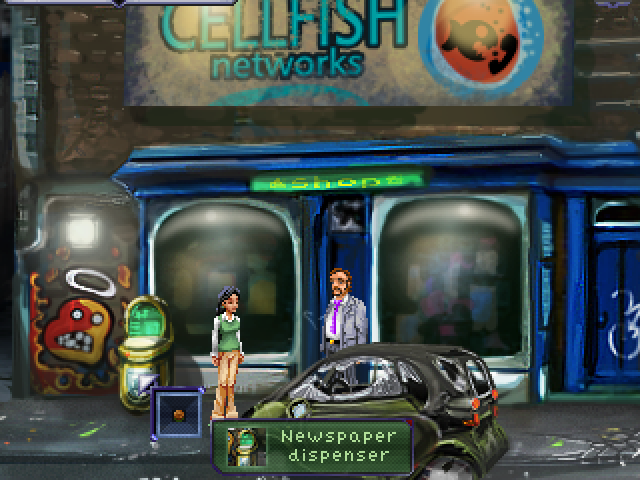
The majority of the game takes place in a tenement block 12th Helen Road, with its sinister sign letters forming a word “hell”. The building is a home to various people, and curious personae, that show the level of awkwardness not unlike the one from “Twin Peaks”. The more Susan explorer the place, the more it seems weird, hellish, onirical, with its denizens creepy and horrifying.

One of the disturbed denizens of the block is Joe, the horrid man, making a very, very bad impression of people who play the “Cat Lady”. We explore his story in the second game, “The Downfall :Redux”. The “Redux” is a remake of the earlier game by Michalski, and it’s a soft of a prequel to the “Cat Lady”, but the prequel that can be appreciated most whole played as a second game in the series. Joe is struggling with his love for his mentally disturbed wife. Yet again ,the game explores very difficult subjects – of anorexia, self acceptance, placing all feelings around a one person, and all destructiveness of those. And yet again, the game is very, very dark, with some unsuspected plot twists.

Image result for the cat lady
Meet Joe and his wife…

Right after playing the second game, I sent a short message to the author, thanking him for the game, and he shared the early alpha screenshot of his third game, “Lorelai” with me. I just couldn’t wait for it , but I had to. And finally, several months ago it was released. Serving as a finale to the story, we follow Laura, called Lorelai, a young girl from a deviated, dysfunctional family and its problems – a drinking mother, a dead father, a pervert, violent stepfather, poverty. During the series of events, full of violence and death, Lorelai meets the Queen of Maggots, who, in turn, wants to play the same game she played with Susan. Lorelai is sent back to life, and she is given yet another chance… As in the other two, Remigiusz Michalski is not afraid to ask difficult questions or convey difficult emotions. But I cannot help to think that the author is a little tired of these depressive games and would like to create something bigger. Well, some people struggle to get to his level, while he looks towards higher goals it seems 🙂
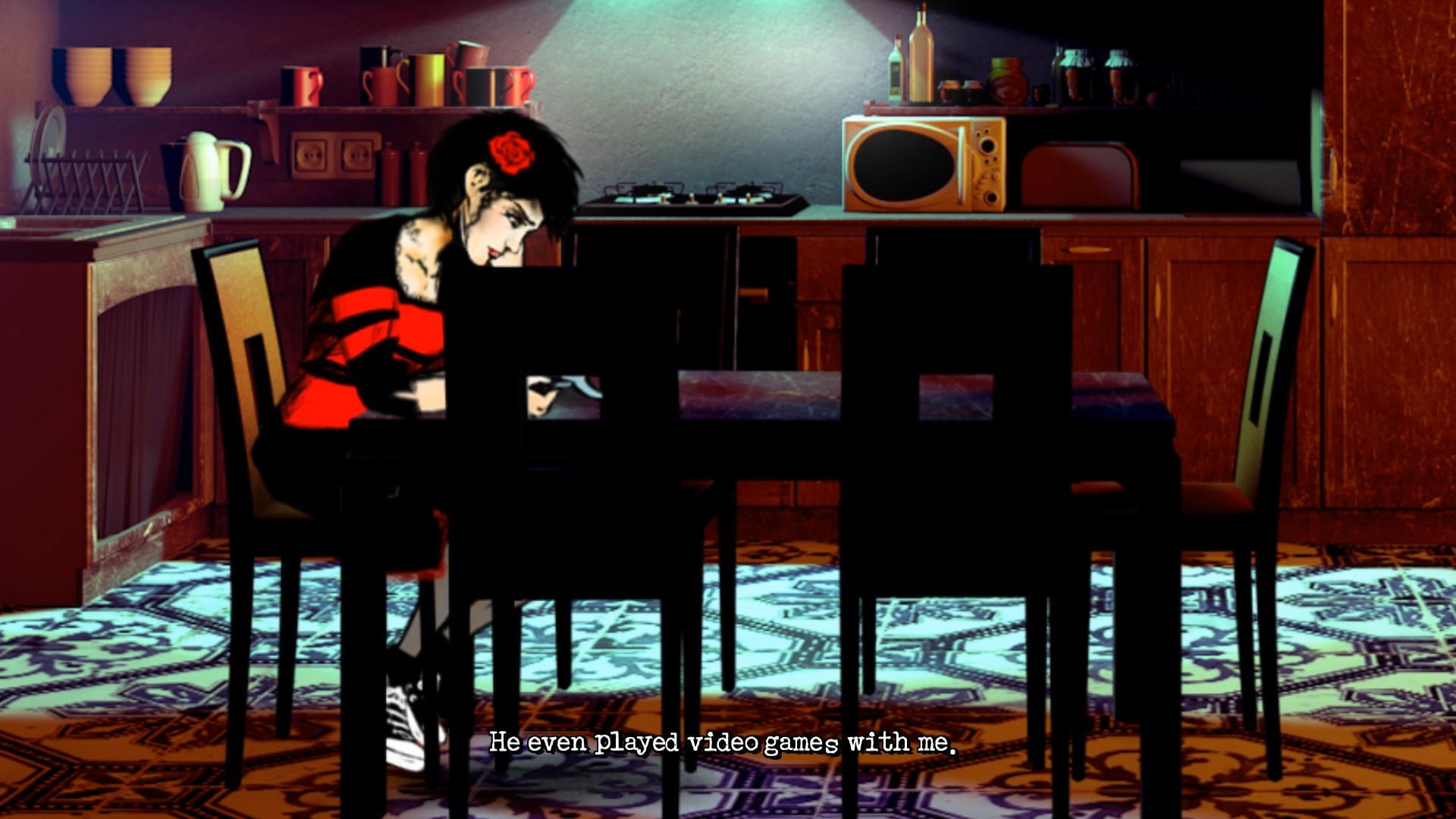
Image result for lorelai game
Lorelai wants just a normal life…

I wanted to write this article to say the trilogy is a MUST PLAY. You seldom find games so captivating, so grim and yet so beautiful with their discourse with humanity and its perils. The questions asked , questions about what it means to exist and what is the nature of evil, are heavy , the scenes are gory, and yet the whole thing feels like a serene contemplation about life, while sitting on the cemetery bench, rather than a horror.

And for me, for me it’s the gamedev goal I aspired towards and I hope my own game with be able provide, even if a part, of the same pleasure these games gave me. Rem Michalski is for sure one of my idol gamedevs.

Don’t wait, these are worth of your time.

A fun fact: the last game features voices of some well known Youtubers like YongYea and Jim Sterling.

“Resonance” – a cyberpunkish thriller

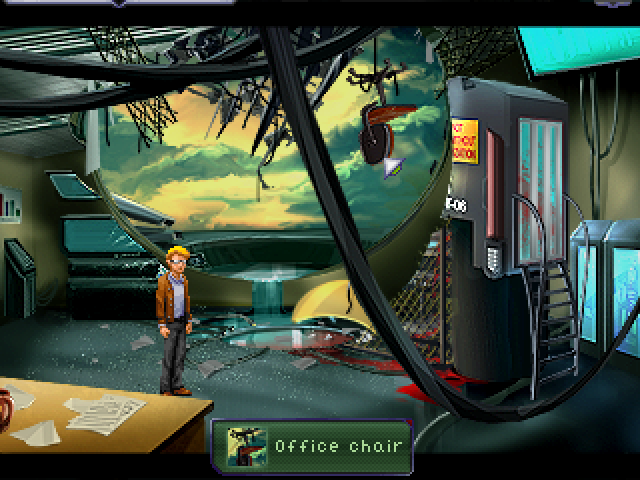
The first game made by Wadjet Eye I ever played was “Resonance”. I was drawn to it after seeing several screenshots published on some gaming portal and, as a person very much into pixel art and 90’s style of graphics, I purchased it immediately. What was just a “but a playtest” approach towards one game, quickly became a years long adoration of the Wadjey Eye company and their products.

The game, set up in the near future, features 4 protagonists. First, there’s Ed, an assistant to the prof. Javier Morales, a scientist working on the resonance effects of particles. Anna – prof Morales’ niece, is a hospital nurse having some psychological issues (and in fact she probably should be in one of the “psychological problems in videogames” articles of this blog) and an unbeaten childhood trauma. Detective Bennet is conducting a police investigation on the track of mysterious Antevorta organization. And there’s Ray, a political blogger and a hacker. All four are brought together by a mysterious explosion in the prof Morales’ lab and start acting together to uncover the secrets of the mysterious experiment.

Znalezione obrazy dla zapytania resonance game
An accident in the lab. An accident? What if…

I normally tend to talk a lot about the plotline of the particular game, but I will leave you deliberately in the dark with this one. It is a detective story, that is most pleasant while uncovering things and matching the pieces of the puzzle together, piece by piece. The game has several shocking plot turns and several dangerous timed sequences – enough to keep the player on edge sometimes ( and far less, than in, say, Telltale games – to my delight).  But what makes the game and the plotline really interesting is how actually these 4 people interact with each other and how their personal storylines intertwine. Giving control over all four to the player is a bold move (although not a new one…), and forces player to experiment with different setups and combinations of characters to achieve some goals. Anna’s feminine charms and medical knowledge combined with a press/hacker attitude of Ray give different results than grumpy Bennet combined with awkward Ed, while facing the same problem and situation. The game tells its story mainly through that trial and error, and soon a player starts to feel those characters, starts to be invested in their lives and problems.

Znalezione obrazy dla zapytania resonance game
Protagonists meet on the stadium to discuss their next steps.

Well, I don’t need to tell you how important it is , especially for those, who like character-centric stories. E.g. “Game of Thrones” TV series was finished recently, and with the books and the show being really Westeros-oriented than character-oriented (as every fantasy with a pretense to be a mythology or a history book of its setting), yet everybody is talking about characters only…

But getting back to the matter – I often tell, times after times, how important it is to leave some things “blank”, so the reader or a gamer could feel it in by himself. The more product relies on imagination the more “blanks” it really needs. And I will be telling more about the subject when I am ready to talk about Tolkien’s “Silmarillion” (not ready yet, for various reasons…even though I read the book dozens of times for 30 years now…). In “Resonance”, player has got plenty opportunities to experiment and walk a mile in protagonists shoes. The player is forced to play a role, yet, the amount of freedom of experimentation, trying to combine various items together or operate various implements and discussing things with people, is huge and so is the amount of player generated story.

Znalezione obrazy dla zapytania resonance game
A futuristic touch&feel.

To those of you who played adventure games before, you know exactly what I mean, but for all the rest: imagine the “Sherlock Holmes” story, in which the chronology of Sherlock’s actions is not determined by a shortest possible way to get to the conclusion, while still building the mystery and the climate through narrration, but, rather, by an unknowing narrator, who experiments with the story, not knowing how it will end. This is what happens in games like this one, and this one is particularly good when it comes to its combinatorics.

I am not a big fan of conspiracy theories or conspiracy games for that matter, so the subject of this game did not captivate me as the other games did. I also prefer rather traditional detective stories instead of dystopian future theme (there’s just too many dystopian themes in popculture these days…). But, like I said before, this is the game that got me onto the Wadjet train and the game one could learn from a thing or two.